
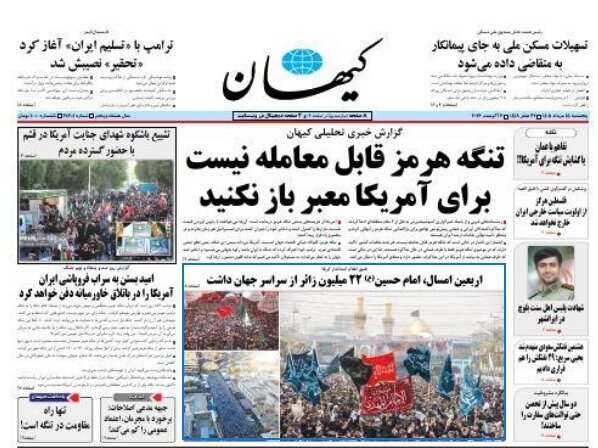
Hamshahri examined President Pezeshkian’s recent remarks under current conditions. Pezeshkian says that we must try to ensure the enemy remains committed to what it has signed.
This sentence also implies that the ongoing negotiations revolve around returning to that memorandum of understanding. But the key to this return apparently lies in the Strait of Hormuz: if Iran and Oman reach an understanding that is also acceptable to the United States, that key will become accessible. In that case, the Strait would reopen, and the blockade would be lifted. Now we must see whether the intense diplomatic activity in the region can once again produce a temporary exit ramp to lower the temperature of tensions, or whether it will turn back toward escalation. In any case, along the path of this ongoing conflict, there is always the possibility of reaching certain understandings — sometimes even a strong possibility. But because there is still no serious will to resolve the tension, achieving a final agreement remains highly unlikely. Such an agreement will only become possible once the war reaches a point where a regional balance can be established.
Shargh: A serious challenge for Trump
Shargh analyzed Trump’s retreat from his military threat against Iran. What appears at first glance to be a political decision actually reflects complex calculations — both hardware and software — of power, economic pressure on Washington’s regional allies, and even internal disputes within the US decision‑making team. CNN, in an analysis by senior military correspondent Brad Lendon, attributes this retreat to a dual factor: on one hand, the economic pressures of a prolonged conflict on Washington’s regional allies, which has increased their desire to halt hostilities; and on the other, the US military’s serious concern about its ability to defend its forces against a potential Iranian response, as interceptor missile stockpiles for advanced systems such as Patriot and THAAD are rapidly dwindling. This indicates that the material and logistical costs of a full‑scale conflict have reached a point that, if not outright unbearable, have at least become a serious challenge.
Etemad: Diplomacy can change the equation
Etemad emphasized the importance of diplomacy amid severe security and military tensions. Developments can reshape the region’s security equations. Regional states have long tried to maintain a fragile balance among Iran, the United States, and Israel, but a change in the behavior of one major actor can force others to reconsider their defensive and security strategies. In such circumstances, diplomacy becomes more important than ever, because the absence of effective communication channels increases the likelihood of miscalculation. What matters most today is recognizing that West Asia’s security environment is changing. Old patterns no longer fit new conditions. New technologies, rapid information flows, and political developments have sharply reduced the time between decision‑making and action. In this environment, states try to deter costly moves by demonstrating military readiness and resolve.
Siasat-e-Rooz: The Strait of Hormuz is America’s lifeline
Siasat-e-Rooz focused on the most sensitive and important strait under current conditions. Iran’s strategy now appears aimed at forcing the United States to return to and implement the 14‑point memorandum. The behavior of the US and Israel suggests they are preparing equipment and forces, and the possibility of a large‑scale attack is significant. If such an attack occurs, Iran will certainly deliver a forceful response, destroying all regional infrastructure belonging to those regimes — including the infrastructure of the fake Israeli regime. Trump’s pressure on Iran is now concentrated on the Strait of Hormuz. Iran knows that the strait is America’s lifeline — and that if Iran loses control of it, it loses its own lifeline. The US insistence on occupying and controlling the strait is precisely the point that must be taken seriously. The strait’s sensitivity is so high that the United States has come to the Persian Gulf to secure it.
Javan: Europe’s structural economic crisis
Javan analyzed the closure of the Strait of Hormuz and the economic shock it would inflict on Europe. The European Central Bank has warned that the worst‑case scenario — “a renewed escalation of the war in Iran” — could once again shut down consumer activity, meaning a return to recession and a sharp drop in economic growth. What is most worrying, however, is Europe’s structural economic weakness. Unlike the US economy, Europe cannot recover quickly and reacts very vulnerable to shocks. The recent conflict in Iran was not merely a trigger; it exposed all the accumulated weaknesses of Europe’s economy. Unless fundamental problems — such as low productivity growth, an aging population, and energy dependence — are resolved, any new crisis could have catastrophic and multiplied effects, reversing the region’s already minimal economic growth and pushing European households toward precautionary frugality and forced saving. This, in turn, accelerates the downward cycle of domestic demand and recession.
Disclaimer : This story is auto aggregated by a computer programme and has not been created or edited by DOWNTHENEWS. Publisher: tehrantimes.com






