
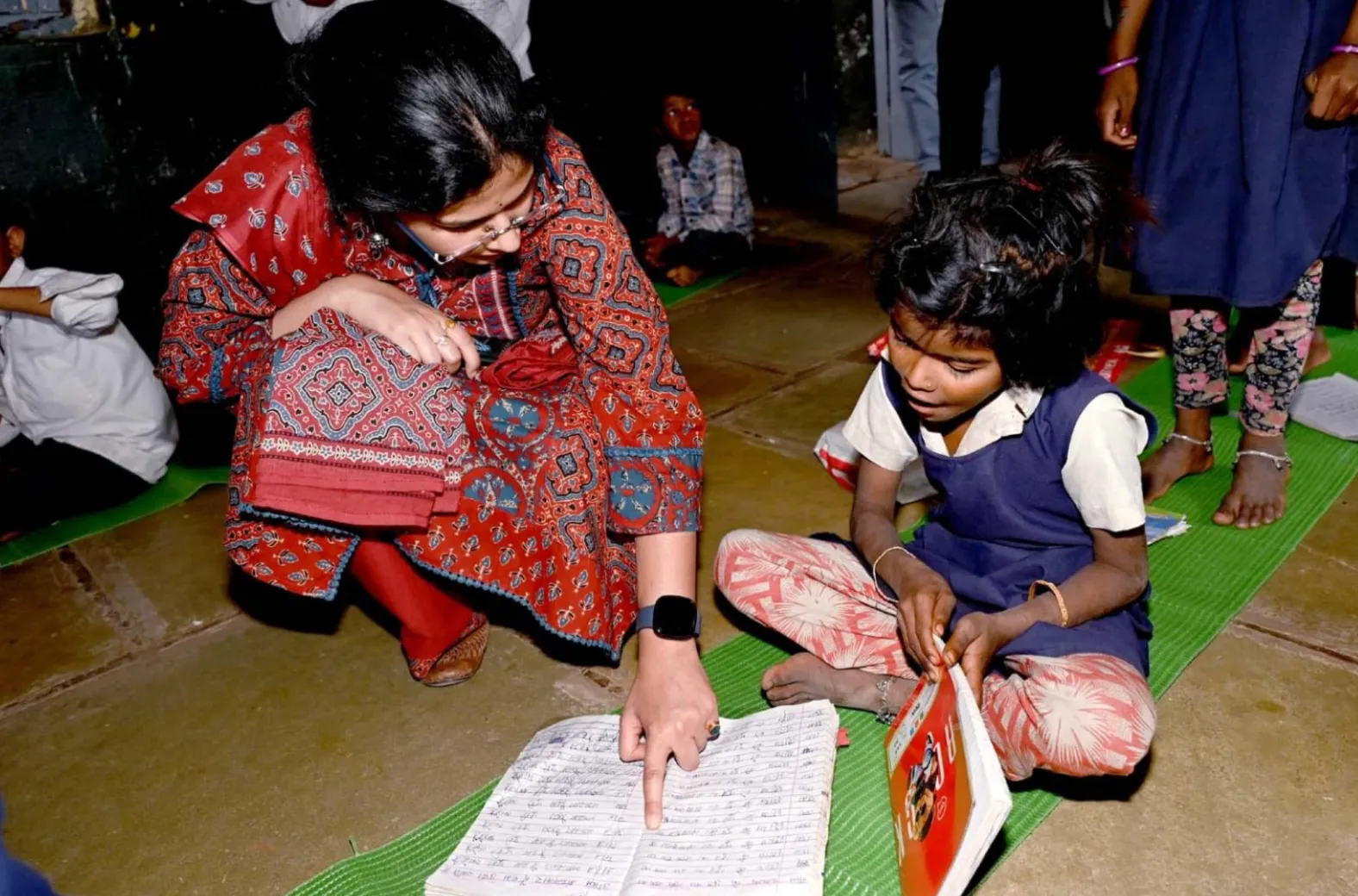
For years, hundreds of children in Ratlam’s government primary schools (in Madhya Pradesh) spent their mornings the same way: seated cross-legged on bare classroom floors because there were not enough desks to go around.
In the district’s secondary schools, smart boards had arrived, but the digital content that could make them useful had not. IAS officer Vaishali Jain, Chief Executive Officer of Ratlam Zila Panchayat and Additional Collector, saw these as connected problems rather than isolated gaps.
Since taking charge nine months ago, the 2021-batch Madhya Pradesh cadre officer has built a three-layered education model for the district, moving from classroom dignity to better learning to spaces where ambition can grow.
Instead of scattered schemes, Ratlam now has one continuous education journey connecting infrastructure, technology and access.
From bare floors to proper benches
A district survey found that hundreds of primary schools lacked basic furniture. That finding became Gyanodaya – Shala Unnayan Abhiyan, a campaign to install over 21,000 bench-desks across 1,011 government primary schools, reaching more than 42,000 students.
Rather than waiting only on government funds, the administration invited villagers to adopt their own schools, drawing in CSR partners and pooled MLA funds, echoing how villager and corporate contributions have rebuilt bare government schools elsewhere in India.
A transparent system of SOPs, Google Forms, authorised vendor lists and a public helpline lets donors pick schools directly. Around 200 schools now have benches, and nearly 100 have been repaired, with rainwater harvesting structures added to extend building life.
“No student in these schools sits on the floor anymore.
/filters:format(webp)/english-betterindia/media/media_files/2026/08/07/2-2026-08-07-17-47-11.png)
They very respectfully sit on their benches,” Jain said. For her, infrastructure signals to a child that they are valued before a single lesson begins.
Teaching, multiplied by technology
With classrooms made more welcoming, Jain turned to a harder question: how could students in remote schools get access to the same quality of teaching available elsewhere?
The answer was E-Gyan Setu, which strengthens rather than replaces teachers in Classes IX and X.
A team of 16 subject experts has built video lectures, bridge courses, chapter-wise material, revision modules, worksheets and AI-assisted learning content mapped to the curriculum, delivered through existing smart classroom infrastructure.
The programme runs in 100 government schools, with fortnightly assessments flagging weak areas for remedial support. Plans are underway for a dedicated recording studio and content in local languages such as Malvi and Bhili.
/filters:format(webp)/english-betterindia/media/media_files/2026/08/07/6-2026-08-07-17-48-51.png)
“We are bridging the knowledge gap,” Jain explained. “Conventional teaching has not been replaced completely, but we are supplementing teachers with additional learning material so students are more involved in classrooms.”
A library within reach
Learning, Jain believes, should not stop at the school gate.
Ratlam’s rural students preparing for competitive examinations often had nowhere quiet to study after class, so the administration launched a Public Rural Library Initiative, converting unused government buildings into study centres across the district’s six Janpad Panchayats using Fifteenth Finance Commission grants.
Each library will offer seating, computers, internet access and a calm environment for a nominal hourly fee. Self-Help Group women will manage the centres while running adjoining Didi Cafes, pairing education infrastructure with livelihood opportunities.
Jain’s approach to governance predates Ratlam. As SDM in Rewa, she disposed of over 9,000 revenue court cases, ensuring every petitioner was heard, and traced nearly 200 inactive bank accounts holding pending land compensation, recovering close to Rs 100 crore for farmers and helping the district identify almost Rs 200 crore more owed.
/filters:format(webp)/english-betterindia/media/media_files/2026/08/07/7-2026-08-07-17-49-13.png)
Jain is candid that results will not show overnight. “Education is something which needs consistent effort. You will be able to see the results after a year or two, maybe more than that,” she said.
Her teams continue working across Ratlam’s tribal blocks, meeting parents and tracking attendance, painting schools and installing benches, all towards one goal: government schools children actually want to attend.
It is a philosophy she carried from Rewa too: “One complaint is not limited to that person only. The entire system can be changed for that particular kind of case.”
All images courtesy: Indian Masterminds
Sources:
‘IAS Vaishali Jain Is Transforming Ratlam’s Government Schools with Benches, Digital Classrooms and Rural Libraries‘: by Bhakti Kothari for Indian Masterminds, Published on August 1, 2026
‘How IAS Officer Dr Saumya Jha Used AI to Boost Math Pass Rates to 96.4% in Rural Rajasthan‘: by The Better India, Published October 23, 2025
Disclaimer : This story is auto aggregated by a computer programme and has not been created or edited by DOWNTHENEWS. Publisher: thebetterindia.com






