TEHRAN — Seven months after the United States and Israel launched their war against Iran, a growing body of reporting, congressional scrutiny, military documents and international investigations is exposing a widening gap between Washington’s public narrative of the conflict and the scale of its human, military and financial consequences.
The war began on February 28 with Washington and Tel Aviv presenting the destruction of Iran’s nuclear and missile capabilities as central objectives. President Donald Trump repeatedly said Iran could not be allowed to obtain a nuclear weapon and, immediately after the opening strikes, described the operation as necessary to prevent that outcome.
Yet the premise of an imminent nuclear threat has remained contested. The Arms Control Association noted that, at the time of the February attack, neither Trump nor Israeli Prime Minister Benjamin Netanyahu publicly presented evidence of an ongoing Iranian nuclear-weapons effort, while International Atomic Energy Agency Director General Rafael Grossi said in early March that the agency did not see a structured program to manufacture nuclear weapons.
Trump nevertheless repeatedly suggested that the conflict would be short. In early March, he said that Iran would have had a nuclear weapon had the United States not acted within two weeks, while subsequent reporting documented a series of shifting predictions about when the war would end. By September, the conflict had entered its seventh month.
Against that backdrop, the question increasingly confronting Washington is not simply what the war has achieved, but how much of its human and material cost has been fully disclosed.
Civilian casualties and the Minab investigation
The most consequential challenge to the official narrative concerns the February 28 strike on the Shajareh Tayyebeh school in Minab, southern Iran.
A recent investigation by the United Nations Independent International Fact-Finding Mission on Iran found “reasonable grounds” to believe that the United States committed a war crime in the Minab strike and in a separate attack on a sports complex and residential area in Lamerd. The mission said the two attacks killed at least 178 civilians.
The Minab attack became one of the war’s most devastating incidents, killing many civilians, including more than 100 children. UN findings said the school was a clearly identifiable civilian facility and that US forces had failed to take the necessary measures to establish that it was a legitimate military target.
The significance of the findings goes beyond the death toll. They challenge the explanation that the Minab strike was simply an unavoidable consequence of the fog of war.
A separate investigation reported by Bloomberg has shed further light on the military decision-making that preceded the attack. According to the investigation, Pentagon investigators identified flawed intelligence, outdated imagery and excessive reliance on artificial-intelligence systems as factors that contributed to the strike that killed 123 children.
The emerging picture is therefore one in which the tragedy cannot readily be reduced to a single technical error. Questions have instead been raised about the entire targeting process — from the intelligence entering the system to the human decisions made after it was processed.
For Tehran, Minab has become a symbol of the civilian toll of the war. Internationally, the UN findings have transformed the incident from an Iranian allegation into the subject of a formal international investigation and legal assessment.
Washington, however, has rejected the UN mission’s conclusions. The White House and State Department have disputed the findings and questioned the mission’s impartiality.
That disagreement does not resolve the underlying issue: whether the full US investigation into Minab should be made public.
Kuhestak: another strike, another demand for answers
The question of transparency has gained renewed urgency following the September 1 strike on a home in Kuhestak, Hormozgan Province, where a wedding gathering was taking place.
Six Democratic senators — Brian Schatz, Patty Murray, Jeanne Shaheen, Jack Reed, Mark Warner and Chris Coons — have called for a “fully and impartially” conducted investigation into the attack.
The lawmakers said reports indicated that four civilians, including women and a child, were killed and more than 60 people wounded, and that weapons experts and visual analysis suggested the strike was caused by a US bomb. They demanded that the Pentagon release its findings to Congress and the American public.
The senators also said Congress had yet to receive the full findings of the Pentagon’s investigation into the February 28 Minab strike.
Their intervention is significant because it places the issue of civilian casualties inside the US political system itself. The demand is not coming only from foreign governments or international organizations; members of the Senate are asking the Pentagon to disclose what it knows about the conduct and consequences of American military operations.
The Kuhestak case therefore adds a second, more recent test of Washington’s commitment to transparency.
A casualty count under scrutiny
The questions surrounding transparency extend beyond Iranian civilian deaths.
On September 18, The Washington Post reported that more American service members had died during the Iran war than the Pentagon had publicly acknowledged.
Five US officials familiar with the Defense Department’s internal casualty accounting told the newspaper that at least 22 US military personnel had died — four more than the number appearing in the Pentagon’s public casualty database. A sixth official put the figure at 23, although that person said not all of the additional deaths were directly attributable to combat and involved US personnel deployed in the Middle East during the hostilities.
The same official said three US contractors in the region had also died since combat operations began.
The Pentagon declined to address the discrepancy in the figures, according to the newspaper.
The issue is not merely statistical. The Pentagon’s public casualty database serves as the official record of military deaths and provides the public with information about the human cost of US military operations.
The Washington Post reported that, as of September 18, the public database listed 18 US military fatalities since the beginning of the conflict, while more than 820 service members had been wounded.
Discrepancy has therefore raised a basic question: if the Pentagon’s internal accounting contains additional deaths, why are they not reflected in the public record?
What the photographs of US bases reveal
Another part of the story has emerged from photographs taken inside American military installations across the Middle East.
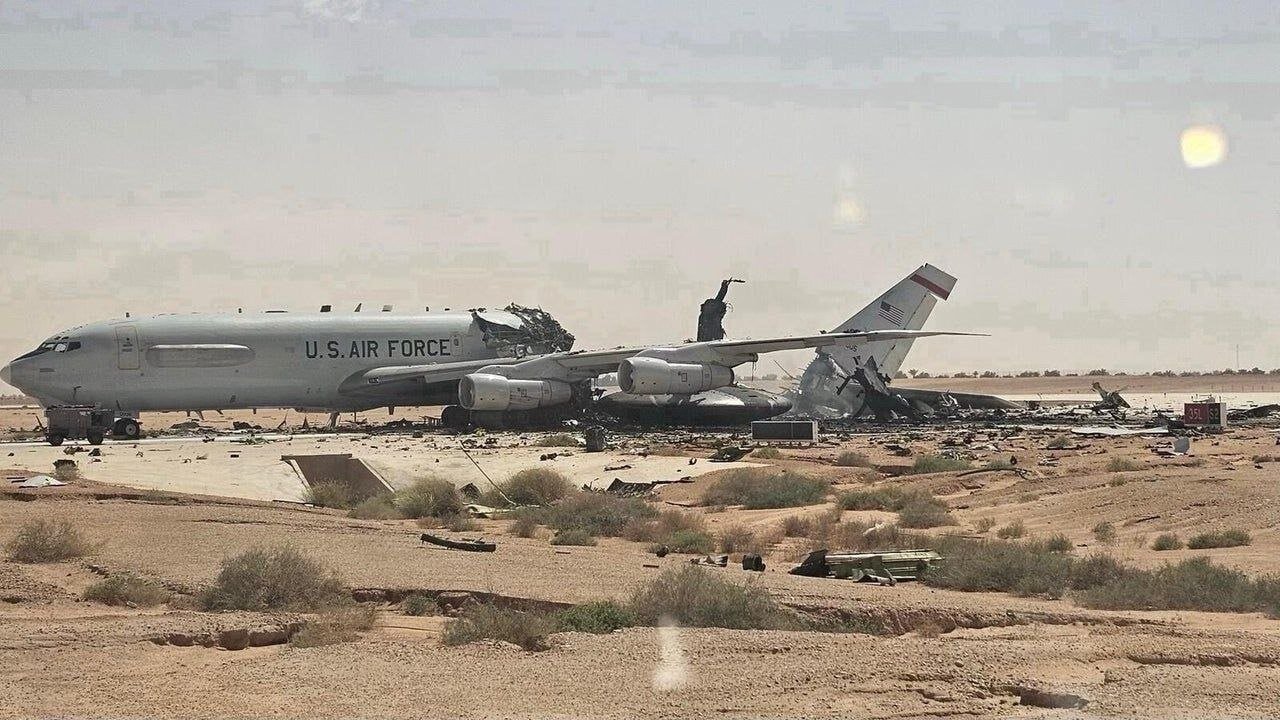
CBS News recently obtained photographs from active-duty US service members showing extensive damage at American positions in Kuwait, Saudi Arabia and elsewhere following Iranian missile and drone attacks.
The images included damaged buildings and vehicles at Camp Buehring and Camp Arifjan in Kuwait and severe damage to an E-3 Sentry aircraft at Prince Sultan Air Base in Saudi Arabia. CBS said the photographs were provided by serving military personnel who spoke anonymously because of military restrictions on the media.
The Pentagon’s inspector general has separately reported equipment losses worth up to $3.7 billion, including losses involving nearly 60 aircraft, while recording Iranian attacks on US bases in Kuwait, Bahrain, Qatar, the United Arab Emirates, Saudi Arabia, Iraq, Oman and Jordan.
The photographs matter because they provide a visual record of damage that is difficult to capture in official statements consisting largely of aggregate figures.
They also complicate the image of an American military campaign conducted with overwhelming protection from retaliation.
One US service member quoted by CBS described the situation in stark terms, saying the damage being inflicted on American bases had not been adequately communicated to the public.
Other reporting has independently documented damage to American aircraft. CBS reported that an A-10 at a US base in Jordan lost a wing in an Iranian strike, while several F-15s sustained damage.
The bill comes to $43.6 billion — and counting
The most tangible measure of the war’s cost is financial.
According to an updated estimate from US Central Command provided to Congress, the conflict had cost the United States approximately $43.6 billion by September 3. About $28.1 billion of the total was attributed to expended munitions. The estimate does not include damage to US bases across the region.
The figure represents a substantial increase from the Congressional Budget Office’s estimate of approximately $38 billion through August 1.
The CBO has projected that the war could continue adding roughly $3 billion a month, depending on the intensity of military operations.
The most striking element of the new estimate is the cost of weapons. US munitions expenditure rose from approximately $21.7 billion in the earlier CBO calculation to about $28.1 billion in the Central Command estimate.
The financial burden comes alongside pressure on American weapons stocks. The CBO has warned that the conflict has consumed substantial quantities of precision weapons and missile interceptors, potentially creating replenishment challenges for years.
For a war whose stated objective was to remove a strategic threat, the depletion of American military stocks has itself become a strategic concern.
A war is increasingly difficult to measure through official statements
The emerging evidence does not establish that every undisclosed casualty, military loss or omission was deliberately concealed. Some discrepancies may reflect classification rules, changing casualty categories, operational security or the normal lag involved in military investigations.
But the accumulation of discrepancies has become difficult to ignore.
Civilian deaths in Iran have generated UN investigations and congressional demands for disclosure. American military fatalities appear to exceed the numbers contained in the Pentagon’s public database. Photographs from US service members reveal damage at bases that was not initially visible in official accounts. Pentagon documents show billions of dollars in equipment and munitions losses, while the overall cost of the war has risen to $43.6 billion.
At the same time, the Trump administration continues to seek additional resources for the military. The administration has proposed a $1.5 trillion defense budget, while also seeking additional funding connected to the Iran war and other defense priorities.
The result is an increasingly difficult contradiction for Washington: the longer the war continues, the harder it becomes to contain its consequences within a simple narrative of a rapid and decisive military operation.
Seven months into the conflict, the central question is no longer only what the United States says happened in Iran.
It is what the accumulating evidence — from UN investigators, American lawmakers, Pentagon documents, US military personnel and American media investigations — says happened after the first bombs fell.
And on that question, the record is becoming considerably larger than the official daily casualty figures, battlefield statements and headline claims of success.
Disclaimer : This story is auto aggregated by a computer programme and has not been created or edited by DOWNTHENEWS. Publisher: tehrantimes.com