Adrian Blomfield
London: Elections in Russia are a curious business.
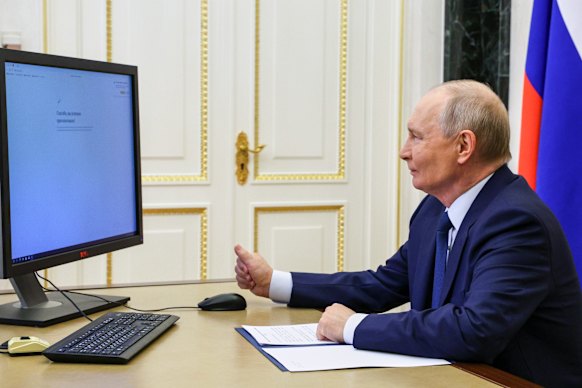
Every few years, its people are invited to demonstrate their loyalty to Vladimir Putin. Most duly oblige, before returning home to learn how their votes have been adjusted to secure the desired result.
Russians have had the opportunity to repeat the experience over a three-day parliamentary election ending on Sunday. Yet the significance of the vote is less its predictable outcome than what comes after.
In European capitals from Kyiv to London, there is growing fear that the Russian president, his electoral charade behind him, will feel sufficiently emboldened to escalate his campaign in Ukraine, his undeclared war against Europe, or perhaps both.
The most immediate concern is that Putin could order another mobilisation.
Ukrainian President Volodymyr Zelensky has warned that the Kremlin is preparing to do just that shortly after this weekend’s elections. He has said Ukrainian intelligence assessments suggest Moscow plans to call up an additional 300,000 troops in an attempt to break the stalemate in the Donbas or launch fresh offensives in northern Ukraine.
It is not just Ukraine in Putin’s sights
Recent weeks have witnessed a series of increasingly provocative incidents involving Russia and NATO. Last month, an explosives-laden drone struck a cargo aircraft at Leipzig airport but failed to detonate, an attack Germany subsequently blamed on Russian intelligence. And in the past week alone, a Russian frigate has fired flares at a Danish military helicopter in international waters and NATO jets shot down a drone over Lithuania.
Danish Prime Minister Mette Frederiksen characterised such incidents as evidence that Russia’s “hybrid war” against Europe had intensified. But some Russia analysts say the term itself understates the seriousness of what is happening.
“No matter how much Russia escalates, some countries are still determined to call it hybrid – as opposed to acts of state terrorism or warlike actions,” said Keir Giles of international-affairs think tank Chatham House.
Privately, European defence and security officials say they fear that such attacks are the beginning of a much more concerted campaign of increasingly overt action against NATO territory that could follow the elections.
If Putin does order a mobilisation, they say, its purpose could just as easily be focused on Europe as Ukraine, allowing him to deploy forces at newly built bases along Russia’s western frontier with NATO.
“A significant increase in Russian military manpower would mean Russia does not have to wait for the end of major combat operations in Ukraine before filling the military infrastructure that has been set up for troops along NATO’s eastern periphery,” Giles said.
“A lot of what’s going on at the moment, like increases in tank production, is not meant for the Ukrainian front. They’re not using these tanks against Ukraine, so plainly they are intending to use them somewhere else.”
All of which suggests, observers say, that Putin remains convinced not just that he will win the election but the war as well – a conflict he increasingly represents less as a confrontation with Ukraine than with the West itself.
Putin the choreographer
Russian elections may be a foregone conclusion, but, for the regime, they are not without their hazards — or their uses.
Russians may not be able to make their votes count, but elections have sometimes allowed them to make their voices heard. Tens of thousands of protesters poured into Moscow’s Bolotnaya Square following controversial parliamentary elections in late 2011, marring Putin’s planned return to the presidency the following northern spring.
A repeat now seems unlikely. The repression unleashed since the invasion has all but eliminated the space for organised dissent, while Putin has successfully navigated a wartime election before. In 2024, he secured another presidential term, defeating rivals who refused to campaign and hinted that they hoped to lose.
The parliamentary election is similarly choreographed. The ruling United Russia party faces nominal competition from parties ranging from communists to nationalists, but on the central questions of Putin’s rule and the war, they offer little meaningful alternative.
“One would have a hard time calling these elections fair or competitive,” said Evgeny Roshchin of the Centre for European Policy Analysis in Washington. “People do compete in these elections, but most of them compete over how much love they have for Vladimir Putin or how strongly they endorse the current war.”
So confident was the Kremlin of the outcome that Russia’s only openly anti-war party, Yabloko, was briefly permitted to run in July, only to be struck from the ballot weeks later. Analysts attribute the about-turn to a surge in social media support for Yabloko among the young.
Far from being an embarrassment to the Kremlin, the episode demonstrates that the system works, according to Giles.
“If you allow a party which poses no evident threat to register for the election, this supports the pretence of democracy,” he said. “And if you then decide that actually it potentially is a problem, it’s very easy to remove it and ensure that nothing disrupts the smooth flow of results.”
The audience
With no party for disenchanted Russians to rally behind, Putin can once again subvert the democratic process without fear, securing a veneer of legitimacy for his authoritarian regime and a manufactured mandate for his war. It also gives him a platform to claim that Russia holds elections in wartime, while Ukraine does not, an argument that could win favour in the White House.
Yet the picture inside Russia is more complicated than the official results suggest.
Ukraine’s campaign to bring the war to the Russian heartland, with drone strikes on energy infrastructure and other targets, has increased the sense of vulnerability among ordinary Russians. For some, that has produced a rally-round-the-flag effect.
“Some Russians are saying ‘well, now we understand that Putin was right from the very beginning and that, since this is a serious, existential struggle for Russia, we should unite around the Kremlin’,” said Nikolai Petrov of the New Eurasian Strategies Centre (NEST) in London.
But anxiety has also risen as the war has become harder to ignore. Ukrainian drones are reaching cities previously untouched by the conflict and war-related inflation is squeezing household budgets. Recent polling has recorded heightened concern about the war and the possibility of renewed mobilisation.
That creates a delicate moment for Putin. He can emerge from the election claiming another overwhelming mandate. But having secured it, he will also have to weigh the domestic risks of whatever comes next.
As such, the significance of Friday’s vote may lie less in who wins than in what Putin chooses to do once it is over.
The cast
Another major round of mass mobilisation carries considerable risks. The last time Putin attempted it, calling up 300,000 men in September 2022, protests erupted in some Russian cities and as many as a million people, mostly middle class, fled the country.
Since then, the Kremlin has sought to restore the unspoken social contract that allows most urban Russians to treat the war as a distant, television-only conflict, while offering increasingly lucrative contracts to those willing to fight in Ukraine.
But the demands of the battlefield are growing. Russia is losing men faster than it is recruiting them, according to Western intelligence estimates, while the rate of its advances has slowed.
CIA director John Ratcliffe in July said a new Russian recruit on the battlefield survived an average of only 20 to 30 minutes, so it is hardly surprising that recruitment is becoming harder.
Fears of a new mobilisation are nevertheless mounting inside Russia, despite Kremlin denials of any such plans. Young men report being summoned to local government offices for “data verification”, while some are fleeing the country, although doing so is now far harder than it was in 2022.
Yet claims that Putin is preparing to mobilise hundreds of thousands of men for the Ukrainian front assume that he believes such a move would materially improve his position. That is far from certain.
Despite setbacks, Putin still believed he was winning the war, said John Lough, a senior fellow at NEST. Russia continues to make gains on some of the most important sectors of the front; it is inflicting greater economic damage on Ukraine than it is suffering itself; and Kyiv’s recruitment problems are even graver than Moscow’s.
There are signs that momentum is shifting back towards Russia.
“The optimism that was fuelled by Ukrainian deep strikes is now steadily being replaced by the pessimism over jet-powered Shahed [drones] and the imbalance between Russia’s capacity for air attack and Ukraine’s capacity for air and missile defence,” said Giles.
That makes a fresh mass mobilisation an unnecessarily risky way for Putin to try to change the course of the war, some analysts believe. He may instead choose to exploit Russia’s growing advantage in the air, subjecting Ukraine to another winter of escalating attacks.
“The Kremlin senses it’s got the Ukrainians on the ropes and it’s going to subject them to a horrific barrage over the winter,” said Lough. “They won’t just attack power or energy facilities. They are likely to go further, targeting water installations and sewerage in an effort to make major cities uninhabitable.”
Managing the stage
Such a strategy may not produce the effect Putin imagines. He has misjudged Ukrainian tenacity before, Lough said. Mobilisation therefore remains an option, some observers believe, but it may take a form less visible than the mass call-up of September 2022.
Mobilisation laws introduced that year give the Kremlin considerable latitude to increase recruitment without announcing a new nationwide mobilisation, potentially allowing Putin to build up the armed forces in stages and less visibly.
‘The Kremlin senses it’s got the Ukrainians on the ropes and it’s going to subject them to a horrific barrage over the winter.’
John Lough, a senior fellow at Nest
“The military case for mobilisation is strengthening, [but] for now it is likely that Putin will continue trying to avoid a large, publicly declared call-up,” said Ruben Stewart, senior fellow for land warfare at the International Institute for Strategic Studies.
“Mobilisation brings the war directly into households previously insulated from it, while taking workers out of the economy. But if he judges that avoiding mobilisation threatens his position more than ordering it, he could act. A phased or selected call-up is a plausible intermediate option.”
Nor does mobilisation necessarily mean merely recruiting soldiers. Putin could also mobilise the economy, forcing private companies to serve the war effort as Britain and the Soviet Union did during World War II.
There are signs that the legal groundwork is being laid. Legislation passed by the Duma in August gave the state powers to impose “temporary management” over key private businesses, which one European security official describes as “a legal mechanism to transition the civilian economy to a war footing without declaring total mobilisation”.
Waiting in the wings
The significance of such measures extends beyond Ukraine. They could give Putin the manpower and industrial capacity to sustain his war there while building forces for a broader confrontation with NATO.
The Kremlin is already preparing Russians for such a confrontation, increasingly portraying the war in Ukraine as an existential struggle with the West rather than a “special military operation”.
Russia is also expanding its military infrastructure along NATO’s eastern flank, expanding barracks and logistics hubs near its border with Finland. Since late last year, it has begun building permanent garrisons close to the Arctic frontier with northern Scandinavia, according to Western intelligence assessments.
The problem is manpower. Much of Russia’s available military strength remains tied down in Ukraine. A phased mobilisation would give Putin a way to fill the new bases without pulling forces away from the war.
There are signs, too, that Russia is accumulating equipment for a future conflict. European defence intelligence assessments say Moscow is increasing production of its T-90M main battle tank but it is not sending all of the additional vehicles to Ukraine, instead placing them in strategic reserves. Russia could produce as many as 1000 T-90s over the next two years, according to the European official.
That does not mean Putin is preparing to launch a mass armoured invasion of NATO. But a larger and more capable Russian force on the alliance’s eastern flank would give the Kremlin a more credible military threat with which to press Europe into reducing its support for Ukraine.
Russia’s election could prove to be about far more than securing another confected mandate for its leader. It may also mark the moment when Putin chooses to accelerate Russia’s transition to a military footing designed not simply to sustain the war in Ukraine, but to confront the West for years to come.
The Telegraph, London
Get a note directly from our foreign correspondents on what’s making headlines around the world. Sign up for our weekly What in the World newsletter.
From our partners
Disclaimer : This story is auto aggregated by a computer programme and has not been created or edited by DOWNTHENEWS. Publisher: www.smh.com.au