
Schools are being pushed to curb classroom screen time amid increasing student anxiety and declining test scores, but experts warn that hasty bans could undo the benefits of teaching with tech.
NSW has announced plans to follow Victoria’s lead in capping students’ screen time, after federal Education Minister Jason Clare called for a digital detox in response to declining maths scores and literacy comprehension.
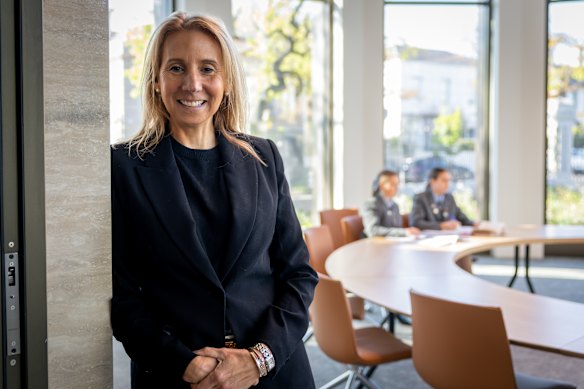
St Catherine’s School in Toorak kept year 7 students off laptops for the first six weeks of term one, a trial that principal Natalie Charles said had “extraordinary” results.
“We know that students flourish when they’re in relationship with each other, and they’re in relationships with the teacher,” Charles said. “And that six weeks was this premium nirvana of relationship building.”
Australian year 9 students recorded their lowest maths and reading scores since testing began more than 20 years ago in the recent Program for International Student Assessment (PISA).
Their results, which ranked them about two years behind Australian students from two decades ago, echoed a global decline, especially among Organisation for Economic Co-operation and Development countries.
As academic results have declined, reports of mental health issues among Australian students have risen – a trend policymakers have linked to increased time online.
The delayed laptop rollout at St Catherine’s will extend to year 8 next year. The initiative was informed by a partnership with the University of Queensland, which warned of heightened anxiety during the transition to secondary school, rather than declining academic results.
Charles said she would consider extending the trial beyond six weeks if it weren’t for online NAPLAN testing in March, which Clare has signalled could return to pen and paper.
The St Catherine’s principal said she believed society would have “deep regret” over the decision to put devices in children’s hands over a decade ago “with very little thought for the impact that it might have”.
“Now the work of schools, and of families, is holding the line in many respects and saying … ‘Is this tool at this particular time in the child’s life the best thing to see them flourish?’” she said.
St Catherine’s is not alone: boys’ school Sydney Grammar, Toorak College, Castlemaine Secondary College and Traralgon College have all reportedly taken steps to curb device use.
While private schools set their own policies, state primary schools in Victoria will be barred from asking parents to buy their own devices from next year, scrapping a previous policy that let schools decide.
State school pupils in years 3 to 6 will also be restricted to 90 minutes of screen time a day from next year, while pupils in prep to year 2 will have minimal exposure to devices.
Teachers at state secondary schools will be required to plan device-free learning, although time limits won’t be enforced.
Dr Jared Cooney Horvath, a neuroscientist and author of the book The Digital Delusion, about the impact of digital tools on learning, said secondary schools should also scrap personal devices and reintroduce computer labs to make tech use more “deliberate”.
Horvath, a prominent critic of digital devices in schools, met with the federal education minister during a visit from his home in the United States this week. In Victoria, his visit took in state schools to discuss the revised education framework and Melbourne Archdiocese Catholic Schools to discuss AI and “why digital technology doesn’t align well with human learning”.
Speaking to this masthead, Horvath said humans were built to learn from other humans, partly because we resonate with others.
“I can watch somebody do something and learn as though I was doing that thing. I can have somebody explain something to me, and I can learn as though I were performing it. You cannot, unfortunately, resonate with tech,” he said.
Horvath said learning from tech was often more surface-level, and we “tap out” as soon as it gets difficult.
“And to make matters worse, screens will also cut that synchrony between people,” he said.
“In a classroom, even if a teacher and student are resonating, as soon as the kid pulls out a screen to take notes or to access a reading, that resonance is now gone, and learning is going to go down.”
Horvath said memory worked best when words were static on paper, rather than moving as they do when students scroll on a screen.
“This is why in schools where you do nothing different but print out your readings again, go back to a hard-copy textbook versus a screen, learning will go up because now you’re playing kind of a memory game,” he said.
In 2020, Victoria was the first state to ban mobile phones in public school classrooms.
The same year, the Andrews government signed a deal with Microsoft to give government students access to a broad range of software, including Minecraft: Education Edition. The computer game, in which players are immersed in Minecraft worlds, has been used in classrooms ever since.
Horvath said research showed that when learning is “gamified”, children focus on the game, not the lesson.
“The content of the game is basically secondary,” he said. “They don’t learn a lot.”
Victoria’s mobile phone ban will be extended to include smartwatches and wireless earphones from next year. Private schools will also ban the devices from next year.
Victorian Education Minister Gabrielle Williams said digital learning had its place in schools but classrooms “should be run by our teachers – not screens”.
Since last December, when Horvath published The Digital Delusion, a book often referenced by advocates of limiting students’ tech use in Australia, the US states with proposed bills to limit classroom screen time have grown from three to 31.
In June, Norway announced it was diverting state school funding from personal devices to textbooks, following a similar move in Sweden, and phone bans are becoming more widespread worldwide.
Professor Therese Hopfenbeck, the head of the University of Melbourne’s School of Learning Science, said policymakers in Norway, where the debate is heated, are looking at the restrictions being introduced in Australia.
Hopfenbeck, the international chair of PISA 2025 and part of the expert group that develops the assessment program’s questions about teenagers’ use of devices in the classroom, said it was not as simple as throwing out the devices and watching the results improve.
She said there wasn’t enough evidence to conclude that banning devices in classrooms would improve learning.
“There are results also suggesting that if you’re able to use the device in a very productive way, at the right time, students can actually learn from them,” Hopfenbeck said.
“From a research perspective, we are very concerned that policymakers will make hasty decisions based upon results without actually asking themselves how and when are teachers and students using a device in a productive way.”
Hopfenbeck said Australia needed strong leaders to “take a step back and acknowledge that there are a lot of things we actually do not know right now”. She said the best researchers in the country were ready to do the work and fill those gaps.
“I wish that there were governments in Australia who would now make sure that we get proper classroom-based research in Australia, so we don’t need to look to England or Norway or other places,” she said.
Students at Candlebark and Alice Miller, two independent schools north of Melbourne founded by the late author John Marsden, are not permitted to bring smartphones to school at all. Prep to grade 7 students at Candlebark don’t have access to laptops or tablets either.
Sarita Ryan, the principal at both schools, said primary pupils used desktop computers in the computer lab about once a week.
“Most of our learning happens through books, pens and paper,” Ryan said.
Founded in 2016, with its first year 12s graduating in 2017, Alice Miller has maintained a median VCE study score above the state average since 2018. Ryan credits the school’s approach to tech as key to its academic success.
“We’ve just always seen the distraction risk to be too great … we think [students] read more accurately from the page than the screen, and they memorise content better with handwriting rather than typing,” she said.
Year 7 to 12 students at Alice Miller have access to school laptops and a computer lab. Students aren’t on the laptops often, and the lab is typically used for subjects like filmmaking or sound design, Ryan said.
“The really critical aspect is that they don’t have their own devices,” she said.
Ryan said all primary school students’ homework is offline, while secondary students have some online.
“But increasingly we’re setting more work that is done through no-tech or low-tech means,” she said.
“We’ve got a big emphasis on firsthand experience here, on relationships, and making sure that students are learning from the teacher and not from a device.”
Read more of our education coverage:
From our partners
Disclaimer : This story is auto aggregated by a computer programme and has not been created or edited by DOWNTHENEWS. Publisher: www.smh.com.au