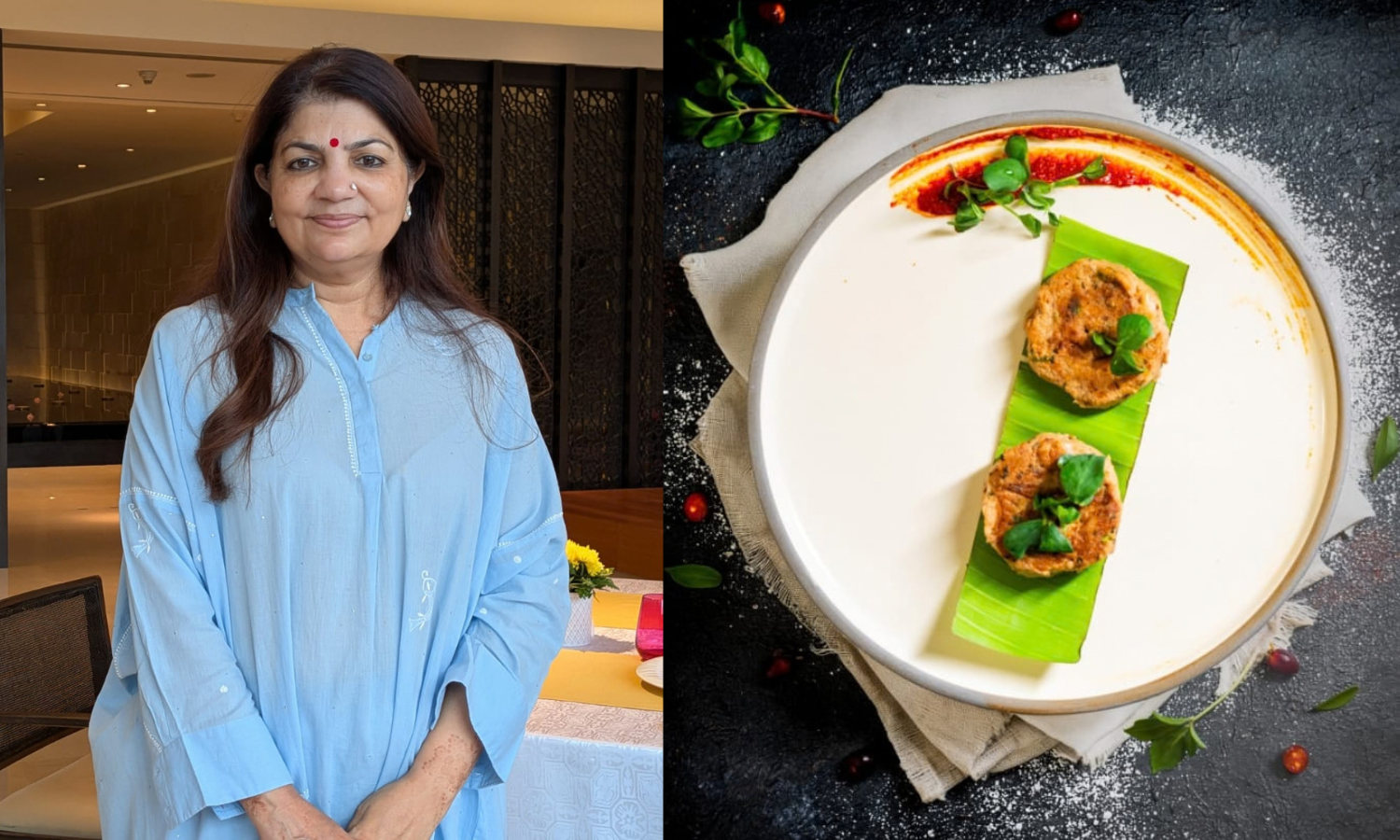
At Kanak, Trident Hyderabad, a five-day culinary showcase from September 21 to 25 is bringing the lesser-known flavours of Bihar to the city. Titled ‘Beloved Bihar’, the showcase features Guest Chef Shubhra Singh and recipes from her ancestral village, Balua Deorhi, drawing on the food traditions of Magadh, Nalanda, Mithila and Anga.
For Shubhra, however, the menu is not simply an exploration of regional cuisine. It is a collection of memories.
She speaks of a childhood in which food was closely tied to family, place and hospitality, where fresh produce, fish and mutton arrived home and cooking was slow and unhurried. Masalas were ground on the silbatta ( a stone grinding tool used to manually grind spices), meat was cooked slowly and ghee was an essential part of the kitchen. It was an environment in which cooking was not a skill to be formally learnt, but something that was absorbed simply by being around it.
Ask her how she developed an interesting in cooking, she says, “It was imbibed, I didn’t have to do anything.”
That sense of food being inherited rather than taught runs through Singh’s recollections of Bihar. Her family has deep roots in the state, and she grew up hearing stories about relatives, writers, public figures and the many people who passed through their home. Food was part of that atmosphere of hospitality.
“There was an atmosphere where a lot of people used to come and go. Food was just a part of it,” she recalls. Among the foods that stayed with her from childhood was a preparation associated with Durga Puja and a particular family tradition. The goat used for the occasion was considered sacred, and the preparation was made without onion, garlic or garam masala before being cooked over charcoal. Shubhra remembers developing a taste for it over time. Eventually, it became something more than a dish. “It became soul food,” she says.
Aloo pomfret chop
That phrase perhaps explains why Shubhra approaches this showcase differently from a popup chef presenting a conventional restaurant menu. She does not describe herself as a professional chef. She cooks at home, and many of the recipes she has brought to Hyderabad are tied to people and moments in her family.
Shubhra says. “Everything that I know to cook is from my heart.” That is also why the menu moves beyond the Bihari dishes most diners may already recognise. Shubhra wants to open up a larger picture of the state’s food, one that stretches beyond litti and chokha and into the different regions and communities that shaped her own family table.
There is Katarni rice, which finds its way into the pulao, and Mithilanchal flavours. There are dishes built around parval, maize, moringa, seven grains and a variety of chutneys. Some are deeply rooted in everyday cooking, while others carry memories of family occasions.
Maize, for instance, is an important crop in Bihar and features in Shubhra’s menu. One of her dishes is a broth made with fresh corn, without cornflour or maize flour. The drumstick kebab is another family favourite. Shubhra speaks enthusiastically about the tender drumsticks, known as Sehjan in her part of Bihar. At home, she says, the vegetables were so fresh and tender that nothing was wasted.
“You are supposed to eat it fully,” she says, describing the young drumsticks as so tender they could be treated almost like beans. Then there is dal puri, which belongs to her grandmother’s repertoire and satanja roti that has its own family history. Shubhra recalls making the seven-grain rotis for her grandfather as part of the family’s effort to maintain his special diet.
Even the sweets carry stories. She remembers weddings where large quantities of boondi were made in the kadhai and served as a delicacy. Leftover boondi could become another dish, while in her family it was also eaten with cardamom infused milk.
The details may seem small, but that is precisely where Shubhra’s idea of Bihari food seems to reside. It is not only in celebrated dishes or restaurant menus. It is in the combinations people eat at home, the ingredients they grow, the food prepared for relatives and the recipes remembered because someone in the family made them.
Her own village, Balua Deorhi, remains central to that memory. She describes it as remote, a place where the family was deeply connected to the land and a region which also carried influences from Assam and Bengal, something she says can be felt in its food and tea culture.
An apt way to understand the meal she has brought to Hyderabad is to try it. The menu may introduce diners to unfamiliar corners of Bihar, but for Shubhra, every dish leads somewhere familiar: back to a village, a family kitchen, a grandmother’s final words, a mother’s cooking or a table around which people once gathered.
The food is regional, but the memories behind it are deeply personal. And that is what makes these recipes feel like pieces of home being shared.
Disclaimer : This story is auto aggregated by a computer programme and has not been created or edited by DOWNTHENEWS. Publisher: deccanchronicle.com