
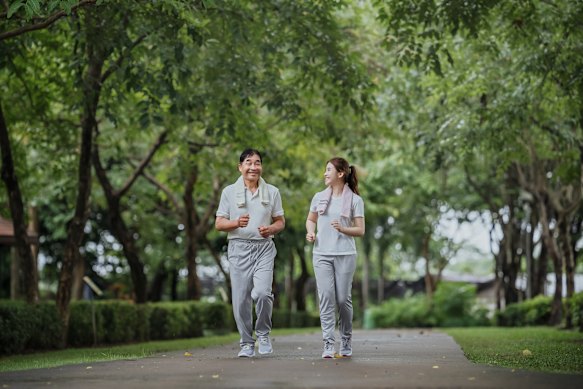

The ubiquity of wearable trackers and the oft-cited prescription of 10,000 steps a day mean we tend to focus on quantity above all else when it comes to our daily physical-activity goals.
But findings from a large prospective cohort study, published in the British Journal of Sports Medicine this month, suggest speed might matter just as much as steps when it comes to mortality risk.
Researchers from Monash University and The University of Sydney found taking fewer daily steps at a faster pace, or more steps at a slower pace may substantially lower the risk of early death by up to 43 per cent.
Data was drawn from the UK Biobank, comprising 64,743 participants aged 40 to 69 who wore a wrist tracker for seven consecutive days. Researchers then followed up eight years later.
They found similar benefits between walking under 5000 steps per day at a faster cadence, and walking 7500 to 10,000 steps per day at a slower cadence.
The lowest mortality risk, unsurprisingly, was among those walking 7500 to 10,000 steps per day at a quicker pace.
Previous population studies show an association between higher daily step count and lower mortality risk. Research has also consistently shown an association between higher intensity exercise – even in short bursts – with lower risk of chronic disease and mortality outcomes.
But co-author Dr Nicholas Koemel, senior research fellow in the Turner Institute for Brain and Mental Health at Monash University, says few large-scale studies have looked at the association between intensity and step count.
“The real goal here was: can we find different avenues for people to achieve those same health benefits?” he says.
“Everybody might not have the same level of motivation or time to accrue the traditional 10,000 steps per day goal that’s often touted around, especially those who have fragmented days or, like myself, are sitting in front of the computer screen all day.”
For Koemel, it’s an important reminder to try to get the most out of the steps we might already be doing.
The other side of this brisk walking coin is “slow jogging”, a growing trend that, as the name suggests, promotes running at glacial speed.
Developed by late Japanese researcher Hiroaki Tanaka, the idea is that jogging at “niko-niko pace”, or “smiling pace”, is a more pleasurable way to exercise and improve cardiovascular fitness.
The practice has since spread to other parts of Asia including South Korea and Indonesia, and has gained popularity in the west thanks to social media, even boasting its own dedicated subreddit, r/slowjogging.
Emmanuel Stamatakis, professor of physical activity, lifestyle and population health at Monash University’s Turner Institute, says while there have been no large cohort studies on the practice, it’s an attractive idea.
“Slow jogging appeals to me because it lowers the entry barrier to an intensity that many inactive adults would otherwise never reach, and the short, high cadence stride keeps the effort steadier than a conventional jog,” he says.
“What the trend does is maintain a running gait at walking speeds, often somewhere between 3km/h and 6km/h, which puts it closer to fast walking than running.”
And the benefits go beyond the physical. As Koemel points out, most social media videos show slow jogging in group settings.
“That’s really exciting because it creates a social structure, which is quite helpful for maintaining physical activity in the long run.”
A recent, small study from the Massachussetts Institute of Technology also found even short bouts of very slow running improved mood and executive brain function.
Dr Hunter Bennett, a senior lecturer in exercise and sport science at Adelaide University, says the benefits of low-intensity exercise like slow jogging depend on one’s fitness levels.
“I think as an entry point, that’s a really positive way to frame slow jogging,” he says.
He says someone with limited physical fitness is likely to see bigger benefits to cardiovascular health compared with someone with greater fitness levels, though these will plateau as capacity increases.
But doing something rather than nothing at all is important, given that less than a quarter of Australians meet the physical-activity guidelines and nearly half of employed adults are sedentary.
“The cheapest health gain available to most Australians is a little more effort inside the walking they already do, whether that arrives as a brisker stretch, a hill, a few flights of stairs or a slow jog,” says Stamatakis.
He suggests using breathing as an easy guide to gauge intensity.
“You should notice it getting faster, and if intensity approaches upper moderate to vigorous, you would manage a sentence but not a comfortable conversation.”
Make the most of your health, relationships, fitness and nutrition with our Live Well newsletter. Get it in your inbox every Monday.
From our partners
Disclaimer : This story is auto aggregated by a computer programme and has not been created or edited by DOWNTHENEWS. Publisher: www.smh.com.au



