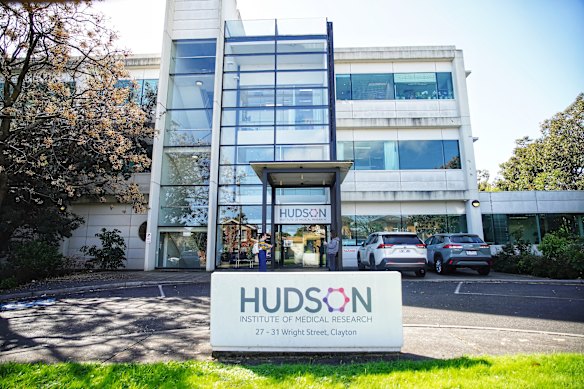

A leading children’s cancer and women’s health institute will cease operating independently and cut at least 75 jobs as it is absorbed into Monash University as financial pressures spark alarm across the research sector.
The fate of the 66-year-old Hudson Institute of Medical Research will be repeated, sector representatives say, as Victoria’s medical research sector is slowly strangled by years of flat federal and state government funding.
The Age can also reveal that the National Ageing Research Institute in Parkville is warning that it is at risk of closing by 2030 unless the funding picture changes.
The 100-year-old Walter and Eliza Hall Institute, considered the jewel in Melbourne’s scientific crown, just restructured from 12 divisions down to four after running an operating deficit of more than $82 million over the past two years.
In total, the sector’s peak body estimates 10 of Victoria’s 14 independent research institutes will be forced to close by 2030.
“They are just not sustainable any more,” said a Hudson Institute source, speaking on condition of anonymity to detail confidential information. “Everyone knew funding was an issue. I’m not sure too many thought that something so big would happen so soon. We are far from the only one considering this type of move.”
The Hudson Institute’s research focuses on cancer, inflammation and women’s and newborn health, including endometriosis. It is a leader in childhood cancer and houses the world’s largest collection of childhood cancer cell lines.
Hudson ran back-to-back deficits totalling more than $5 million across the 2024 and 2025 financial years. Its revenue has flatlined since 2021.
The Clayton-based institute’s leadership informed staff about the proposed merger on Thursday, a source with knowledge of the merger but not authorised to speak publicly said, with a consultation period of three weeks. The institute employs 181 full-time and 90 part-time staff.
In a joint statement, Hudson and Monash said the institute would be absorbed in the first half of 2027 as part of the university’s Faculty of Medicine.
“Monash and Hudson have a strong, longstanding relationship. Building on this foundation, the Hudson Institute board has been considering how to respond to a changing research environment.
“This would bring one of Australia’s leading medical research institutes fully into Monash University, strengthening Monash’s own research capability and reach.”
Researchers who have ongoing government grants are secure, while scientists without ongoing funding and professional staff are in a precarious position.
“When it comes to the non-scientific staff, like all the support staff, very few are going [across to Monash]. Monash does not need another finance team. It’s a lot of jobs,” said the senior staff member. They estimated at least 75 jobs would be lost “and potentially considerably more”.
The Hudson is far from alone in being financially stressed.
Australia’s spending on research and development as a percentage of GDP has been declining for 18 years now, as other advanced economies have stepped up science spending. After adjusting for inflation, Australia’s key government funding agency for health research has seen its budget fall every year since 2014.
The bigger problem for Victoria’s 14 independent research institutes, the Association of Australian Medical Research Institutes says, is the widening gap between the federal taxpayer grants they receive and the cost of doing research.
A federal government grant for a cancer research project covers less than half the cost of doing that research. The rest must mostly be found from philanthropy, commercial activities or state governments.
The state government last year increased support to $47 million a year for the institutes, but for more than a decade before that it was well below the NSW government’s level of support.
“If there is no change at federal or state level, 10 of the 14 institutes are forecasted to close their doors by 2030,” said Dr Saraid Billiards, chief executive of the Association of Australian Medical Research Institutes.
“They are all in a world of pain. Everybody is going through major reform.”
Among those 10 is the National Ageing Research Institute, a 50-year-old institute based in Parkville in the heart of Victoria’s biomedical precinct. The institute researches ageing and aged care, and pioneered the model for ageing-related research clinics around the country. It ran deficits in 2023, 2024 and 2025.
“We’re solvent. But we’re running deficits year in, year out. There is a structural issue. We are not bringing in enough,” said chief executive Professor Tracy Comans.
“Without fundamental change in the funding scheme, we can’t continue indefinitely.”
Comans said the institute was also exploring merger opportunities but such a move would be unlikely to save enough money to allow it to continue operations.
The other option would be to fold into a university.
“But then you completely lose your independence, and that would be a devastating thing to happen,” said Comans.
Melbourne’s Burnet Institute merged with the autoimmune-focused Austin Research Institute in 2006.
Burnet director Professor Brendan Crabb warned other institutes against taking that path.
“We’ve tried our best over the last 20 years. But to be honest, [the Austin Research Institute] are largely invisible and that [autoimmune] focus is not really visible any more despite our best efforts,” he said. “I’m not saying mergers are off the table. I’m saying there is good evidence to show they are not a magic-bullet fix.”
To ensure the institutes survived, Crabb said, the state government needed to double funding support to the sector – from about $50 million to closer to $100 million a year.
“I don’t see another way in the immediate to fix this issue,” he said.
Victorian Minister for Medical Research Anthony Carbines said the state government had increased funding by $24.6 million over two years to support the state’s research institutes.
“As a result, the program will provide more than $47.7 million in funding support in 2025-26, the largest amount of funding for research indirect costs provided by any Australian state or territory, in absolute terms,” he said.
”We will continue to support our medical research sector and continue to work with stakeholders and the Association of Australian Medical Research Institutes to advocate for a fairer share of medical research funding from the Commonwealth.“
 Liam Mannix is an investigative journalist at The Age. Before that, he was national science reporter for The Age and the Sydney Morning Herald.
Contact him via email or Signal (encrypted) liammannix.18
Connect via X, Facebook or email.From our partners
Disclaimer : This story is auto aggregated by a computer programme and has not been created or edited by DOWNTHENEWS. Publisher: www.smh.com.au