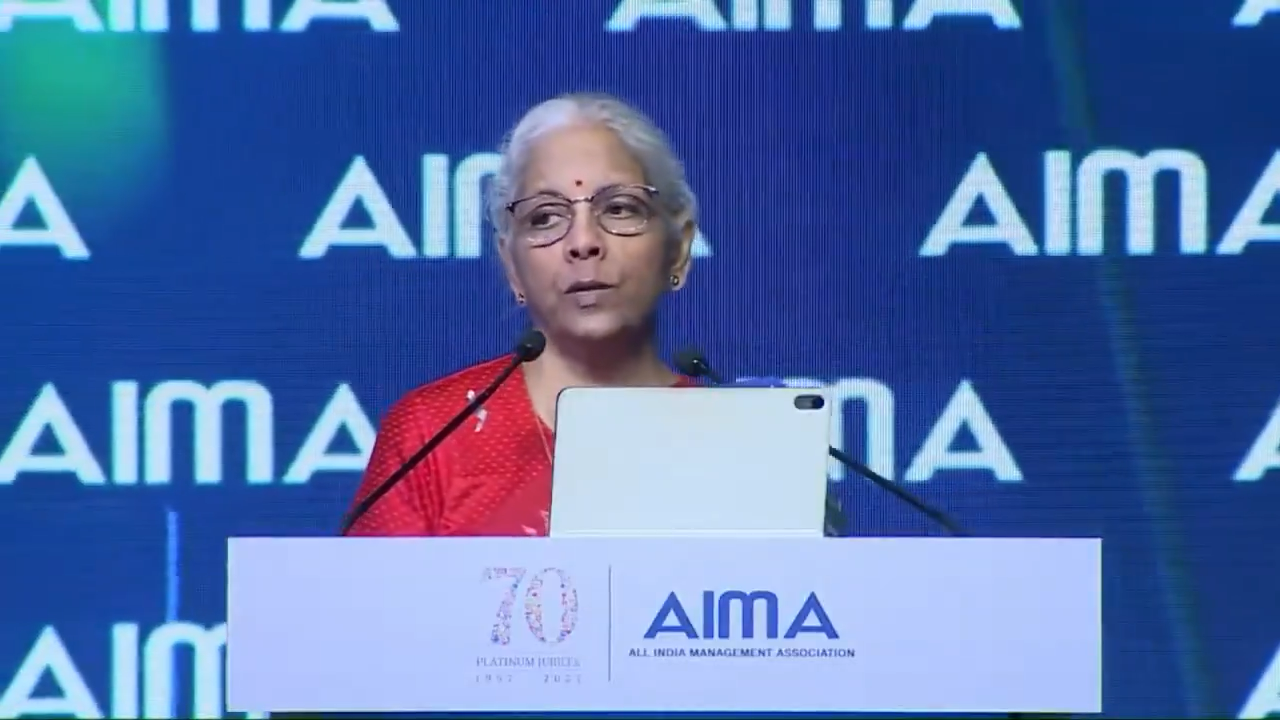
New Delhi: Union finance minister Nirmala Sitharaman on Tuesday asked India Inc to focus not just on scale but also on building stronger, more resilient, and better-governed enterprises as the country works towards the goal of Viksit Bharat by 2047. At the same time, she also hailed India’s public capital expenditure for private investment, saying that the impact is now visible in higher capital formation, improved manufacturing capacity utilisation and stronger bank credit to industry.
Addressing an AIMA event here, Sitharaman has also said that Indian industry needs to build institutions that combine scale with durability, higher quality, better governance and deeper technological capabilities. “India today has the scale of the market, the entrepreneurial energy and the institutional capacity to aim much higher. Execution will determine how successfully we convert these strengths into lasting national capability,” she said.
The finance minister also emphasised that sound corporate governance is not simply a set of external codes to be adopted, it also depends on the standards institutions set for them. “Trust between businesses cannot be demanded; it has to be built through conduct on both sides,” she said.
Highlighting that India’s next phase of growth must be built on quality, Sitharaman also said that corporates need to spend more on R&D, either in-house or through collaboration with academia. “This will help in driving innovation and improving existing products and higher R&D expenditure should also translate into more intellectual property being created in and from India,” she said.
Focussing on capital expenditure (capex), she also said that public capex has deliberately been used to crowd in private investment, and the impact is now visible in higher capital formation, improved manufacturing capacity utilisation and stronger bank credit to industry. “The government scaled up capex to more than Rs 12 lakh crore in 2026-27, while effective capital expenditure, including grants provided by the Centre to states for creation of capital assets, has crossed Rs 17 lakh crore,” she said.
She further said that crowding-in is now visible as gross fixed capital formation rose to more than 34 per cent of GDP in Q1 of 2026-27, growing about 12 per cent in real terms, while manufacturing capacity utilisation has climbed to 75 per cent. “This operational velocity has been unlocked by resolving the twin balance sheet crisis,” she said.
While global momentum slows below 3 per cent, she said, Indian GDP continues to expand close to 8 per cent, and the latest quarter came out stronger than most forecasts, she said, adding that this macro stability is prompting the world to re-rate India. “Reform and rising incomes are together reshaping demand. India stands at a structural inflection point: the next phase of consumption will be driven by upward mobility into brackets where discretionary spending accelerates,” she added.
Disclaimer : This story is auto aggregated by a computer programme and has not been created or edited by DOWNTHENEWS. Publisher: deccanchronicle.com