Angelenos recognize Armand Hammer as the founder and namesake of Westwood’s Hammer Museum. New Yorkers associate him with Hammer Galleries, specializing in impressionism and modern art. (Pop culture aficionados may know his great-grandson is Armie Hammer.) No matter what you know about the 20th century oil tycoon, you likely associate him with art.
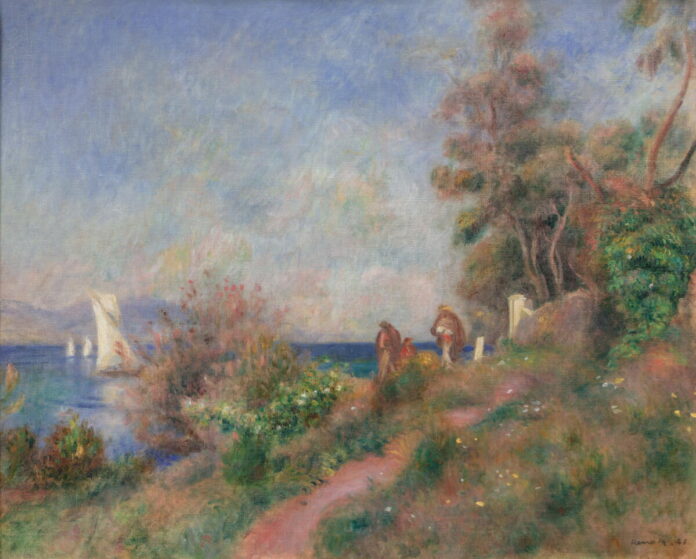
Now, a dozen pieces from Hammer’s private collection are set to be auctioned by Sotheby’s, with highlights — including Mary Cassatt’s “Summertime,” Edgar Degas’ “Trois danseuses (Jupes jaunes)” and Pierre-Auguste Renoir’s “Antibes” — on preview at Sotheby’s Los Angeles from Wednesday through Friday. (The sale will begin in New York in November.)
Pierre-Auguste Renoir, “Antibes,” 1888
(Sotheby’s / Armand Hammer collection)
Hammer moved to Los Angeles in 1956 at the age of 58 with plans to retire, but instead invested $50,000 into two wildcat oil wells owned by Occidental Petroleum (at the time nearly bankrupt), and the rest is monied history. His last public appearance was at a party celebrating the opening of the Hammer Museum in 1990.
“Armand Hammer’s imprint on Los Angeles is difficult to overstate,” the head of Sotheby’s L.A. office, Jacqueline Wachter, said in a news release. “He believed that collecting art came with an obligation to share it, a conviction that shaped not only his own museum but decades of gifts to institutions across this city and beyond. Long before Los Angeles was recognized as a global capital for art, Hammer was already insisting that world-class painting belonged here.”
Among the selection of 12 works, estimated to be worth $25 million to $37 million, Cassatt’s “Summertime,” painted between 1894-95, stands out. It does so literally: full of light, sumptuous, in clear conversation with Cassatt’s French impressionist contemporaries (she was the only American and one of few women to exhibit with the impressionists in Paris). But it also may do so in dollar signs: Sotheby’s says it’s poised to set an auction record for Cassatt; they expect it to break $10 million.

Mary Cassatt, “Summertime,” 1894-95
(Sotheby’s / Armand Hammer Collection)
“There’s also, obviously, the moment we’re in, and that’s a moment in which women artists are continuing to be recognized more and more, and specifically recognized as undervalued in comparison to their male counterparts,” said Julian Dawes, Sotheby’s head of impressionist and modern art. “That hasn’t actually made its way, I don’t think, to the impressionist realm, where there are unbelievable female artists, Cassatt being probably the most famous, but also Berthe Morisot, Eva Gonzalès.”
In 1971, when Armand Hammer bought “Summertime,” the sale set a world record for both Cassatt and any female artist at the time ($150,000, or about $1.256 million in today’s dollars). This phenomenon has recently repeated itself among female artists: Leonora Carrington’s “The Pleasures of Dagobert” broke her own sales record in 2024 ($28.5 million), and Frida Kahlo’s “El sueño (La cama)” did the same in 2025 ($54.7 million, the most expensive artwork by a woman ever auctioned). Which might be why Cassatt is poised to break her own record now.
“Collectors genuinely see it as an opportunity. It’s like, ‘This may be the last chance to get a world-class Mary Cassatt for only $10 million,’” Dawes said. “It’s also a refreshing narrative. It’s, like, oh, you walk into somebody’s house, ‘Wow, that’s a nice Monet.’ ‘Actually, it’s not a Monet.’ And that’s kind of cooler than saying, ‘Yes, it’s another Monet.’ And I think people love new stories. Not that it’s a new story, but it’s an under-told story.”

Edgar Degas, “Trois danseuses (Jupes jaunes),” circa 1899
(Sotheby’s / Armand Hammer Collection)
The other standout is “Trois danseuses (Jupes jaunes),” painted around 1899 by Degas, who was independently wealthy and from an aristocratic family, which allowed him the freedom to experiment. That freedom “comes across here in his sensorial, atmospheric approach, where he’s completely dissolved any attempt at delineation, and it’s just this sea of colors, to the point where he’s literally finger painting it,” said Dawes. “I mean, it’s unbelievable how much of this is done with the pads of his fingers. And all of his fingerprints and thumbprints are crystal clear in the paint.”
Proceeds from the sales will go to the Armand Hammer Foundation. The organization is in the early stages of shifting its focus from stewardship of the collection to providing grants for arts education and institutions.
“I feel there is no better way to honor my great-grandfather’s legacy than to support programs that instill a love of the arts, especially for students, and build appreciation of the roles they play in our lives and communities,” foundation chairman Viktor Hammer wrote in an email. “This is especially important at this time when there are cutbacks in arts funding.”
More to Read
Disclaimer : This story is auto aggregated by a computer programme and has not been created or edited by DOWNTHENEWS. Publisher: latimes.com