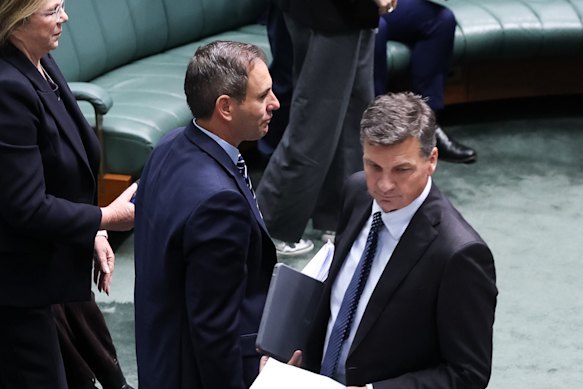

Labor’s claim that the budget will return to surplus by the middle of next decade has been blown apart by what Opposition Leader Angus Taylor called an $83 billion black hole.
Treasurer Jim Chalmers said on Tuesday that he had not “necessarily” given up on bringing the budget to balance, a day after a 40-year forecast of the economy showed taxes and debt rising if productivity remained flat.
The release of the Intergenerational Report on Monday opened up debate on Australia’s economic settings, as Labor and the Coalition prepare for a probable election contest over rival tax cuts after years of real wages decline.
Reserve Bank governor Michele Bullock on Tuesday again warned that inflation could be baked in and said the report was a “call to action” to politicians and business leaders to focus on growth, adding that unemployment may need to rise to tame inflation ahead of one and possibly two rate hikes.
Bullock also said that the bank could “see very directly” the impact of Labor’s property tax changes on investor housing approvals, which have tumbled along with those of first home buyers.
As the Coalition scrambles to rebuild its economic credentials and continues a messy internal debate on superannuation, Taylor told this masthead that the Intergenerational Report had compromised Labor’s budget strategy.
The May budget forecast a return to surplus in 2035 off the back of savings from the NDIS, winding back property and superannuation tax concessions, and ever-rising income taxes extracted from workers moving into higher tax brackets.
But the Intergenerational Report, also produced by Treasury, introduced a hypothetical tax cap from 2032-33, assuming that future governments would probably lower income taxes.
Even though the tax cap of 24.2 per cent of GDP is only hypothetical rather than actual government policy, Taylor said that Chalmers must “explain how an $83 billion budget black hole has opened up between the budget and the Intergenerational Report in just four months”.
Taylor said his party’s internal analysis showed an $83 billion difference between the 10-year forecast of the tax take revealed in the May budget and the hypothetical tax haul outlined in the report.
Taylor said it was highly unusual that the report generated uncertainty about the government’s 10-year forecasts by imposing the cap in six years’ time, shifting it forward from the end of the 10-year forecast in the last Intergenerational Report in 2023.
The opposition leader, trailing One Nation in the polls, said Labor had attacked the Coalition’s policy to offset bracket creep by pegging tax brackets to inflation, but now appeared to be embracing a similar plan.
“Four months ago Australians were given one set of budget numbers. The government’s own Intergenerational Report now shows a very different picture,” Taylor said.
Labor accused Taylor of generating a $12.5 billion black hole in May when the Coalition revealed the tax bracket indexation policy.
Chalmers said on Monday that Labor had made tough decisions on taxing capital, by winding back negative gearing and the capital gains discount, so the government could reduce reliance on income tax.
“Governments of both political persuasions, whenever they can afford to do that, return as much bracket creep as they can,” the treasurer said at the launch of the report on Monday.
Asked on Tuesday if Labor had given up on returning to surplus, Chalmers said: “No, not necessarily.”
“Even in the context of these very substantial budget pressures that come from things like ageing and other pressures in our economy … we’ve actually got a budget which is substantially stronger than other countries’,” Chalmers said on ABC Radio, after delivering two surpluses in Labor’s first term.
Coalition frontbencher Andrew Bragg sparked the latest battle over superannuation on Tuesday when he told this masthead that pension savings could be used as collateral for a mortgage.
Shadow treasurer Tim Wilson, like Bragg a long-time critic of superannuation, backed Bragg and said that using super to buy housing would encourage people to start families more than government payments upon childbirth.
Taylor said he supported giving Australians more choice for their super, weeks after One Nation revealed a policy to use super as a wage top-up, but noted Bragg’s idea was not yet formal Coalition policy. Chalmers went on the attack and said that conservatives wanted to dismantle Australia’s $4.8 trillion private pension scheme.
“Well, they hate super,” Chalmers said. “They always have and they always will. And they’re coming after superannuation. They put all of their time and effort into copying One Nation on superannuation. That would be devastating for people’s retirement.”
Cut through the noise of federal politics with news, views and expert analysis. Subscribers can sign up to our weekly Inside Politics newsletter.
 Paul Sakkal is Chief Political Correspondent. He previously covered Victorian politics and won a Walkley award and the 2025 Press Gallery Journalist of the Year. Contact him securely on Signal @paulsakkal.14.Connect via X or email.
From our partners
Disclaimer : This story is auto aggregated by a computer programme and has not been created or edited by DOWNTHENEWS. Publisher: www.smh.com.au