TEHRAN — Donald Trump’s address to the 81st session of the United Nations General Assembly was a cascade of verifiable falsehoods, internal logical collapses, and explicit threats of destruction.
Speaking from the podium of an institution founded to prevent aggressive war, the American president presented world leaders with a binary ultimatum regarding Iran: accept unilateral submission or face total physical erasure.
Ten minutes into the speech, the Iranian diplomatic delegation stood up and walked out of the hall. They left behind a single junior representative sitting stone-faced in an empty row.
The Cuban delegation exited shortly after when Trump branded their government a failed state.
The walkout was a deliberate refusal to validate an argument grounded in coercion rather than international law.
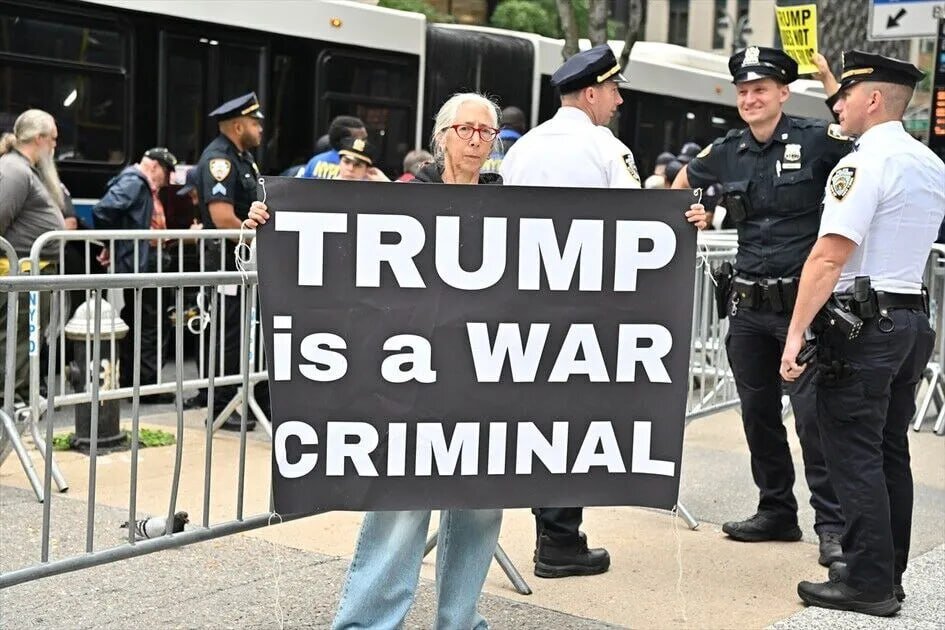
Outside the UN complex near Dag Hammarskjöld Plaza, protesters clashed with New York police while chanting against U.S. military aggression, carrying placards denouncing Trump, including one that read, “TRUMP is a WAR CRIMINAL.”
The nuclear ‘obliteration’ lie and the asymmetric reality
Trump’s primary justification for the nearly seven-month-old war against Iran relies on a claim he has repeated since June 2025.
“Operation Midnight Hammer,” he insisted, “obliterated” Iran’s nuclear program “beneath mountains of rubble.”
That statement collapses under the weight of Washington’s own timeline.
Leaked Defense Intelligence Agency assessments and International Atomic Energy Agency claims following the June 2025 strikes confirmed that hardened facilities such as Fordow suffered structural damage, not total destruction.
By February 2026, Trump himself cited resumed Iranian uranium enrichment as his explicit justification to launch the current campaign of aggression.
A program permanently erased in 2025 cannot serve as the rationale for launching a massive military campaign in 2026.
His assertions regarding conventional military damage follow the same pattern.
Trump claimed that the war launched on February 20206 sank “all 159 ships” of “Iran’s navy” while “erasing” its air force, radar networks, air defenses, and missile production.
CENTCOM claimed destroying roughly 17 surface ships in the war’s initial weeks. But conventional surface warships have never formed the core of Iranian maritime strategy.
For 30 years, Tehran designed its defense around asymmetric survival.
The doctrine relies on the Islamic Revolution Guard Corps Navy, operating mobile shore-based anti-ship missile batteries, fast attack craft, and extensive naval mining capabilities embedded along mountainous terrain, now combined with the effective strength of the IRGC Aerospace Force equipped with various types of state-of-the-art missiles and drones.
Degrading conventional surface ships does not mean the Iranian navy was destroyed.
As for Iran’s missile prowess, months of missile attacks on U.S. bases across the region have demonstrated that its missile forces remain an effective and operational component of its military power.
Hormuz escorts and the munitions shortage contradiction
If Iran’s naval capabilities were truly resting on the seabed, Washington would not be forced to deploy naval escorts to protect commercial energy shipments.
Trump boasted that the U.S. Navy has escorted over one billion barrels of oil through the Strait of Hormuz, moving groups of “up to 37 ships” every day and night.
The claim refutes his own argument. A state whose maritime defenses have been erased does not have the ability to move global energy markets and does not require daily naval convoys to pass through a strategic choke point.
Trump’s claims regarding military logistics proved equally contradictory.
He attacked critics who highlighted U.S. ammunition shortages, calling them “cowards and traitors” and claiming America possesses “more munitions than we could ever possibly even think of using.”
He then announced that 18 massive new munition plants are currently under construction across the United States.
Both statements cannot be true. A nation possessing inexhaustible stockpiles does not undertake an emergency industrial expansion in the middle of a war.
Reports from the Pentagon’s Inspector General and defense analysts outside the Pentagon confirm that seven months of intense missile strikes against Iranian targets, alongside ongoing arms transfers to Israel and Ukraine, have severely depleted critical stocks of precision-guided munitions and air-defense interceptors, including Tomahawk cruise missiles and PAC-3 air-defense interceptors.
The U.S. military has been forced to expend multi-million-dollar interceptors against low-cost drones and conventional missiles.
The construction of 18 new facilities is an admission of industrial exhaustion under a sustained war of attrition.
‘Strategic desperation’ of ‘a deranged sociopath’
The central foreign policy statement of the address supposedly offered Iran a choice between capitulation and destruction.
“Do I annihilate the Islamic Republic,” Trump asked, promising to drive the nation “into hell with no chance of survival and no hope of future greatness or generations.”
Delivered before the United Nations, this language directly violates Article 2(4) of the UN Charter, which strictly prohibits threats or use of force against the territorial integrity or political independence of any state.
Legal analysts have noted that explicitly threatening the total destruction of nation meets the threshold of genocidal intent defined under the Rome Statute and the UN Genocide Convention.
Trump added a bizarre domestic calculation to this threat, predicting that Tehran would sign a deal “right after the election” because Iranian leaders were “waiting to see how I do in the midterm election.”
He then corrected himself mid-sentence, noting that he is not running in the midterms.
The slip revealed a profound misreading of Iranian defense strategy. Iranian national security policy is not calibrated around American congressional election cycles.
Iran and the Resistance Front operate on a long-term structural defense against the hegemony of the U.S. and Israel and their proxies, regardless of which American political party holds majorities in Washington.
Reactions to the speech were swift and scathing.
In Tehran, Iran’s General Staff and Central Khatam al-Anbiya Headquarters dismissed Trump’s remarks as “a tool for domestic propaganda,” arguing that repeated threats reflected U.S. “strategic deadlock” and military exhaustion rather than strength.
They said the rhetoric showed “strategic desperation” and warned that Iran’s armed forces were prepared to respond with “even harsher, more devastating, and unpredictable blows.”
Media commentator Brett Erickson called Trump “a global embarrassment to the United States,” adding that “taking 30 minutes at the UN General Assembly to spew hatred, nonsense, and propaganda” was “single-handedly dismantling American credibility.”
Independent American journalist Glenn Greenwald highlighted the shifting pretexts of American interventionism, pointing out how administration narratives shifted from liberation to open aggression once initial arguments dissolved.
Political analyst Andy Ostroy responded bluntly: “Only a deranged sociopath would make a comment like this.”
Imperial plunder in Caracas, Greenland, and Gaza
Trump abandoned diplomatic euphemism when describing U.S. military interventions elsewhere in the world.
Discussing the U.S. military operation in Caracas that led to the capture of President Nicolás Maduro and the deaths of more than 100 Venezuelans and Cubans, Trump cited the deal covering 65 billion barrels of Venezuelan oil, summarizing his doctrine in five shameless words: “To the victor belong the spoils.”
That statement constitutes an explicit admission of state piracy. Pillage and the expropriation of sovereign economic assets from subjugated nations are explicit war crimes under the Geneva Conventions.
Combined with his announcement of an agreement granting the U.S. permanent security control and two major military bases in Greenland, the Venezuela declaration exposes American strategy as an unvarnished effort to seize global energy and territorial assets.
Trump applied the same transactional framing to Palestine, claiming he had “ended the war in Gaza” through a 20-point plan and an international “Board of Peace” chaired by himself.
The claim ignores the reality on the ground. Since the so-called ceasefire and implementation of Trump’s plan began in October 2025, more than 1,394 Palestinians have been killed in Israeli attacks, according to the Gaza Health Ministry, while the Strip continues to face widespread destruction, severe shortages and acute humanitarian needs.
Trump’s “Board of Peace” includes no Palestinian representation, functioning instead as a colonial management mechanism designed to bypass Palestinian self-determination and replace statehood with foreign administration funded by Arab states in the Persian Gulf.
Collapsing domestic consensus and global rejection
Trump’s attempt to project absolute global dominance comes at a moment when domestic support for his foreign policy is rapidly eroding.
A CNN poll released on the day of his speech revealed that 71 percent of Americans disapprove of his handling of foreign affairs, a record high across both of his terms. Only 26 percent of Americans approve of his handling of the war against Iran.
78 percent believe he is not doing enough to end the conflict, while 76 percent conclude that the human and financial costs of the war, which has already exceeded $45 billion in direct Pentagon spending and over $132 billion in broader economic damage, are not worth it.
Republican approval for his Iran policy dropped from 73 percent in March to sixty percent in September.
Trump arrived at the United Nations demanding complete global isolation for Iran and asserting total victory across multiple war zones.
The facts on the ground tell a different story. The war in the Persian Gulf remains active, U.S. military stockpiles are straining under attrition, global energy markets are disrupted, and domestic public opinion has turned decisively against Trump’s war on Iran.
Disclaimer : This story is auto aggregated by a computer programme and has not been created or edited by DOWNTHENEWS. Publisher: tehrantimes.com