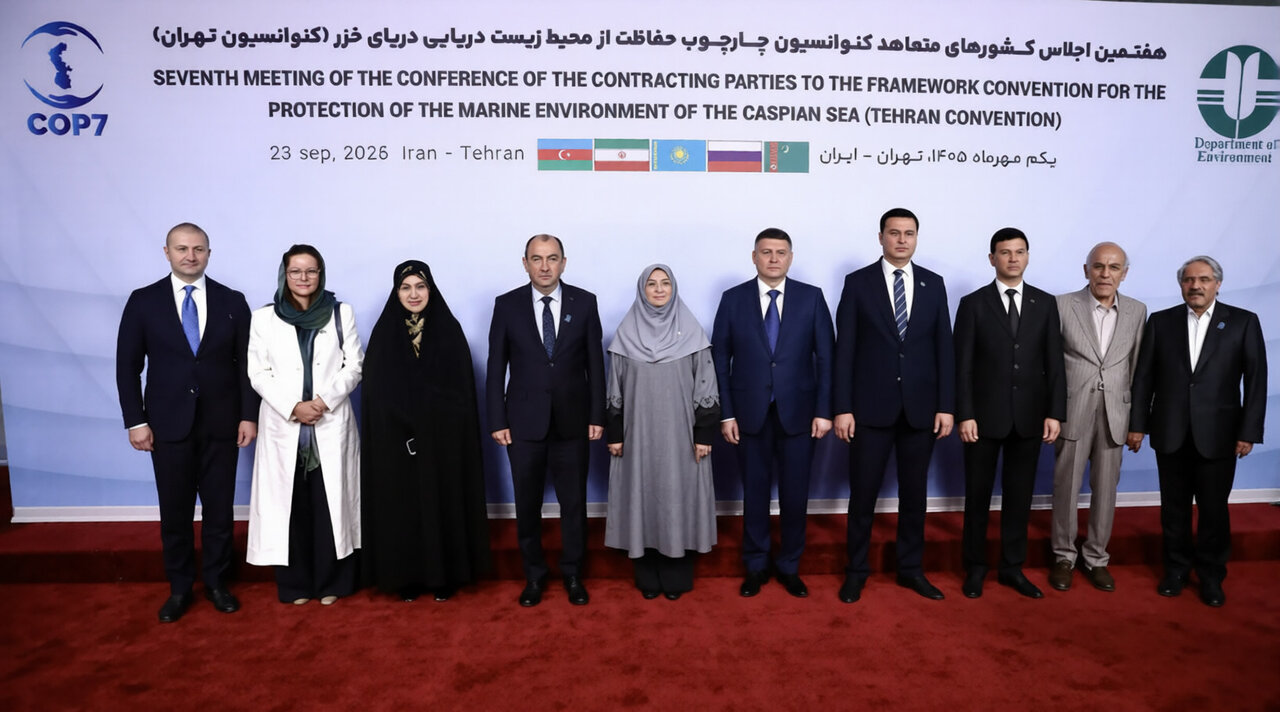
TEHRAN – “Five countries, one ecosystem, one future” was the message highlighted by Shina Ansari, head of Iran’s Department of Environment, at the seventh meeting of the Conference of the Parties (COP7) to the Tehran Convention on the Protection of the Marine Environment of the Caspian Sea in Tehran on Wednesday, underscoring the vital importance of preserving the Caspian Sea and its unique ecosystem for the present and future generations of the region.
Ansari said protecting the Caspian Sea is a shared and transboundary responsibility, stressing that the five littoral states must move from legal commitments to practical action, from fragmented information to shared data, and from national monitoring to coordinated regional monitoring. She called for greater use of science and technology to protect the shared ecosystem and build a more sustainable future.
Addressing the opening ceremony of COP7, Ansari welcomed officials and representatives from the Tehran Convention’s member states, the United Nations and international organizations, ambassadors, government officials, academics, experts, civil society representatives and members of the media. She described Tehran’s hosting of the meeting as an opportunity to renew the countries’ shared commitment to protecting the Caspian Sea and strengthening regional cooperation.
Referring to the significance of the Caspian Sea, Ansari said the body of water is “not merely a stretch of water,” but a shared heritage, an interconnected ecosystem and a vital asset for present and future generations.
The unique sea, with its rich biodiversity, is home to species such as the Caspian seal and constitutes one of the world’s most important breeding grounds for sturgeon. Millions of people living around the Caspian also depend on the health and sustainability of the sea for their livelihoods and future.
Ansari stressed that protecting the Caspian has become more than ever a shared and transboundary responsibility, noting that pollution from land-based sources, habitat degradation, pressure on biological resources, climate change and fluctuations in water levels are challenges that no single country can address alone.
She also referred to Iran’s experience over the past year, saying the Islamic Republic had faced aggression by the United States and Israel, during which, in addition to the loss of the lives of Iran’s leader and civilians, including women, men and children, infrastructure, scientific and medical centers, and historical heritage were damaged. She added that the environment, protected areas and some international environmental obligations and rules were also affected.
The head of the Department of Environment said explosions at fuel storage facilities in Tehran, which caused widespread pollution, as well as attacks on oil facilities in the Assaluyeh region, were examples of what she described as “ecocide” or environmental crimes.
“The environment is the silent victim of wars,” Ansari said, warning that water and soil pollution, damage to habitats and environmental infrastructure, and increased pressure on natural resources can leave the impacts of wars for years or even generations.
She stressed that environmental protection and strengthening ecosystem resilience should therefore be an integral part of countries’ efforts to promote peace, security and sustainable development.
Turning to the history of the Tehran Convention, Ansari said that in 2003, the five Caspian littoral states – Azerbaijan, Iran, Kazakhstan, Russia and Turkmenistan – established a common regional legal framework for protecting the Caspian Sea by signing the convention.
The agreement, she said, went beyond the signing of an international document and reflected the five countries’ shared determination to cooperate in protecting a common ecosystem.
Over more than two decades, cooperation among the littoral states has expanded into areas including oil pollution response, biodiversity conservation and transboundary environmental impact assessment, Ansari said, adding that the time had come to take another step forward.
She described “Five countries, one ecosystem, one future” as one of the central messages of the meeting, saying the phrase is more than a symbolic slogan.
“Five countries” represents a shared responsibility; “one ecosystem” reflects the scientific reality of the Caspian Sea’s interconnected nature; and “one future” serves as a reminder of the responsibility the countries have toward future generations, she explained.
Ansari emphasized that the fate of the Caspian cannot be divided along political borders, as water currents, biological species, pollution and climate change do not follow such boundaries.
“The future of the Caspian cannot be five separate futures; it is a shared future for all the littoral states,” she said.
According to Ansari, advanced technologies, including remote sensing, satellite monitoring, smart environmental systems, ecological modeling, shared databases and modern analytical and forecasting tools, offer valuable opportunities to better understand changes in the Caspian and respond more rapidly to emerging threats.
She said another message of the meeting could therefore be to move “together, with the support of science and technology, to protect the Caspian Sea ecosystem and build a more sustainable tomorrow,” stressing that the message must be translated into practical action.
Ansari called for stronger scientific data-sharing mechanisms, joint monitoring systems, regular assessments of the ecosystem’s condition, joint preparedness for pollution incidents, biodiversity conservation and measures to reduce the discharge of pollutants into the sea.
Emphasizing the littoral states’ responsibility toward future generations, she said their duty extends beyond the present generation.
“We are custodians of a sea that must be handed down to future generations healthier, more sustainable and more resilient,” Ansari said.
She added that Iran is ready to deepen cooperation with the Caspian littoral states, the Tehran Convention Secretariat, the United Nations Environment Programme (UNEP), scientific and research institutions, and other regional and international partners.
Ansari expressed hope that the decisions adopted at COP7 would not only reflect the shared political will of the littoral states, but also provide a clear roadmap for practical and measurable action to protect the Caspian Sea.
She concluded by expressing her appreciation to the littoral states, the Tehran Convention Secretariat, UNEP, experts, researchers, civil society organizations, local communities, the media and all institutions that have worked for more than two decades to protect the shared heritage.
“We hope the Caspian Sea will remain healthy, vibrant, sustainable and resilient – for today, tomorrow and generations to come,” she said.
Disclaimer : This story is auto aggregated by a computer programme and has not been created or edited by DOWNTHENEWS. Publisher: tehrantimes.com