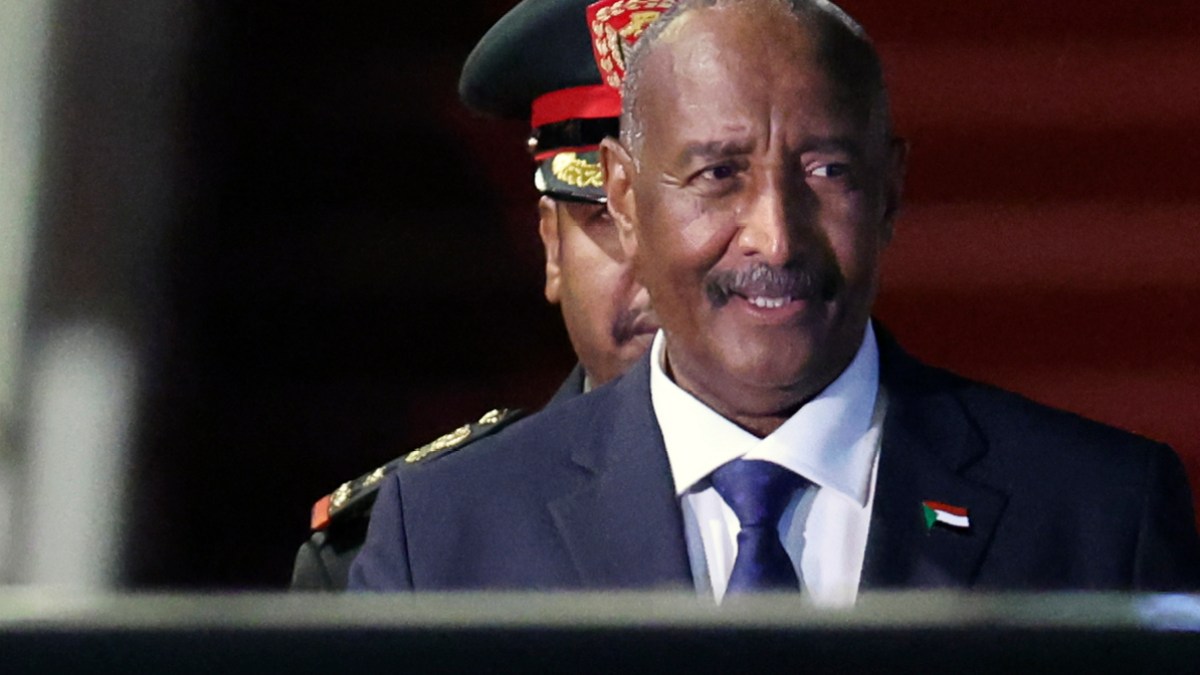
Sudanese activists and journalists have criticised the United States over reports that Washington has withheld a visa from army chief Abdel Fattah al-Burhan before the United Nations General Assembly in an apparent bid to pressure him into accepting a ceasefire proposal.
Activists took to social media on Wednesday to slam the reported move as “political pressure”, arguing that access to the UN should not be used to influence Khartoum’s position on Sudan’s three-year civil war.
Recommended Stories
list of 4 itemsend of list
Neither the Sudanese government nor the US Department of State has commented on the reports.
General al-Burhan, whose army has been fighting the paramilitary Rapid Support Forces (RSF) since April 2023, was scheduled to address the General Assembly on Thursday in New York. The army chief has spoken at the assembly twice since the war began.
The conflict has killed more than 200,000 people, according to aid worker estimates, and caused the world’s largest hunger and displacement crises.
The Reuters news agency, citing Sudanese sources, reported on Tuesday that the US was withholding al-Burhan’s visa and had made its issuance contingent on him agreeing to a 90-day ceasefire proposed by Massad Boulos, US senior adviser for Arab and African affairs.
The AFP news agency, quoting two diplomatic sources, also reported that Washington refused to issue the visa. One source called the move a “clear violation of the UN’s agreement with the US” while another said the visa had been “conditioned” on al-Burhan accepting the three-month truce.
Advertisement
‘Political pressure’
Sudan’s UN ambassador, Al-Harith Idriss Al-Harith, wrote to Secretary-General Antonio Guterres to request the UN’s “immediate intervention” with US authorities, according to Reuters.
Stephane Dujarric, a spokesman for Guterres, said the UN chief was “deeply concerned” that the visa had reportedly not been issued. He told the AFP that the UN Secretariat has urged the US, as host country, to ensure visas were issued in accordance with its obligations under the UN Headquarters Agreement and in time for al-Burhan to participate in the General Assembly.
Sudanese activist Mamoun al-Sheikh denounced the US move in a post on Facebook, saying: “Even if the visa is withheld, it will not silence Sudan’s voice.”
Another activist, Sayed Al-Mazaj, described linking the visa to a proposed 90-day ceasefire as “a tool for political pressure”. And in a video posted on X, Sudanese journalist Diaa Al-Din Bilal said barring al-Burhan from New York would not force him to accept the US position and could instead boost his popularity and rally support around him.
Another X user, @Atifazhri, also denounced the US move, noting that Israeli Prime Minister Benjamin Netanyahu, who is wanted by the International Criminal Court on charges of war crimes in Gaza, had been granted a visa.
“The issue is double standards – when visas become instruments of political coercion against a sovereign state while far more serious cases are treated differently. International law and justice cannot be applied selectively,” the user wrote.
US questions al-Burhan’s legitimacy
The State Department issued a statement on Tuesday that did not directly address al-Burhan’s visa but called into question his legitimacy. Its spokesman Tommy Pigott said neither the Sudanese army nor the RSF “nor their respective leaders, represent legitimate, constitutional governance for Sudan”.
He added the US would “seek to raise the cost of continued conflict on all belligerents”.
Sudan’s Ministry of Foreign Affairs hit back on Wednesday, calling on the US to engage positively with the country’s government. Any peace initiative, it said, must “be grounded in respect for Sudan’s sovereignty, unity, territorial integrity, and legitimate national institutions”.
“It must also address the root causes of the war’s continuation — foremost among them, negative foreign interference,” the ministry added.
Al-Burhan has been Sudan’s de facto leader since 2019 although the African Union and Western powers withdrew recognition after a 2021 coup that he led with Mohamed Hamdan Dagalo, the RSF’s leader, against the civilian leadership.
Advertisement
He has rejected externally imposed ceasefires, arguing that earlier pauses in the fighting benefitted the paramilitary group.
The US has also refused visas to Palestinian Authority President Mahmoud Abbas and some members of Iran’s delegation to the UN.
Disclaimer : This story is auto aggregated by a computer programme and has not been created or edited by DOWNTHENEWS. Publisher: aljazeera.com