
Swinney backs decriminalisation of drugs after spike in deaths
-
Published
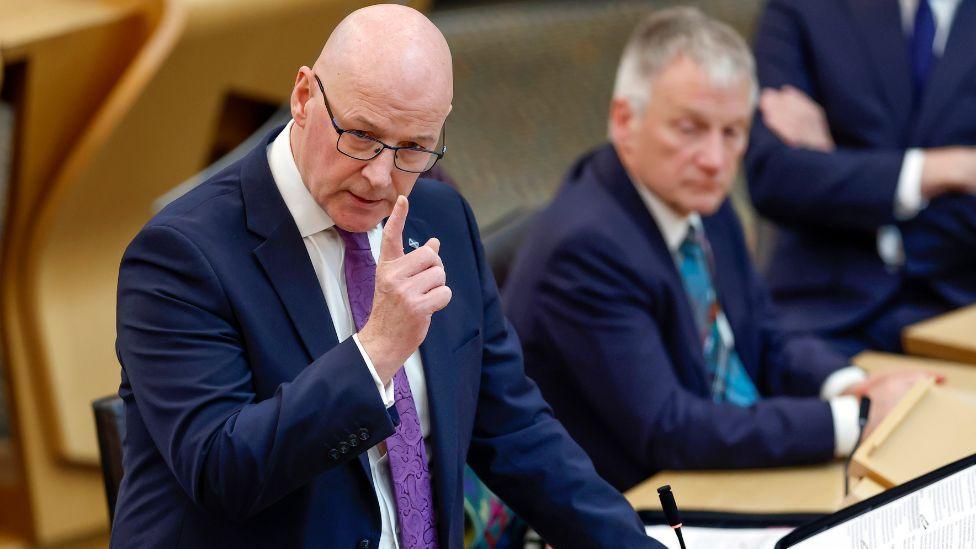
First Minister John Swinney has reaffirmed his government’s support for decriminalising all drugs for personal use following a spike in drugs deaths.
Scotland has retained its grim moniker as Europe’s drugs deaths capital after it was revealed there were 1,133 fatalities related to illicit drugs last year, a rise of 116 (11%) on 2024.
Swinney described the rise as “unacceptable and intolerable”, but opposition leaders rounded on the first minister, calling his record “indefensible”.
The UK government, which controls drugs policy, would have to agree to decriminalisation for it to be rolled out in Scotland.
At First Minister’s Questions, Swinney expressed his “deepest sympathies” to all those who had lost a loved one as he cited “intergenerational poverty and trauma” and an “upsurge in grossly harmful synthetics” as reasons for the rise in deaths.
Afterwards, he told BBC Scotland News that his government was in favour of decriminalisation – meaning people would not face criminal punishment for having drugs for personal use.
He said the move could be part of a range of measures which would offer “more control and ability to provide greater support to those affected by drugs use”.
The Scottish government, under the leadership of Humza Yousaf, announced in 2023 that it supported decriminalising personal drug use. The UK government rejected the plan as dangerous.
The SNP included the policy in its 2024 manifesto, with the party pointing to the example of Portugal, which relaxed drugs laws in 2001, as a potential model.
Swinney said his administration’s current approach was “testing to the limits what we can do in Scotland”.
This has included setting up the UK’s first safer consumption facility in Glasgow – which allows drug users to inject heroin or cocaine while under medical supervision.
Ministers have also announced that the country’s first drugs-checking facility will soon open in the city.
More than 11,000 drugs-related deaths have been recorded in Scotland over the past decade.
The crisis has been worsened by the emergence of dealers mixing powerful synthetic opioids with heroin, cocaine and other dangerous drugs.
National Records of Scotland (NRS) said last year’s increase was driven by a rise in fatalities among males, with drug-related deaths in the most deprived areas 15 times as high as in the least deprived areas.
The most recent comparable data from 2024 shows that Scotland had an age-adjusted death rate of 216 per million compared with 91 for England, 140 for Wales and 135 for Northern Ireland.
New Scottish Labour leader Michael Marra described the government’s record as “indefensible”, but said his party would work with ministers on finding solutions.
He told MSPs: “If this was a middle-class epidemic, we would have locked down, legislated, found the money, educated widely and reformed indiscriminately.
“Nothing near that scale has happened.”
Swinney agreed that parties should work together, and pointed to his focus on eradicating child poverty – saying that “we have to interrupt the circumstances that are feeding and refeeding this crisis in our society”.
Scottish Conservative leader Russell Findlay urged the government to close its safer consumption facility – highlighting that deaths in the Glasgow had increased since it opened.
He told MSPs that the government’s approach was sending thousands of drug users “to an early grave by pedalling the lie that inherently dangerous drugs can be taken safely”.
Swinney said Findlay was “plain wrong”, adding that more people would have died without the Glasgow facility.
National mission ‘has failed’
Scottish Liberal Democrat leader Alex Cole-Hamilton said he had warned over a “spike in synthetics” three years ago.
“Back then, these drugs were connected to just nine deaths in Scotland. Last year, they took the lives of 247 people.”
He added: “It begs the question of the first minister, if this truly is the SNP’s national mission, why has it failed?”
Reform UK Scotland leader Malcom Offord said the government’s “national mission on drugs has collapsed”, adding that “the blame lies squarely on the SNP”.
Reform subsequently lodged a motion of no confidence in Alcohol and Drugs Minister Maree Todd, saying that “bereaved families want someone in government to finally be held accountable”.
The UK government has been asked to comment.
-
-
Published22 August 2023
-
Disclaimer : This story is auto aggregated by a computer programme and has not been created or edited by DOWNTHENEWS. Publisher: BBC




