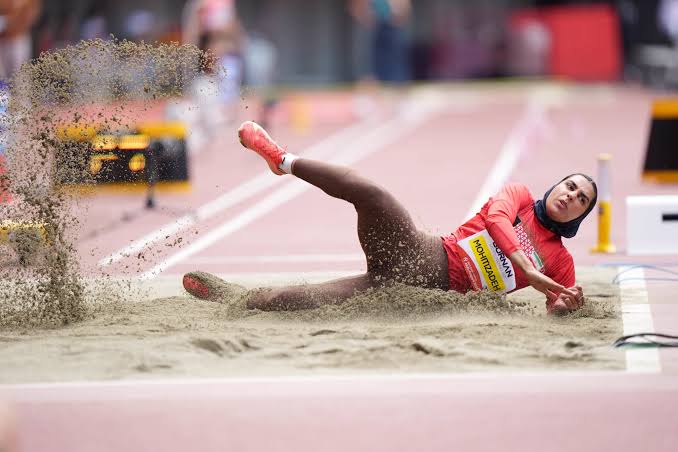
Years of training can come down to the smallest of margins in elite sport, 100 grams on the scales, a millimetre on a spike or a fraction of a second at the start. When the rulebook draws the line, even the tiniest breach can turn a winning performance into a disqualification.
Cost of a tiny margin
Iranian heptathlete Fatemeh Mohitizadeh knows how brutally small margins can be. At the 2026 Asian Games in Aichi-Nagoya, she led the heptathlon after Day 1 with 3,486 points and was firmly in medal contention. But her 5.97m long-jump effort was annulled after officials ruled that her footwear did not meet competition regulations. Her medal campaign was undone not by her performance, but by a technical violation involving her shoes.
It is a familiar story in elite sport. At the Paris Olympics, Vinesh Phogat was disqualified from the 50kg wrestling final after being found 100 grams over the weight limit. And the margins can be even smaller. At the 2026 Winter Olympics, American ski jumper Annika Belshaw was disqualified after her skis were found to be one centimetre longer than permitted, while Austrian ski jumper Daniel Tschofenig was disqualified after his boots exceeded the permitted size by four millimetres. In elite sport, sometimes the rulebook can be as unforgiving as the competition itself.
Equipment becomes part of the competition
The fine print can be just as decisive on two wheels. Dutch sprinter Lorena Wiebes faced a similar equipment-related setback at the 2026 Giro d’Italia Women. She won the opening stage and initially took the race leader’s jersey, but was later disqualified after her bicycle was found to be approximately 20 grams below the UCI’s 6.8kg minimum weight.
One false start, one costly celebration
Sometimes, the athlete’s own actions or technique become the deciding factor.
At the 2011 World Championships, sprint great Usain Bolt was disqualified from the 100m final after a false start. Under the rules, an athlete who starts before the gun is disqualified, meaning a fraction-of-a-second mistake can end a race before it has properly begun.
At the 2025 Asian Athletics Championships in Gumi, South Korea, India’s men’s 4x100m relay team finished second in its heat but was later disqualified after officials ruled that a baton exchange took place outside the designated takeover zone. A strong race was undone by a technicality measured in just a few metres.
French steeplechaser Mahiedine Mekhissi-Benabbad discovered that even a celebration could have consequences. After winning the 3,000m steeplechase at the 2014 European Championships, he removed his shirt before crossing the finish line. Following a protest, he was disqualified and the gold medal was reassigned.
Details still matter
For India’s shooter Manu Bhaker, the issue was far less consequential — but still highlighted the importance of getting the details right. At the 2026 Asian Games opening ceremony, she reportedly wore borrowed ceremonial clothing because the kit provided to her did not fit, while her father reportedly said the supplied shoes were also the wrong size.
There was no medal at stake and no sporting penalty. Yet the episode highlighted the same basic truth: in elite sport, details matter.
Athletes spend years training to control everything they can — their weight, technique, timing, equipment and preparation. But sometimes, sport can still come down to something an athlete cannot afford to overlook.
“THERE IS NO SUCH THING AS A MINOR VIOLATION”
Adille Sumariwalla, Olympian and Arjuna Awardee, former President of the Athletics Federation of India (AFI), and Vice President of World Athletics, on why elite sport cannot have grey areas when rules decide results. “What is a minor violation? If you say 100 grams is minor, what about 101 grams? If a spike is one millimetre bigger, what about two millimetres? Where do you draw the line?
In sport, rules are either followed or they are not. There are very clear demarcations. There can be no ambiguity because the rule has to be equal for everybody. If you give somebody a leeway of one millimetre, why not two?
It simply doesn’t work. In the case of footwear, the regulations are published and athletes know which shoes are permitted and what the specifications are. There is no excuse for not knowing the rules at that level.
Look at Vinesh Phogat — if an athlete is even 100 grams over the weight limit, the rule applies. If Sachin Tendulkar is one millimetre outside the crease, he is out. Out is out.
That is why rules exist. If a long-jump board is cut by even one millimetre beyond what is permitted, it is a foul. Sports is very different from everyday life — there are rules, and they are not negotiable.”
Disclaimer : This story is auto aggregated by a computer programme and has not been created or edited by DOWNTHENEWS. Publisher: deccanchronicle.com