TEHRAN — The United States expanded its economic warfare against Iran into Iraqi airspace this week. Baghdad complied. Resistance factions immediately pushed back.
Following a September 8 U.S. Treasury threat to impose secondary sanctions on any airport servicing 27 Iranian airlines, the Iraqi government ordered aviation authorities in Baghdad, Najaf, Erbil, Sulaymaniyah, and Kirkuk to suspend all Iranian flights. Najaf International Airport grounded operations in the early hours of Friday.
The closures have stranded thousands of religious pilgrims, students, and medical patients.
They have also sparked an immediate backlash from Islamic Resistance groups. Factions view the shutdown as a direct extension of the U.S.-Israeli military and economic campaign designed to weaken the Resistance Front.
Threatening sit-ins and seeking fatwas
Harakat Hezbollah al-Nujaba Secretary-General Akram al-Kaabi promised direct action on Friday. He vowed his group will organize sit-ins at airports across the country unless normal air traffic resumes.
“We will not wait long,” Kaabi warned, condemning political forces that tolerate American dominance.
Kata’ib Sayyid al-Shuhada leader Abu Ala al-Walai urged the Iraqi parliament to pass a resolution rejecting the U.S. dictates, citing Russia and China as models of state independence.
He described Baghdad’s compliance as a betrayal of religious heritage. “It is not fitting for the Iraq of [Imam] Hussein [AS] to be part of an unjust siege on Iran, the land of knowledge and jihad,” al-Walai stated.
Kata’ib Hezbollah escalated the pushback by requesting Shia religious authorities issue a fatwa determining whether it is religiously permissible to help an enemy besiege the Iranian people.
The group urged citizens to circumvent the embargo directly by purchasing Iranian commodities.
Hadi al-Amiri, Secretary-General of the Badr Organization, condemned the unjust siege and said the government must not submit, calling it the first test for achieving full and comprehensive sovereignty.
Street protests and the fallout
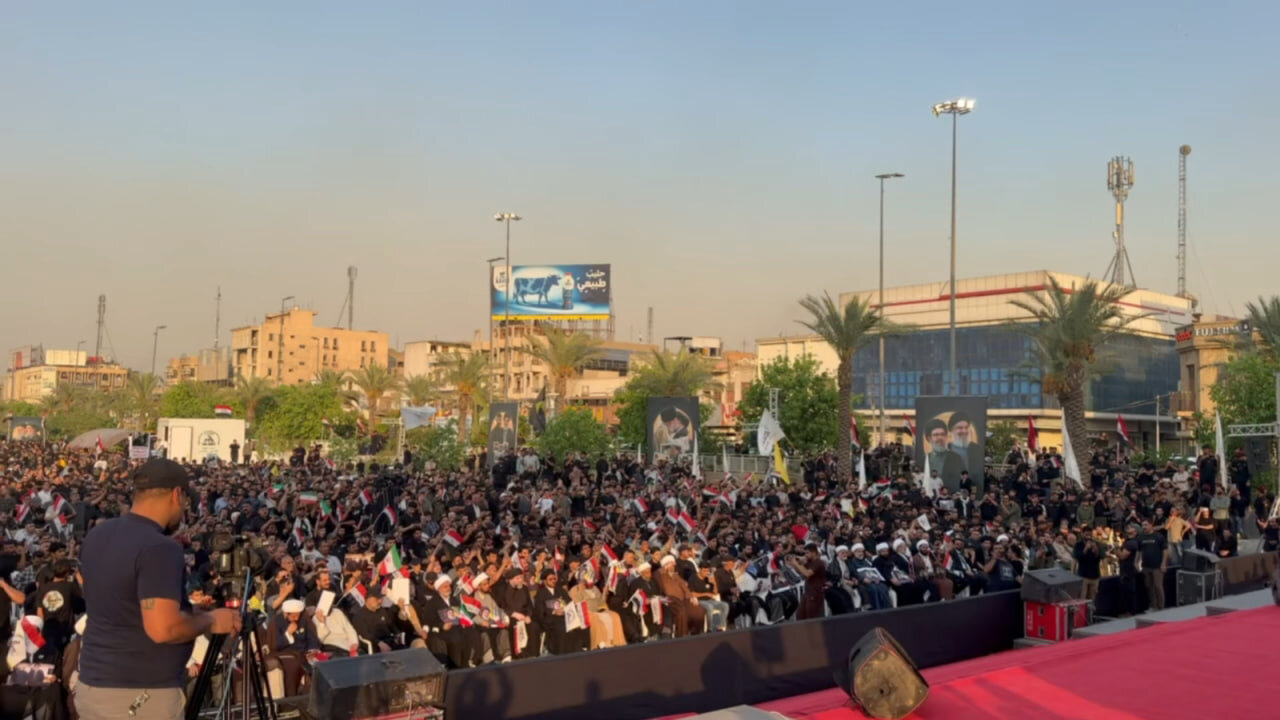
Public anger materialized quickly. Demonstrators in Basra gathered near the airport and surrounded a grounded Iranian passenger aircraft.
Crowds in central Baghdad chanted against the siege, directing their anger at Prime Minister Ali al-Zaidi.
Lawmakers are rebelling against the executive order. First Deputy Speaker Adnan Faihan declared the flight ban unconstitutional on Saturday. He outlined the material risks of isolating an ally.
Faihan warned that if Tehran retaliates by cutting natural gas exports, Iraq will lose up to 40 percent of its national power grid capacity. Basra parliamentarians gave the government 48 hours to explain the decision, gathering signatures for an emergency legislative session.
Senior political figures joined the dissent. Former Prime Minister Adel Abdul Mahdi labeled the closure a major mistake against an allied neighbor.
The office of Marjaa Sayyed Mohammad Taqi al-Modarresi condemned the capitulation, while Sayyed Abdul Qader al-Hassani al-Alousi described the ban as a historic error striking at Iraq’s religious identity.
The al-Zaidi government is attempting to manage the fallout. The prime minister’s office claims it is holding direct talks with Washington to secure exemptions for medical and religious travel. Yet Baghdad’s submission has yielded no financial relief, according to a report by Tasnim News Agency.
The U.S. Federal Reserve continues to block regular dollar cash transfers to Iraq despite the government’s enforcement of the aviation ban.
Trump has repeatedly said he approves of the conduct of Iraq’s new head of state, declaring that al-Zaidi is “a fantastic man.”
Disclaimer : This story is auto aggregated by a computer programme and has not been created or edited by DOWNTHENEWS. Publisher: tehrantimes.com