Suttinee Yuvejwattana and Brian K. Sullivan
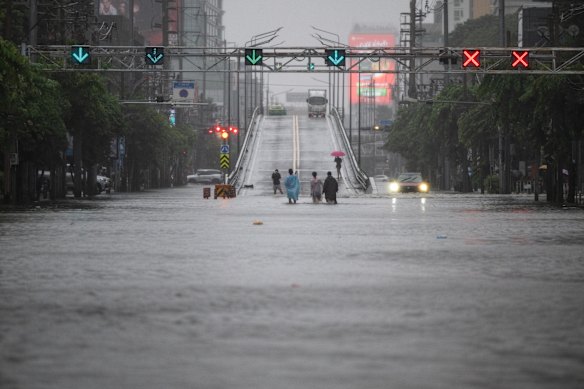
Bangkok/Boston: Thailand’s capital declared all 50 of its districts disaster zones after nearly 300 millimetres of rain pounded Bangkok in about 48 hours, flooding major roads and prompting the governor to urge residents to stay home.
Rainfall since late Thursday dumped the equivalent of about 30 million cubic metres of water on Bangkok, with eastern parts of the city among the worst-hit, Governor Chadchart Sittipunt said in a statement on Saturday (Bangkok time).
Meanwhile, in the US Northeast, a powerful nor’easter has knocked out power to thousands of homes and businesses, grounding hundreds of flights and prompting state leaders to declare emergencies. Two weekend concerts by pop star Ed Sheeran at Gillette Stadium outside Boston were cancelled as a precaution.
Bangkok disaster area expanded
Bangkok is operating pumps at their combined capacity of 1200 cubic metres a second and has prepared 1 million sandbags. Municipal schools were being opened as temporary shelters, while officials had been deployed to assist vulnerable residents, including bedridden patients, according to the governor’s statement.
Thailand’s Meteorological Department warned that the deluge, which has been pouring since Thursday afternoon, would continue in most parts of the country through Sunday.
Bangkok’s disaster declaration expands the designated area from three districts to the entire capital, allowing authorities to co-ordinate assistance and deploy resources more quickly.
Thai Prime Minister Anutin Charnvirakul, who was due to return to Bangkok on Sunday from an overseas trip, said in a Facebook post that he would soon visit the affected areas.
New York, New Jersey declare emergencies
In the US, high winds battered the coast from Delaware to Massachusetts, and conditions were expected to get worse in New York City as the day wore on, said Bob Oravec, a senior forecaster with the US Weather Prediction Centre on Saturday (US time).
Storm surges are expected to raise ocean levels by almost a metre along the New Jersey and New York coast, and even higher across New England.
“The worst effects of it are tonight into Sunday morning, anywhere from southern New England west across Long Island toward New York City,” Oravec said. “The coastal flooding will be the biggest flooding impact for this.”
New York Governor Kathy Hochul declared an emergency in New York City and the surrounding areas on Friday as the storm developed, and New Jersey Governor Mikie Sherrill did the same for her state. From Massachusetts to Maryland, 101,674 homes and businesses were without power, with areas in Queens, Long Island and along the New Jersey coast among the hardest-hit, according to Poweroutage.com.
Across the US, 425 flights were cancelled, mostly from Boston’s Logan International Airport and other Massachusetts fields, FlightAware said. At least 15 flights were also cancelled from New York’s LaGuardia Airport. Ground stops and delays were likely in Newark, Philadelphia, Washington, and at John F. Kennedy International Airport as well, the Federal Aviation Administration said on its website.
The National Weather Service issued coastal flood warnings and watches, including for New York City. From the coast in New England through the New Jersey coast, wind gusts could reach 97km/h.
Oravec said the storm would remain intense in New York and New England through Sunday but will weaken by Monday morning.
Hurricane Nolo could unleash flooding, mudslides
Meanwhile, Hurricane Nolo just skirted the Hawaiian Islands as it gained intensity on Saturday, but officials said it still posed a risk for flash floods, dangerous winds and extreme surf in areas recovering from previous storms.
Nolo was churning very slowly south of the Big Island with maximum sustained winds of 150km/h. Its centre was about 260 kilometres south-southwest of Hawaii’s southernmost point, and it was forecast to strengthen into a major hurricane through the weekend while travelling westward to the south of the islands.
A hurricane watch was cancelled, and direct landfall by the storm’s centre was not expected. But forecasters said its outer bands could cause life-threatening flooding and mudslides, with parts of the Big Island expected to see rainfall totals up to 51 centimetres. Heavy rain was also expected on the other islands.
Bloomberg, AP
Get a note directly from our foreign correspondents on what’s making headlines around the world. Sign up for our weekly What in the World newsletter.
From our partners
Disclaimer : This story is auto aggregated by a computer programme and has not been created or edited by DOWNTHENEWS. Publisher: www.smh.com.au