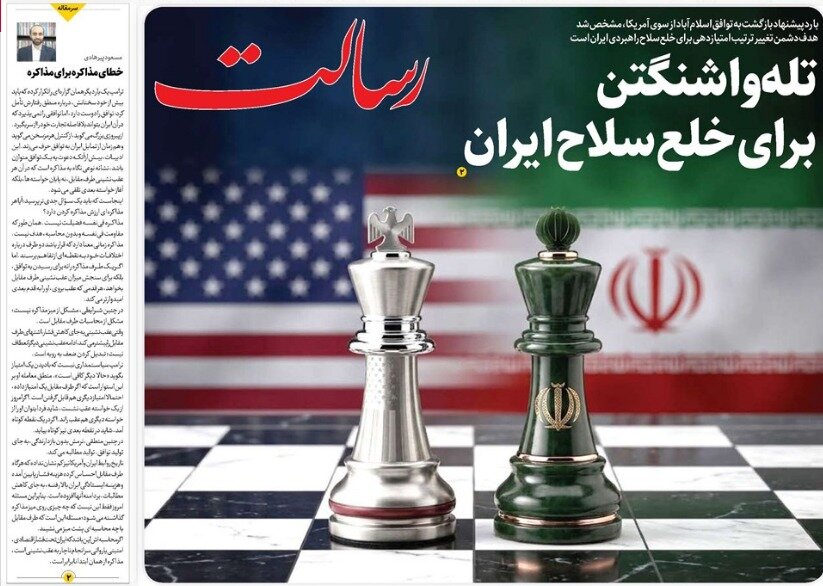
Resalat highlighted the Iranian president’s forceful speech at the United Nations. The main message of the developments and speeches in New York can be summarized in one key proposition: the era of unipolar order and cost-free bullying has come to an end. Iran does not welcome war, but it will not compromise when it comes to defending its dignity and independence.
Iran has extended a hand of cooperation to the world and seeks an international order based on justice, equality among nations, and the rejection of double standards; a world in which nuclear weapons do not provide immunity to Israel’s apartheid regime, while Iran’s peaceful scientific and technological development is not met with sanctions and threats. If the United States wishes to escape this self-created quagmire, it has no choice but to recognize the new balance of power in West Asia and accept the legitimate rights of the Iranian nation.
Kayhan: Positive signals should not be sent to negotiations
In an interview with Foad Izadi, an expert on US affairs, Kayhan examined American hostile policies toward Iran and their impact on the region. There is a view in the United States that maritime and air blockades, along with its current policies, are effective tools. This is why, while the Iranian negotiating delegation was in New York, the United States initiated an air blockade before the delegation could return home. American assessments recognize the capability and resilience of Iran’s military forces, believing they will not surrender. However, some US policymakers perceive certain Iranian political figures as having no option but negotiation. As long as this perception remains unchanged, the threat of war will persist, and American hostile policies will continue to escalate. Therefore, the best course of action for some Iranian officials is to avoid sending positive signals regarding negotiations, since the approach pursued by some political figures so far has produced the opposite of the intended results.
Ettelaat: Rejection of Iran’s proposal or progress in negotiations?
Ettelaat discussed the decision by Iranian Foreign Minister Abbas Araghchi and his accompanying negotiating team to remain in New York until Wednesday. After the first meeting between Araghchi and Steve Witkoff, the US representative, Iranian technical experts joined the talks. During these negotiations, Iran proposed a plan to reopen the Strait of Hormuz within seven days if the maritime blockade were lifted. The paper suggested that, should negotiations advance further, meetings between Iranian and American officials could be held with mediation from Qatar or Oman. Nevertheless, it remains to be seen in which direction the New York discussions will move and which account of the negotiations more closely reflects reality, especially as the maritime blockade has been intensified by an air blockade and the economic consequences are rapidly becoming visible.
Arman-e-Melli: The efforts of mediators
Arman-e-Melli focused on efforts by mediators to revive negotiations between Iran and the United States. While many international media outlets and observers interpret recent developments as evidence of heightened tensions between Tehran and Washington, others believe that the positions and activities taking place on the sidelines of the UN gathering could mark the beginning of a renewed negotiating process and a way out of the current situation. The main mediators between Iran and the United States, namely Qatar and Pakistan, are seeking to use the opportunity provided by the UN General Assembly to help resolve the current dispute. In their view, the presence in New York of leaders and foreign ministers creates an opportunity for message exchanges and bilateral or multilateral consultations that could help steer the present deadlock toward negotiations. The outcome of Iran’s proposed plan and the US response to it are issues whose implications may become clearer in the near future.
Shargh: Playing the oil card
In an explanation, Shargh addressed the uncertainty surrounding the prospects of war or negotiations. Oil prices have surpassed $100 per barrel, at a time when the outlook for conflict in the Persian Gulf remains uncertain. Meanwhile, the world’s two largest economies, the United States and China, are paying particularly close attention to oil prices. According to forecasts by some oil-tanker tracking institutions, Iranian crude oil exports to China, its largest and nearly sole oil customer, had declined significantly by late September. Nevertheless, during the recent meeting between Trump and Xi Jinping, virtually no discussion reportedly took place regarding the Iran conflict or oil prices. At the same time, Iran has put forward a new seven-point proposal aimed at reviving negotiations, while reports suggest that China has urged Iran to reopen the Strait of Hormuz and return to talks. Despite all these developments, the future of negotiations, the possibility of continued conflict, and the direction of the oil market remain more uncertain than ever.
Disclaimer : This story is auto aggregated by a computer programme and has not been created or edited by DOWNTHENEWS. Publisher: tehrantimes.com