
The disaster began with a low-pressure system building in the Great Australian Bight. It was a one-in-50-year event. When it tore across South Australia on September 28, 2016, it unleashed havoc that no one had anticipated.
A string of supercell thunderstorms not only dumped sheets of hail and rain; tornadoes unspooled from their vast bellies.
One carved through Wilmington, a town on the route between Adelaide and Port Augusta. It tore down gum trees and caused a farm shed to collapse. More crucially, it cut critical transmission lines and demolished five transmission towers.
Almost 20 more of these steel giants soon went down across the state. More than 80,000 lightening strikes were recorded. By around 3.50pm, South Australia was effectively isolated from the rest of the grid and out of power.
For some, the power was back up within eight hours but for others, it would take days. At the Flinders Medical Centre, a diesel back-up failed and 17 intensive care patients had to be moved. Embryos at a fertility clinic were lost and the contents of a zinc smelter at Port Pirie cooled and solidified.
Before the rain stopped falling, the blackout was fodder for Australia’s unceasing culture warfare over climate and energy policy, with Barnaby Joyce and then SA independent Senator Nick Xenophon at once blaming intermittent wind power for the blackout.
SA’s then premier, Jay Weatherill, pushed back. “For people to be saying those things without being actually appraised of all the facts demonstrates that people are using this to play politics instead of responding to what is a state emergency,” he said that night. Later he would later make the case that storms, not the state’s rapid deployment renewables caused the blackouts.
Over the following days, the disaster became something like a policy Rorschach test. Josh Frydenberg, then federal energy minister, blamed over-reliance on renewables in SA, since some wind farms had automatically shut down to protect themselves once the transmission lines went down. One Nation’s Malcolm Roberts called for all Australian governments to “exit all climate change policies”.
The political combat dragged on over coming months as heatwaves rolled across the continent and fears of shortages grew. Then, in March 2017, Lyndon Rive, Tesla’s vice-president for energy products, at the time visiting Australia, boasted that his company could alleviate SA’s immediate problems by building a giant battery, and it could do so within 100 days of a signing a contract for less than $100 million.
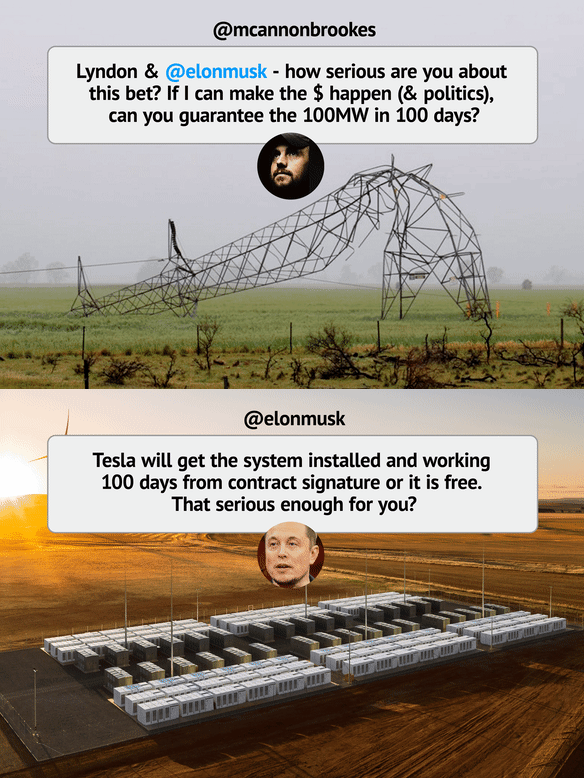
The Atlassian co-founder Mike Cannon-Brookes saw the boast reported in the Australian Financial Review and addressed a tweet directly to Tesla’s boss, Elon Musk.
“”Holy s#%t”, he wrote. “Lyndon & @elonmusk – how serious are you about this bet? If I can make the $ happen (& politics), can you guarantee the 100MW in 100 days?”
Musk took up the challenge. “Tesla will get the system installed and working 100 days from contract signature or it is free. That serious enough for you?” he replied.
In the end, the battery was built in 63 days from the signing of the contract, and the consequences of the challenge are hard to exaggerate.
At the time, any grid-scale power infrastructure took years of planning and then years of construction, and cost eye-bleeding sums, but in 2017, the cost of batteries had started to fall after Tesla’s completion of its vast $US5 billion gigafactory in Nevada.
A big battery of the sort Musk was proposing is basically a bunch of car batteries strung together. What is now known as the Hornsdale Power Reserve proved that grid infrastructure could now be made from off-the-shelf parts at speeds previously unimaginable.
Jean-Christophe Cheylus, chief executive of Neoen Australia and New Zealand, the French-based renewables company which built and operates Hornsdale, said the speed of the project depended on the “perfect alignment of many planets”.
Though unproven at grid-scale, the technology was already readily available. Neoen happened to have a spare main transformer – a piece of kit that can take months to secure – in Australia at the time, the SA government issued planning approvals at high-speed and federal regulatory agencies backed the scheme. Having been spurred into action by a bet, Elon Musk flew Tesla packs to Australia rather than waiting on shipping.
“Everyone was very, very curious and willing to do it because it was a world first,” said Cheylus.
Following testing, the Hornsdale big battery was officially opened next to a wind farm 200 kilometres north of Adelaide on December 1, 2017. With a capacity of 100 MW, it was around three times the size of any other lithium-ion battery installation operating in the world at the time.
Soon after the battery began operating other benefits became clear, too, explains the Grattan Institute’s Tony Wood. Like other storage technologies, it can soak up cheap energy during the day when renewables are abundant and sell it back into the grid during the evening peak, but Hornsdale could do far more than that.
Traditionally, coal and gas fired power stations have not only made power, but help stabilise the frequency of electricity streaming through a grid with their vast spinning turbines. Hornsdale demonstrated that big batteries could provide what is known as “virtual inertia”, detecting potentially destabilising shifts in frequency injecting stabilising electricity in the system in milliseconds, cheaper and faster than the big old spinning machines.
Early reports said Hornsdale saved consumers $40 million in 2018 and $160 million in 2019 via these so-called Frequency Control Ancillary Services. On one occasion when the state was “islanded” from the rest of the national grid due to instability, Hornsdale’s FCAS capability saved $14 million in just five hours.
Former prime minister Malcolm Turnbull recalls the SA storm as a watershed moment for Australia. It drove him to push for the Snowy Hydro 2.0 scheme to serve as a giant battery to store the nation’s growing renewables supply.
“South Australia was a big wake-up call for me because it made me realise that we were rolling out variable renewables without any real consideration about how they should integrate with the grid.
“No consideration was being given to the issue of storage, and in those days, batteries were nowhere near where they are today. It was a very, very important moment, to make us realise that if we were going to move into a grid where most of our primary generation was from solar and wind, we were going to need a lot of storage.”
As Snowy Hydro works towards completion of its delayed mega-scheme, Australia already leads the world in the per capita use of both domestic and grid-scale batteries.
Neoen boss Cheylus said that once Hornsdale served as proof of concept, competitors in Australia began exploring grid-scale batteries, as did operators across the world. There is now so much battery capacity in Australia that it is beginning to displace more expensive gas during the evening peak, driving down power costs.
“The significant increase in large-scale and household battery capacity is changing how electricity is produced, consumed and priced across the day,” AEMO executive general manager of policy Violette Mouchaileh said in April, when it reported that Australia’s battery boom had allowed capacity to double over the previous year.
During the March quarter, grid-scale batteries set prices across the grid nearly a third of the time, it said, while gas-powered generation was squeezed to its lowest quarterly average since 1999, and coal-fired power fell to a record-low first-quarter contribution.
According to Atlassian’s Mike Cannon-Brookes, Hornsdale proved that big batteries could do crucial work once reserved for coal. “Ten years on, Australia has more grid-scale battery capacity per person than any other major economy, and last week we hit a record 80 per cent of renewable energy on the national grid.
“That’s awesome progress but we need to keep building. We need more storage, more transmission and a stronger grid – that’s how Australia becomes a more prosperous and secure renewable energy superpower.”
Greg Bourne, a councillor at the Climate Council and former regional president of BP Australasia, said the “entrepreneurial spirit” with which Hornsdale was championed by the billionaires behind the bet, but also by governments and agencies, proved to be defining.
“On the one hand you’ve got those who were embracing the future; on the other, you had those who still wanted to hug the past.”
Get to the heart of what’s happening with climate change and the environment. Sign up for our fortnightly Environment newsletter.
 Nick O’Malley is National Environment and Climate Editor for The Sydney Morning Herald and The Age. He is also a senior writer and a former US correspondent.Connect via email.
From our partners
Disclaimer : This story is auto aggregated by a computer programme and has not been created or edited by DOWNTHENEWS. Publisher: www.smh.com.au