“Your worth is not decided by an exam, a rank, or a result. It is decided by who you are when all of that is taken away.”
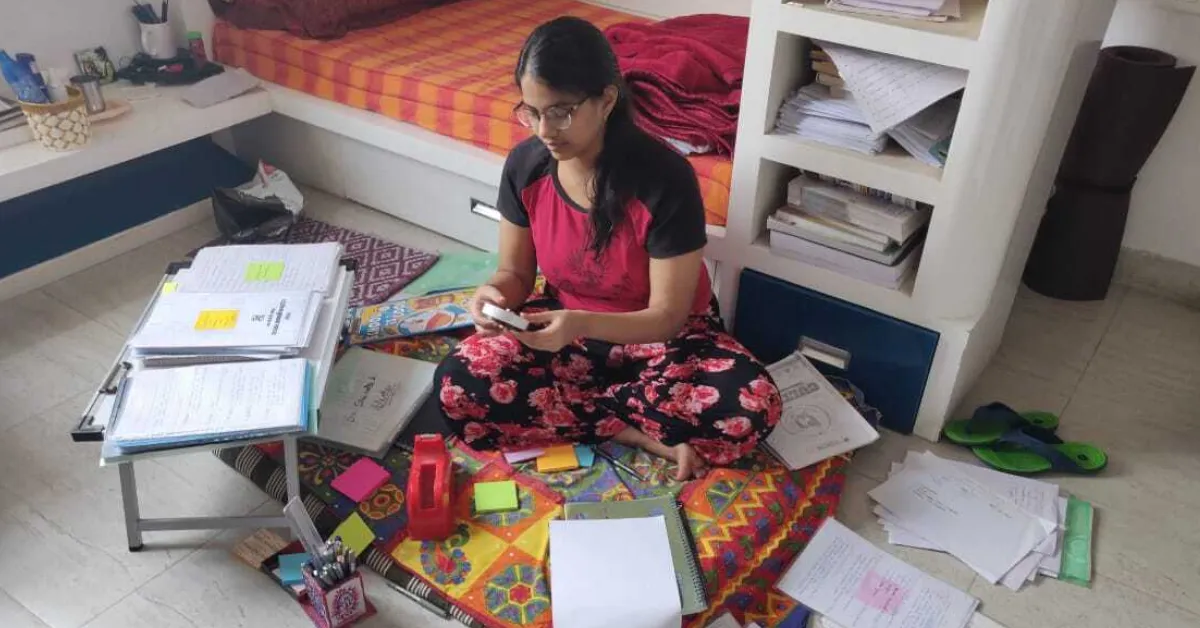
On the day the UPSC results were announced in 2024, Shruti Shrivastava balanced her phone against a stack of books and pressed record. After seven years of preparation, six attempts, four prelims cleared and one interview, she wanted to save the moment she saw her name on the final list.
Instead, the camera recorded heartbreak. As the list loaded, confidence gave way to disbelief. Then silence.
Her name wasn’t there.
“I genuinely thought I had made it,” she says. “The interview had gone well. I had worked harder than ever before. When I couldn’t find my name, it felt like the ground disappeared beneath me.”
For days afterwards, she barely left her room.
The grief wasn’t only about losing a future she had imagined for nearly a decade and questioning her own worth.
Today, she leads ‘Sashaktikaran Foundation’ in Bhopal, working with over 800 rural children and helping around 30 women build sustainable livelihoods.
She calls it a process of grieving, healing, and learning that a dream can end without a life ending with it.
A friend, a small school, and the questions that stayed
Long before UPSC entered her life, Shruti grew up across the towns and districts of Madhya Pradesh.
Her parents, Om Prakash Shrivastava and Bharti Shrivastava, both worked in government service. Because they were frequently transferred, she moved between schools and neighbourhoods. She learnt to adapt.
“Every transfer brought a new environment. But she accepted each situation and adjusted herself to it. She was sensitive, serious about her studies and responsibilities, but she rarely complained,” her father says.
Most of her friends came from ordinary households, children whose parents worked as labourers, domestic workers, or daily wage earners.
One girl left a lasting impression. Her father worked as a labourer, and her mother had passed away. Before and after school, she cooked, cleaned, and managed household responsibilities.
“I remember wondering how she managed everything. She would finish her chores, go to school, come back and continue working. Then she would come out to play as if nothing was unusual,” she tells The Better India.
Shruti attended one of the better schools available there, while her friend studied in a small government school with limited facilities.
“She would tell me stories about her school. Sometimes she would say the teachers slept during class. At that age, I didn’t understand policy or inequality. I only knew something felt unfair,” she recalls.
Why did some children have opportunities that others didn’t?
“Even during her middle-school years, she was very vocal about discrimination,” her mother says. “Whether it was the difference between boys and girls in villages or the way domestic workers were treated, she would always question it.”
The girl who lost her confidence
As she learned about inequality, she also experienced another side of it. Some of her earliest memories involve comments about her appearance. A relative making fun of her complexion — someone asking why she was so dark.
“The first incident I remember was when I was four or five,” she says. “People don’t realise how much children absorb.”
She found herself struggling to fit in among wealthier classmates.
By secondary school, bullying had become a regular part of her life. “Suddenly, I became the small-town girl trying to fit in, and for a long time, I felt like I didn’t belong anywhere,” she explains. “My self-esteem was very low. I doubted myself constantly.”
But those experiences also gave her something she would later carry into her work.
Empathy.
When she saw someone being excluded or lacking confidence because of where they came from, she understood what they were carrying. But before she could help others believe in themselves, she first had to rediscover her own confidence.
The city that helped her find herself
In 2012, Shruti left Madhya Pradesh for Delhi after securing admission to Lady Shri Ram College.
/filters:format(webp)/english-betterindia/media/media_files/2026/09/28/shruti-shrivastava-upsc-journey-2026-09-28-08-36-10.png)
“I was intimidated when I arrived in the city, and for the first few months I was just trying to understand this entirely new world around me,” she explains.
She was surrounded by women from different states, cultures, languages and social backgrounds.
“LSR changed the course of my life. It opened my mind, challenged many of my assumptions, and helped me see the world very differently,” she adds. Philosophy introduced her to a different way of thinking. “It taught me to question everything,” she explains. “Not blindly reject things, but critically examine them.”
At college, she met women who looked like her and carried themselves with confidence. “I saw women with darker skin who were brilliant, confident and completely comfortable in who they were,” she says. “For the first time, I realised the problem was never me.”
Then she came across ‘Chehel’.
The classroom that changed her life
Chehel was a student-run community initiative where volunteers taught children from nearby low-income communities. She joined in her first year.
Every evening, children gathered for classes after school. Many lived in one-room homes and attended government schools where learning levels remained poor.
“The children shared stories that were difficult to hear, and through them I realised how many were being denied the quality education they deserved,” she continues.
She volunteered from 2012 to 2013, took on leadership responsibilities until graduation in 2015, and continued working with the initiative afterwards.
“The initiative gave direction to the purpose I had carried since childhood and helped me understand that social change is ultimately about people, their struggles and their everyday realities,” she adds.
Her dream had a name.
UPSC.
Seven years, six attempts and one goal
In 2016, she began preparing for the Civil Services Examination. “I wanted to work for people,” she continues. “It felt like the natural next step for someone who wanted to work closely with communities while influencing larger systems.”
Most people around her did not even know she was preparing. “I rarely spoke about it,” she recalls. “I worried people would judge me.”
In 2019, she cleared prelims. It should have been a moment of celebration, but she became consumed by the fear of wasting the opportunity. “I remember crying and not understanding why. I had achieved something important, but I was not happy,” she reflects.
Then came 2020. Her father was admitted to hospital, several family members fell ill, and she, too, tested positive.
“I spent the whole night awake, crying and questioning myself before finally deciding not to appear for the exam,” she says.
What she now identifies as panic attacks went unnoticed then. “I wish I had sought help earlier,” she admits.
In 2021, she injured her writing hand just before mains.
She wrote the examination with a bandaged hand.
“Every year, I felt like I was on the verge of a breakthrough,” she adds. The line between who she was and the result she was chasing began to blur.
The video she never deleted
By 2023, Shruti had cleared prelims, mains, and reached the interview stage. Her biggest fear was not the questions she would be asked. She worried about explaining the seven years she had spent preparing and whether people would see those years as a failure if she did not make it.
/filters:format(webp)/english-betterindia/media/media_files/2026/09/28/shruti-shrivastava-upsc-journey-2026-09-28-08-38-07.png)
“My confidence had taken a hit by then. I was afraid people would think I had wasted those years,” she shares.
But when she entered the room, she stopped thinking about everything that could go wrong and focused on being herself. She faced the panel and walked out with a smile.
“I wasn’t trying to be perfect. I just wanted to be authentically myself,” she admits.
Then came the result day.
Like many aspirants, she had recorded herself opening the final list. Instead, it captured her slowly realising that her name was not there. “I didn’t know who I was without UPSC,” she says.
UPSC had become connected to how she saw herself. Her twenties had revolved around this one goal. When that chapter ended, she felt she had lost the identity she had built around it.
For months, she struggled with grief and confusion.
The letter that reminded her who she was
Her family stood beside her.
“Of course we worried,” says Om, her father. “But we never stopped believing in her courage. We knew she had the strength to come out of this.”
The letter reminded her that she had given the examination everything she had, with honesty and dedication. Some outcomes, they told her, are beyond a person’s control.
“We told her that very few people know who the Cabinet Secretary of India is,” her mother adds. “But people remember Baba Amte and Vinoba Bhave because they dedicated their lives to society. A person’s worth cannot be decided by a result.”
For Shruti, its biggest impact was personal. It reminded her that she was loved beyond any rank or result.
Therapy became an important part of her recovery.
“I kept telling myself to push harder, never stopping to recognise that I was struggling and needed support,” she admits.
Therapy helped her understand the patterns she had carried since childhood. She slowly began to unpack the pressure of being seen as the capable one, the fear of disappointing people and the habit of linking her value to achievement.
“I started understanding myself again,” she explains. “I realised I mattered beyond success and failure.”
Returning to the work that always mattered
As she slowly began finding her confidence again, an unexpected opportunity came her way.
Sashaktikaran Foundation had been founded in 2017 by her close friend Mrinalika Rathore, whom she had first met through Chehel. When Mrinalika cleared the Civil Services Examination and joined the Odisha cadre as an IAS officer, she needed someone who could continue the work she had started.
/filters:format(webp)/english-betterindia/media/media_files/2026/09/28/shruti-shrivastava-upsc-journey-2026-09-28-08-39-44.png)
She turned to Shruti. “Mrinalika believed that nobody else would be able to run the organisation with the same honesty and principles,” she tells us.
Taking over the foundation meant moving away from the dream she had chased for years while staying connected to the purpose that had motivated her since childhood.
Her husband Gaurav stood by her through the transition. Together, they moved from Delhi to Bhopal so that she could concentrate fully on rebuilding the organisation.
“We both stepped into new roles in our lives. She became a civil servant, I became a social worker, but the intention remained the same,” she explains.
A different definition of success
Today, Sashaktikaran Foundation works with rural children to improve access to education while also supporting women from underserved communities through livelihood and skill-development initiatives.
It brings her closer to why she started caring about inequality.
“Success today is being able to end the day feeling that I have done something meaningful,” she says. “Even if I have made a difference in one person’s life, that is enough.”
Her parents see the same qualities in her.
“Since childhood, she has carried a concern for people who do not get the same opportunities as others,” Bharti says. Years later, Shruti is still working on the same question that stayed with her from those small towns in Madhya Pradesh. Why should a child’s future depend on where they are born?
The Civil Services Examination did not take her where she expected to go. But it brought her back to where her journey had begun.
With children.
With communities.
And with the belief that every person deserves a fair chance.
/filters:format(webp)/english-betterindia/media/media_files/2026/09/28/shruti-shrivastava-upsc-journey-2026-09-28-08-42-26.png)
All pictures courtesy Shruti Shrivastava.
Disclaimer : This story is auto aggregated by a computer programme and has not been created or edited by DOWNTHENEWS. Publisher: thebetterindia.com