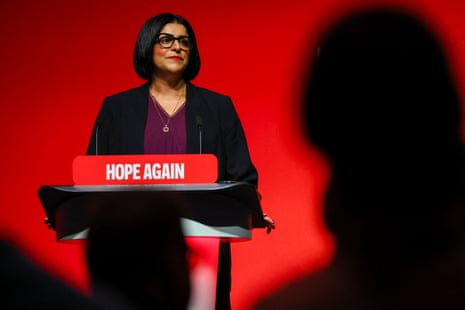
Shabana Mahmood, the home secretary, is addressing the conference now.
She says the job of a Labour government is to make the country fairer and she explains why that matters to her.
My parents came to this country from rural Kashmir because they knew that they would get a fair shot at a better life here, a fairer shot than they could ever expect back home, where past was present and where your birth dictated your future.
They were largely welcome to this country because most Brits thought it was right to welcome people who came here legally, build a new life and contribute to our nation. There were exceptions to that welcome. Of course, this was the 1970s, but they were exceptions and not the rule.
Fairness is what unites us in this country, and a fair society unlocks the very best of us. Because when people think this country is fair, they are more open and generous to others. When we are secure in ourselves, we are more tolerant to [others] because the existence of one group does not threaten another.
And so a proud Muslim like me can be a proud Brit and a Brummie too.
When fairness isn’t present, the opposite is true. When this country feels unfair, people turn inwards. A Britain that is unfair is one that is smaller and colder for those who look like me.
So my job is to create that fairness in our immigration system and on our streets.
Here is an assessment of John Healey’s speech by Heather Stewart, the Guardian’s economics editor. She says the chancellor offered “an upbeat vision of a reindustrialised Britain with fresh opportunities for young people, but he gave little sense of how he intends to pay for Andy Burnham’s radical plans”.
In his speech to the conference earlier, Jonathan Reynolds, the business secretary, announced that the government would close the “bogus self-employment loopholes” that deny workers basic rights.
He said:
Loopholes in our employment laws being used to define workers as self-employed when they are clearly not, denying basic employment rights, undercutting businesses who are doing the right thing, and leaving people with the sense that playing by the rules doesn’t pay.
Everyone can see this isn’t right. It is a fundamental question of fairness … This Labour government will put an end to it.
Explaining how this would work, Labour said:
Reynolds announced a formal consultation, due to be published in the coming weeks, on how to clamp down on abuses, give greater legal certainty to workers and potentially extend core employment rights to those often excluded from them. It will consider proposals to have a legal assumption of worker status when a case is brought to tribunal and to de-emphasise the personal service test when assessing status in order to clamp-down on misuse of substitution clauses. This could help workers such as parcel couriers, delivery drivers and gig economy workers.
Rajeev Syal is the Guardian’s home affairs editor.
Shabana Mahmood has signalled that she is considering watering down her plans to make it harder for foreign workers to claim permanent residence in the UK amid growing demands for a U-turn from cabinet colleagues and unions.
In a speech to Labour conference, the home secretary said the government will “come to a position that balances fairness for those who came here legally” after acknowledging that “some have said elements of these reforms are not fair”.
Her comments follow demands from Angela Rayner and Unison’s general secretary Andrea Egan to drop changes to indefinite leave to remain which would penalise foreign overseas care workers looking after the UK’s older citizens.
Mahmood told conference:
As we restore control and fairness to our asylum system, we must do the same for legal migration too. Fair to those who seek a new and better life here, like my parents did, and fair to those already here, including British workers, and especially the young.
That same principle underpins my reforms to the right to live here indefinitely, ensuring settled status is earned, by those who have shown a consistent commitment to this country.
I know that, throughout our consultation process, some have said elements of these reforms are not fair. To that: let me say this. We will come to a position that balances fairness for those who came here legally, and fairness to British citizens across this country.
Mahmood confirms that she is announcing a new legal route for refugees that prioritises Afghan women and girls and Palestinians.
Shabana Mahmood, the home secretary, is addressing the conference now.
She says the job of a Labour government is to make the country fairer and she explains why that matters to her.
My parents came to this country from rural Kashmir because they knew that they would get a fair shot at a better life here, a fairer shot than they could ever expect back home, where past was present and where your birth dictated your future.
They were largely welcome to this country because most Brits thought it was right to welcome people who came here legally, build a new life and contribute to our nation. There were exceptions to that welcome. Of course, this was the 1970s, but they were exceptions and not the rule.
Fairness is what unites us in this country, and a fair society unlocks the very best of us. Because when people think this country is fair, they are more open and generous to others. When we are secure in ourselves, we are more tolerant to [others] because the existence of one group does not threaten another.
And so a proud Muslim like me can be a proud Brit and a Brummie too.
When fairness isn’t present, the opposite is true. When this country feels unfair, people turn inwards. A Britain that is unfair is one that is smaller and colder for those who look like me.
So my job is to create that fairness in our immigration system and on our streets.
Shelagh Fogarty ended by asking what nightclubs in Liverpool Burnham used to visit as a teenager.
Burnham replied:
I was always football in Liverpool and music in Manchester.
He admitted he was a woolyback – a local nickname for people who come from near Liverpool, not from the city itself.
He recalled going to the Haçienda in Manchester. But he said he was “turned away more times than I got in” because he did not pass the dress code.
Asked if he regarded social care reform as the most important thing he would do in government, Burnham replied:
One of the things for sure, but maybe the main thing, because it is very, very personal for me.
Burnham said he would put forward a plan. He went on:
I don’t know whether people will feel able to back it.
For too long, politicians had refused to put forward proposals if they seemed too difficult, he said. He said he was not going to do that. He was going to offer an answer.
It might be possible to get support to get it through, he said.
If it’s not, I will accept the consequences,
Q: Will you ban protesters wearing balaclavas?
Burnham hints that he will take action.
The scenes that I’ve seen in recent weeks people wearing black balaclavas, black clothing, on British streets – you don’t want to necessarily reach for extreme measures, but when people are causing fear and intimidation in communities, you have to prevent them doing that.
Burnham said one option might be “localised provisions where there’s an ongoing problem”.
He went on:
But I don’t want to see a Britain where people are wandering around the streets causing fear with black balaclavas on.
Q: Are you on Team Rayner or Team Mahmood in the dispute about indefinite leave to remain?
Burnham says he’s on both teams.
The government is consulting on the issue, he says.
The next question comes from a man from Piddington who says his son won’t want to go out if more than 1,000 asylum seeker are housed in a military base near the village. He asks why they can’t be kept on the base.
Burnham replies:
I have been asking questions of the Home Office about the precise arrangements, related to this particular location, but also to others as well, where we have legitimate concerns.
Obviously, measures must be put in place to ensure that things can be managed properly and safely. So I am going through those things, at the moment.
But asylum seekers need to be housed in way that is “fair to everywhere”, he says.
And he says the government is ending the use of asylum hotels, which was unpopular.
Q: Why did you not say yesterday whether you were or were not in favour of a third runway at Heathrow?
Burnham says he had to be cautious because this is a live consultation, that could lead to a planning application. He says he had to be sure he did not prejudice the process.
He also says there are “strong views on either side”.
Q: Did you discuss President Trump’s proposed diesel export ban with him when you met him last week?
Burnham does not anwer exactly, but he says they discussed all issues relating to the supply of goods from the Middle East.
Q: Did you ask for exemptions for the UK?
Burnham says he always makes the case for the best deal for the UK.
Asked why he was not moving faster on care, Burnham said he had to “work within the manifesto that I inherited”.
He said he would give more detail of his proposals to fund the plan tomorrow.
He said 2030 was the target date for his social care reform plan to start.
The next question is about social care.
Burnham says he saw how the care system worked when his late father was in a home.
The carers were excellent, but the system let them down, he says.
You cannot deliver a care system of quality in 15 minute slots. You just can’t because the minute people’s needs got beyond the simple and head towards the more moderate or even severe, then things just completely break.
Burnham also pays tribute to foreign care workers, implying the proposed permament settlement rules that would make them wait for 15 years will be revised.
He says:
There are lots of people working in our care system who’ve come from abroad. I think it’s really important that we say to them that we recognise what they are doing day in, day out. We could not do without them. The care system may well not function were they not there.
Burnham says he will be chairing a meeting of the Cobra emergency committee later to discuss the RAF Fairford suspected bomb plot.
Disclaimer : This story is auto aggregated by a computer programme and has not been created or edited by DOWNTHENEWS. Publisher: theguardian.com