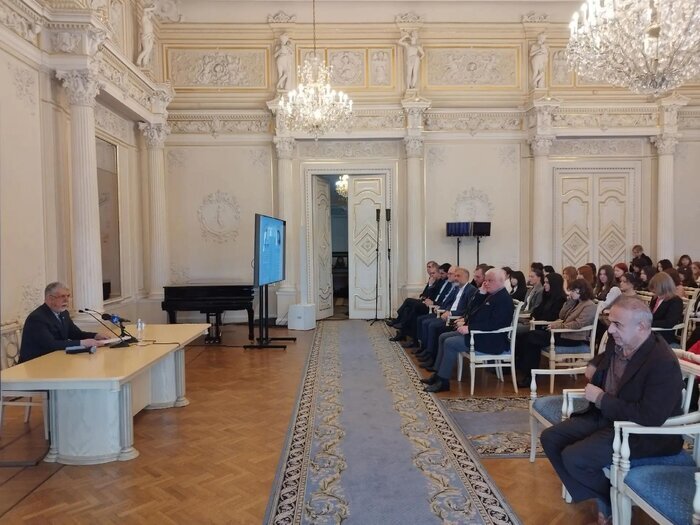
TEHRAN – Iran’s Minister of Culture and Islamic Guidance addressed the faculty and students at the St. Petersburg State University of Culture and Arts on Sunday and stressed the importance of taking a strategic view of Iranian-Russian cultural and civilizational dialogue as a means of building resilience against future crises. He also discussed the country’s cultural elements and its “cultural shield” in the face of military threats.
Seyyed Abbas Salehi, who was attending events marking Iran’s Cultural Week in Russia, opened his remarks with a fundamental question: “Why do some civilizations collapse in the face of crises, while others not only withstand them but also build new strength from within them?”
Recalling the many kinds of crises Iran and Russia have faced over the course of history, including imposed wars, foreign occupation, economic sanctions, efforts to isolate them geopolitically, natural disasters, and cultural pressure, Salehi said that what had sustained the two countries was not merely military power or material resources, but cultural and civilizational elements accumulated over centuries, IRNA reported.
He went on to explain the cultural factors Iran draws on in confronting contemporary crises. “Each crisis activates different cultural elements; Iran therefore draws on a diverse set of cultural resources in response to diverse crises,” he said.
Referring to Iran’s experience of the imposed war with Iraq, recent attacks by the US and Israel, and ongoing military threats, Salehi said: “Emotional solidarity is the first cultural element activated in response. This solidarity is rooted in a culture of altruism and collective commitment, reinforced by Persian literature and religious teachings”.
“Women in Iran are at the heart of building this solidarity when the country faces external threats. They play an essential role in caregiving, distributing aid, and rebuilding social ties, a role that was fully evident during the recent attacks by the American and Israeli regimes,” he asserted.
Salehi also pointed to the effective role played by Russian women during the Second World War, saying that women’s empowerment in times of crisis could be an area of cooperation between Iran and Russia.
After emotional solidarity and the role of women, the minister identified the historical memory of suffering and resistance as a third cultural factor in confronting external threats. “Sharing experience in positively retelling historical memory could be another area for cultural cooperation between Iran and Russia,” he noted.
Salehi named religion, spirituality, and mysticism as the fourth cultural element shaping Iranians’ response to external threats, saying that Iran’s religious, spiritual, and mystical teachings and traditions play a central role.
“Iranian religious and spiritual traditions regard commitment to others and altruism as conditions of humanity, and therefore reject passivity and selfishness,” he underlined.
Salehi said that the emphasis on Orthodox spiritual traditions in preserving Russia’s national identity is a similar cultural factor. “These traditions have helped strengthen social bonds and provide the potential and foundation for broad national solidarity in times of crisis,” he added.
Summing up the cultural elements at work in responding to war and external threats, he said Iran relies on emotional solidarity, women, historical memory, and spirituality. “These four resources are Iran’s cultural shield against foreign military threats.”
In another part of his remarks, the minister discussed the cultural elements Iran draws on in response to sanctions and efforts by its adversaries to isolate it economically.
He listed these elements as adaptability and informal initiatives; the agency of young people and communication networks; traditions of statecraft and public administration; and science, knowledge, and educational institutions.
“In conditions of scarcity and instability, Iranians show considerable ability to change their way of life, find alternatives, and make use of resources in multiple ways. This skill in managing difficult circumstances is a significant advantage,” he explained.
According to the minister, “Resilient informal economy” is reflected in Persian literature, proverbs, and stories. “Comparative study of culture and the informal economy could be an area for current cooperation between Iran and Russia,” he stressed.
Salehi went on to say that Iran’s greatest asset in a crisis is the people’s capacity for solidarity and mutual support. “This asset is stored neither in the Central Bank nor in military pacts,” he said.
“It lies in a shared sense of identity, attachment to the homeland, and historical memory. The contemporary experience of Iranians, from the eight-year imposed war to unjust sanctions and recent attacks, has shown that, despite all hardships, Iranians are prepared to make any sacrifice for their culture, civilization, and homeland. The secret behind this civilization’s survival over the centuries lies in this shared Iranian identity,” he emphasized.
At the end of his remarks, Salehi urged Russian faculty, researchers, and students to view Iranian-Russian cultural and civilizational dialogue not as a diplomatic project, but as a strategic investment in shared resilience against future crises.
Salehi traveled to Russia on Thursday to attend the 12th International Forum of United Cultures and advance joint cultural programs between Iran and Russia through the organization of Iran’s Cultural Week in four Russian cities.
On Friday, during the second day of his trip to Russia, the Minister of Culture and Islamic Guidance spoke at the 12th International Forum of United Cultures in Saint Petersburg before ministers and influential figures from more than 70 countries and answered questions from journalists.
On Saturday, he met his Russian counterpart Olga Lyubimov and the two sides signed a memorandum of understanding for joint film production.
Iran’s Cultural Week includes a performance by an orchestra of Iranian artists and a visual arts exhibition, as well as specialized sessions and film screenings.
SS/SAB
Disclaimer : This story is auto aggregated by a computer programme and has not been created or edited by DOWNTHENEWS. Publisher: tehrantimes.com