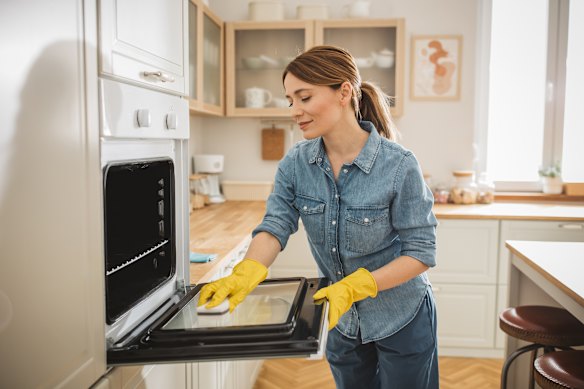
Like it or not, your oven really does needs a good clean once in a while. Here’s how to do it properly with as little pain as possible.
Debora Robertson
I know most of us, in fact all sane people, look forward to cleaning our cookers with the glee with which we might contemplate a light bit of root canal work. But if you’re anything like a keen cook – i.e. not the woman I once knew who stored her sweaters in the oven, so seldom did she cook anything – keeping this essential piece of household equipment clean will help it work more efficiently, more safely and, ultimately, prolong its life.
If you get into a simple routine of cleaning up spills as they happen, wiping down doors, handles and seals regularly, and from time to time, taking out all of the racks and rack supports and scrubbing them clean of any grease, you will seldom, if ever, have to give up a precious Saturday to doing a deep clean. Here’s how to do it.
Step 1: Gather the materials you need
You’ll need old newspapers or something to cover the floor if your oven is particularly dirty, also rubber gloves, and possibly a face mask, if you’re using strong chemicals. If the oven is very dirty, you might want to use a commercial oven cleaner such as OzKleen Oven Power or Selleys Oven Clean Aerosol.
For the exterior of the oven, a product such as Jif Power & Shine Kitchen Spray is useful, though for less tough jobs some washing-up liquid in hot water should be enough. If you want to use fewer strong chemicals, you could try bicarbonate of soda and white vinegar.
The best recipes from Australia’s leading chefs straight to your inbox.
You will also need lots of soft cloths – I use microfibre cloths for everything – and a few scrubby sponges and/or scouring pads. A plastic scraper, the kind you might use to scrape dough off a counter surface or ice from a windscreen, can be good for removing stubborn burnt-on bits from the bottom of the oven.
Step 2: Clean the exterior and door
In most cases, you can clean the exterior of the oven with a squirt of washing-up liquid in a bowl of hot water and a tightly wrung out microfibre cloth. You can also make an easy cleaning spray of one part water to one part white vinegar with a drop or two of washing-up liquid in it.
If the oven is very greasy, you might want to try a commercial de-greasing spray. Make sure you wipe around the door seals too. Clean the door handles and knobs if it has them – some knobs are removable and can be put in the dishwasher.
Step 3: Clean the hob
If you have a ceramic, induction or otherwise flat hob, they can usually be cleaned with washing up liquid in hot water with a tightly wrung out microfibre cloth. If there are stubborn marks, go at them gently with a soapy, scrubby sponge.
If you have a gas hob with pan supports, remove them and any other removable parts and give them a good wash – often they’ll go in the dishwasher – before reassembling.
Step 4: Clean the oven racks
Remove all of the racks from inside the oven and remove the rack supports too (see the note on self-cleaning ovens below, if you have a self-cleaning cycle on your oven). These will usually come up very well with washing-up liquid and a scrubby sponge, or with a scouring pad.
If they’re very dirty, try a product such as OzKleen Oven Power Kit, where you place the racks in a large plastic bag with powerful chemicals to soak for a period of time before rinsing them.
Whenever you use strong chemicals in the kitchen, wear rubber gloves, open all windows and doors, and if any liquid splashes onto your skin or into your eyes, rinse immediately in copious amounts of cold water.
Step 5: Deep-clean the inside of the oven
Now to the main event (see note below, if you have a self-cleaning cycle on your oven). If possible, check your oven manual for specific cleaning instructions, but the following has served me well with many makes and models. If the oven is very dirty, you may want to use a commercial oven cleaner following the manufacturer’s instructions. Make sure you wear rubber gloves and the room is well ventilated.
If your oven is not too bad, mix up a thick paste of bicarbonate of soda and water. Use a brush to spread the paste over the interior of the oven and inside the door, avoiding any heating elements and vents. Leave this for at least 8 hours or overnight. Use microfibre cloths and lots of warm water to wipe off most of the residue, then spray with white vinegar and leave for 30 minutes before wiping down again.
Oven cleaning FAQs
How often should I clean my oven?
The answer to that is obviously that it depends how often you use it. I had a neighbour who never cooked but loved clothes. She kept her sweaters in the oven, so all she needed to do was dust it from time to time. For most of us, keeping on top of wiping up spills and burnt bits as they happen, plus a deep clean every three to six months, should be enough. It helps ensure your oven works efficiently, prolongs its life, and makes your food taste better.
Once I’ve cleaned my oven, how quickly can I use it?
If you’ve used natural materials such as bicarbonate of soda and vinegar, you can use it straight away. If you’ve used a commercial cleaner, once you’ve rinsed off all the product, heat the oven at 180C/160C Fan/380F for 30 minutes, turn off the heat, allow to cool, then leave the door open for an hour before using.
How can I stop my oven from getting so dirty?
Get into the habit of putting a baking sheet under pies, cakes and casserole dishes before you put them in the oven so if they bubble up over the top of their containers you won’t have to scrub the burnt remains from the racks and the bottom of the oven. You can also cover the bottom of the oven with foil or liners and change them regularly – but be careful not to cover any vents.
The Telegraph, London
From our partners
Disclaimer : This story is auto aggregated by a computer programme and has not been created or edited by DOWNTHENEWS. Publisher: www.smh.com.au