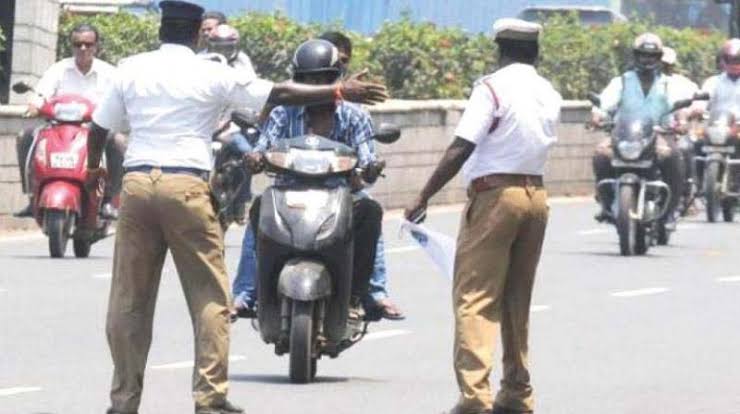
Hyderabad: The Supreme Court’s suggestion to link unpaid traffic e-challans with electricity bills to improve recovery has triggered debate over how traffic penalties should be enforced, with citizens and road-safety advocates raising questions about implementation, legal procedures and whether stronger recovery measures would lead to better driving behaviour.
Observing that states and Union Territories had around Rs 45,000 crore in outstanding e-challans, and of which about Rs 25,000 crore had been recovered, a bench of Justice J.B. Pardiwala and Justice K.V. Viswanathan said issuing challans alone was not sufficient and suggested exploring measures to ensure recovery.
“If people are not paying traffic challans, add it to their electricity dues bill. They will have to pay electricity bills, otherwise the power line will be disconnected. Work it out. In this country, you have to find a way out,” the bench said.
The observations came during the hearing of a plea concerning systemic reforms in road safety, traffic enforcement and post-accident victim care.
Reacting to the suggestion, a post-graduate student, Sai Eshwari, said linking challans to essential services could make it harder for people to ignore pending fines. “People can ignore SMS, but they cannot live in a dark house. If traffic challans are linked to electricity, licences and vehicle blacklisting on the Vahan portal, it could make people take pending challans seriously,” she said.
However, a Shaikpet resident, Habeebuddin, questioned whether stronger penalties should be pursued without addressing traffic management and road conditions. “It is not fair to impose heavy fines when traffic is not being properly controlled and roads are in poor condition. The department is collecting fines, but traffic management also needs to improve,” he said.
A lawyer, Deepika, 25, raised concerns about the impact of linking challans to electricity bills on the legal process available to motorists. “Holding people accountable for their challans is one thing, but linking them to electricity bills may create problems because challans can be challenged in traffic courts. The recovery mechanism should not interfere with a person’s right to contest a challan,” she said.
Software developer Shashank, 31, questioned how such a system would work for people who do not own the electricity or water connection at the address linked to them. “Implementation could become complicated, particularly for tenants. If the electricity or water connection is in a family member’s name, it is unclear how the pending challan of a vehicle owner would be recovered through that connection,” he said.
High Court advocate Vijay Gopal questioned the legal basis for connecting traffic penalties with electricity services. “Traffic violations are governed by the Motor Vehicles Act, while electricity services are governed by the Electricity Act. Linking the two would require a clear legal framework and legislative backing. The suggestion, in its present form, raises questions about viability and implementation,” he said.
Traffic and road-safety advocate Lokendra Singh said the recovery problem needed to be addressed but through a dedicated mechanism. “The challenge of recovering pending challans is genuine, but traffic penalties and electricity services operate under different legal frameworks. Instead of linking challans with unrelated public utilities, a dedicated vehicle-based system could be considered,” he said.
He suggested exploring systems linked to FASTag or a separate traffic-compliance mechanism that maintains a record of violations and outstanding penalties. “Such a system would require amendments to existing laws and safeguards for citizens. States should also focus on implementing the amended Motor Vehicles Act, 2019 and use the powers available under the law to prescribe higher penalties wherever permitted,” he said.
Lokendra Singh also drew a distinction between recovering fines and changing driving behaviour. “Recovering challans is not the same as changing behaviour. Stronger recovery mechanisms may help collect pending dues, but they may not necessarily make motorists drive more responsibly,” he said.
He noted that suggestions to link traffic dues with bank accounts, toll payments or FASTags have also been discussed. Chief Minister A. Revanth Reddy had earlier spoken about linking traffic challans with bank accounts, which led to public reaction.
The larger issue, he said, was whether enforcement mechanisms were changing driving behaviour. “Are we trying only to recover money, or are we trying to make people drive responsibly?” he asked.
IT employee Sriharsha Tulasi, who runs Team Road Squad on X, said sustained enforcement and penalties were needed to influence driving behaviour. “Countries such as the US, China, Israel and the UK have used strict regulations, including action against licences when drivers repeatedly violate rules. Enforcement has to focus not only on collecting fines but also on ensuring compliance with traffic rules,” he said.
Disclaimer : This story is auto aggregated by a computer programme and has not been created or edited by DOWNTHENEWS. Publisher: deccanchronicle.com