Doctors say radical plan to merge Scotland’s health boards should be scrapped
-
Published
Leading doctors are calling on the Scottish government to withdraw its plans to drastically reduce the number of health boards.
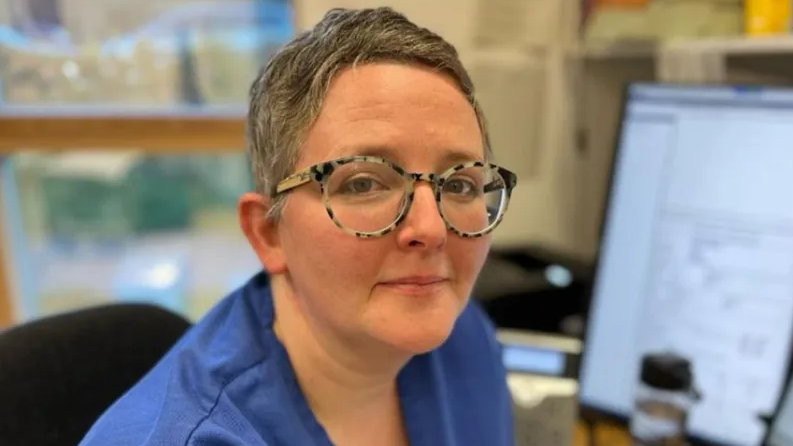
The new chairwoman of BMA Scotland, Dr Nora Murray-Cavanagh, said the proposal to cut the number from 14 to just two would be costly and time consuming – and that there was no clear evidence it would benefit patients.
First Minister John Swinney unveiled the plan a month ago, saying it would streamline management and free up resources for frontline care.
Health Secretary Angela Constance said she stood by the proposals and promised engagement with a range of groups including unions and NHS boards as the details were developed.
Swinney announced the plan as part of his Programme for Government at the start of September, describing it as the “most significant structural reform of our NHS in the devolution era”.
Fourteen existing health boards would be reduced to just two Strategic Health Boards, covering the west and east of mainland Scotland, with different arrangements considered for the three island health boards.

Ministers said it would simplify administration and reduce duplication so that more resources could be directed to front line treatment as well as delivering more consistency in care across the country.
But members of the British Medical Association’s Scottish Council raised serious concerns and voted to oppose the plan during a meeting on Wednesday.
After the vote, Murray-Cavanagh said it wanted the government to “withdraw and rethink its whole approach” and come up with a more immediate way of helping patients.
-
Swinney to cut number of health boards from 14 to two
-
Published1 September
-
-
Swinney suggests Scots will not travel further for health care under reforms
-
Published6 September
-
The GP from Wester Hailes in Edinburgh, who took up the role with BMA Scotland just a few weeks ago, stressed that doctors did not deny that the NHS needed to change.
She said: “Our position is not one that argues NHS reform isn’t necessary – no-one thinks we can simply go on as we are.
“As doctors, we know better than most the precarious state of services across Scotland.
“But this is the wrong set of reforms, and it will set Scotland on a path of a costly, time consuming, resource-sapping reorganisation, with no serious engagement with those of us holding the service together and no clear evidence put forward on how it will benefit patients.”
Murray-Cavanagh said members of the BMA’s Scottish council had spoken passionately of their concerns about the impact the proposals would have on them and their patients.
She added: “At the core of everything is the lack of any evidence on how these reforms will practically make care better.”

In response to the BMA’s remarks, Health Secretary Angela Constance said the plans for NHS reform were focused on improving services for people across the country, regardless of where a person lives.
“They will simplify how people get the care they need and remove the current geographic and bureaucratic barriers that exist between 14 health boards, which we know are currently causing unwanted variation and duplication,” she said.
She said the changes would build on work that was already under way, involving every NHS board in Scotland, to improve planning.
She added: “The development of detailed proposals will be supported by a full business case and will include engagement with NHS boards, staff representatives, trade unions, local government, integration authorities, social care partners and the public.”

Analysis: Not the only group raising concerns

The BMA is the first medical organisation to publicly call on the government to rethink its plans.
The doctors’ union is very much in favour of reform and for many years has issued stark warnings that without fundamental change, the NHS cannot survive.
But it has now come out strongly against the government’s current plans to transform healthcare by reducing the number of regional health boards to two.
The first minister argued consolidation would reduce bureaucracy while freeing up more time and capacity to improve patient care. He also claimed it would reduce inequality for some patients.
But the BMA don’t see it that way.
They are also not alone in raising concerns that consolidation could actually widen health inequalities if people are forced to travel further for treatment. The patient safety commissioner, as well as some rural campaign groups, have echoed these fears.
The union also question where the evidence is that these reforms are in the interests of patients and NHS staff, saying a reorganisation could be time-consuming and costly.
Others have argued that structural reform does not address wider issues the NHS faces around access to social care, which the government is also trying to address.
It is also unclear whether this new structure will result in financial savings by cutting senior roles or streamlining departments.
At the moment, the NHS has a no compulsory redundancy programme which the government reiterated its commitment to after this announcement was made.
The union Unite, which represents thousands of health and social care workers in Scotland, warned ministers at the time that it was considering “all options” if the reorganisation results in cuts to jobs or frontline services.
-
-
Published1 September

-
-
-
Published6 September

-
-
-
Published2 September

-
Disclaimer : This story is auto aggregated by a computer programme and has not been created or edited by DOWNTHENEWS. Publisher: BBC