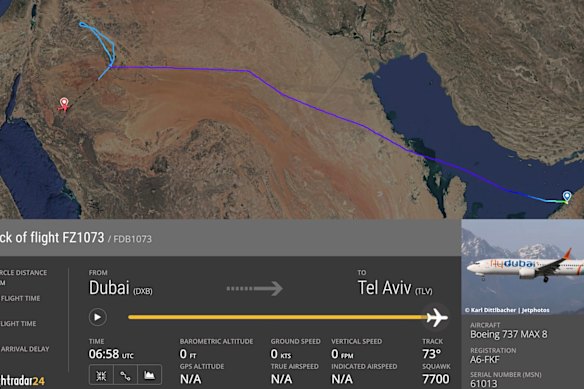
The heroic effort of the pilot, passengers and crew to subdue a co-pilot apparently intent on killing all on board an Israel-bound flydubai Boeing 737 is the conquest of courage over fear, and certainly cause for celebration.
But the near-disaster underscores the continuing threat to people of the Jewish faith around the world almost a year after the December 14 attack in Bondi.
It also raises issues about better aircraft safety and helps ease the public’s deep-seated fear of flying in an era when commercial airlines have sometimes been recruited as weapons of war or used by suicidal pilots.
Above Saudi Arabia on Wednesday, Indian-born Captain Smit Machchhara was stabbed by his Omani co-pilot. He then pitched the nose of the plane and they wrestled as it plunged 17,000 feet until the badly wounded pilot was able to unlatch the cockpit door, enabling passengers and crew to subdue the assailant.
In an unlikely stroke of luck, one of passengers who stormed the cockpit, Yaniv Hayoun, had also watched a Canadian documentary series, Mayday, about aviation catastrophes and had known to pull back on the yoke to pull the plane out of a dive. Relief pilots from New Zealand and South Africa who were sitting with passengers then took over and landed the Emirates budget airline plane in Tabuk, Saudi Arabia.
The co-pilot accused of stabbing the pilot and attempting to crash the Boeing 737 carrying 174 passengers is under arrest in Saudi Arabia.
Whether the Dubai-to-Tel Aviv flight near-miss was terrorism or attempted mass murder by a suicidal pilot presently remains open to conjecture. The motive is still being investigated.
But coming so soon after the 25th anniversary of 9/11, a few days before the third anniversary of the October 7 mass killings by Hamas and just weeks before the Israeli elections, the Israel Defence Minister Israel Katz called it “an attempted jihadist terror attack”.
Of flight FZ1073’s 174 passengers, 166 of them were Israelis. Sydney couple Steven and Carol Moss were on board. Steven’s father, Sam, was a Czechoslovakian-born Holocaust survivor who co-founded the Katies fashion empire.
Pilot suicide was, and remains, largely a single engine aircraft phenomenon. But the 2014 disappearance of Malaysia Airlines Flight 370 and Germanwings Flight 9525 the following year – and their links to mentally troubled crew members – reminded the world how vulnerable passenger jets could be to suicidal maniacs.
Ever since international airline travel took off with the arrival of the jet engine in the 1950s and 1960s, the industry has been wrestling with hijackings, ransom demands and terrorist attacks.
In 1964, cockpit doors on large commercial airplanes had to be locked after a man shot both pilots and himself on a Pacific Air Lines plane that crashed in California, killing all 44 on board.
The 9/11 attacks in 2001 had a profound effect on air travel with security at airports and cockpit security heightened. Previously, it had been possible for passengers to visit the flight deck and speak to the pilots. After 2001, cockpit doors were locked, with only the pilots controlling who could enter, and reinforced, bullet-resistant cockpit doors became mandatory.
Whatever the cause behind the flydubai cockpit fracas, the Mayday moment challenges the aviation industry to balance emerging security risks against a potential new wave of malevolent pilots.
 The Herald’s View – Since the Herald was first published in 1831, the editorial team has believed it important to express a considered view on the issues of the day for readers, always putting the public interest first.
From our partners
Disclaimer : This story is auto aggregated by a computer programme and has not been created or edited by DOWNTHENEWS. Publisher: www.smh.com.au