The TikTok creators arrived first.
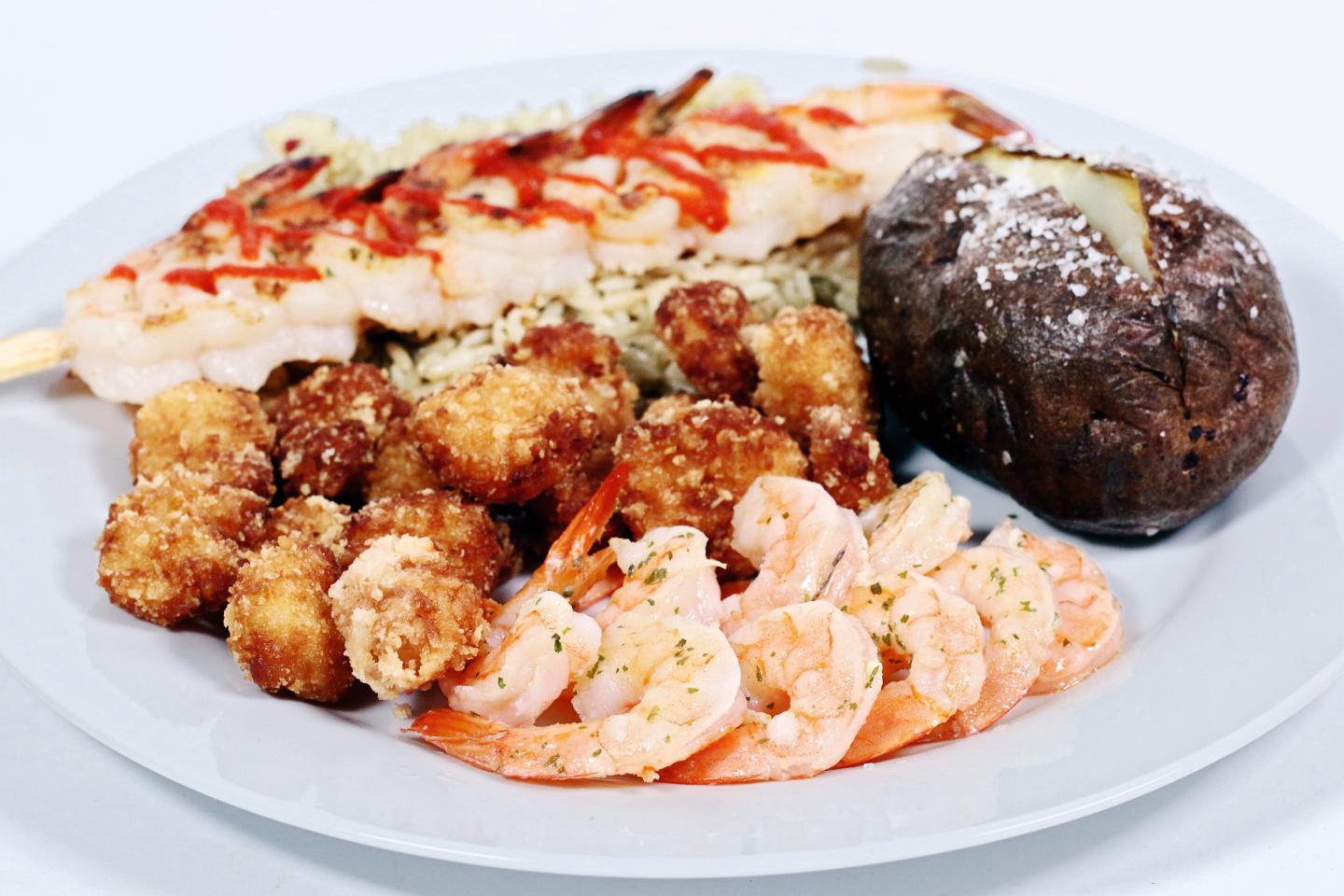
It was the summer of 2023, and Red Lobster had announced what it billed as an “iconic first”: “Ultimate Endless Shrimp Is Here to Stay All Day, Every Day.” The casual-dining chain was offering customers all the shrimp they could eat for $20—scampi, coconut, Alfredo-ed, skewered, or butterflied and deep-fried—not as a seasonal promotion but as a permanent fixture, along with a side dish and the brand’s famous Cheddar Bay Biscuits.
“Insider tip,” the press release advised: “Avoid grabbing the extra biscuit to leave room for endless amounts of shrimp.”
Red Lobster had unwittingly handed creators the perfect stage for a mukbang—the South Korean–born online genre in which hosts eat for an audience, sometimes to spectacular excess. Ambitious mukbang-ers eager to prove their gastronomic stamina descended on Red Lobster locations across the country to consume absurd quantities of shrimp. One YouTube video by Joey Kinsley, a.k.a. “Sir Yacht,” features the influencer shoveling down shrimp for 10 hours straight.
The chaos spread from dining rooms to newsrooms as Red Lobster became one of America’s most-discussed restaurants—for all the wrong reasons. While customers drawn by the deal monopolized tables to gorge on order after order of shrimp, restaurants ran out of shrimp and turned away regular customers. The chain filed for bankruptcy protection in May 2024, with $692 million in total liabilities, and revealed in court documents that it lost $11 million on Ultimate Endless Shrimp in the third quarter of 2023, and then $12.5 million in the fourth quarter. It closed roughly 130 of its 700 restaurants and cut corporate staff.
To be sure, Ultimate Endless Shrimp wasn’t the only factor in the bankruptcy: The chain was also saddled with hundreds of costly leases after its previous private equity owner, Golden Gate Capital, sold off much of its real estate in a damaging sale-leaseback deal. But several sources, including former Red Lobster executives requesting anonymity because they signed restrictive nondisclosure agreements, said the disastrous shrimp promotion was a symptom of the deeper problems plaguing the beloved restaurant brand.
TANNIS TOOHEY—GETTY IMAGES
“Trust me,” one told Fortune, “it’s not a pretty sight—people sitting there for two hours downing 50 pounds of shrimp.” Another source described how the crowds drawn by the stunt actually scared away regular customers; the chain failed to hit its traffic goal for historically packed Mother’s Day. “Just an absolute mess,” the source said.
The Ultimate Endless Shrimp fiasco became a running joke, showing up in comedy monologues and online skits, but the bankruptcy’s consequences weren’t funny at all: Thousands of retirees lost out on expected payments as Red Lobster crashed into insolvency. Court documents reveal more than $12 million in deferred compensation that went unpaid, and $16.7 million in unpaid wages.
Now a creditors’ trust is suing Red Lobster’s former parent companies, claiming breach of fiduciary duty and fraud. In a lawsuit filed in May, it’s alleging that Ultimate Endless Shrimp wasn’t an epic blunder, but a conspiracy designed to force Red Lobster to buy massive amounts of shrimp—a scheme, the trust alleges, that put an Asian seafood giant’s interests ahead of Red Lobster’s, extracting millions from the American restaurant chain via overpriced shrimp purchases, and ruining its reputation in the process.
The parties involved in the litigation—as well as Red Lobster itself, which is not being sued—declined to comment for this article, but their court filings lay out the sad saga in dramatic detail. And in conversations with people who experienced the chaos of the dining rooms, the broken loyalties, and the ruined retirements afterward, Ultimate Endless Shrimp emerges as something like a fever for everyone involved—one that brought long-simmering problems to a boil.
The shrimp supplier turned owner
Red Lobster’s controlling owners until its bankruptcy were Thai Union, the Thailand-based seafood giant famous for its Chicken of the Sea brand, along with its partner Seafood Alliance. In the lawsuit filed in Florida, the trust sued both along with several former executives, accusing them of embedding their proxies in Red Lobster’s leadership and executing a pattern of “self-dealing and exploitation” that created at least $32 million in avoidable purchases and about $23 million in overpayment. Unless there’s a settlement, resolution of this lawsuit—and potential recovery for the creditors—is a long way off, with a trial set for early 2028. Fortune made multiple requests for comment to Thai Union and its lawyers, but received no response. In a motion to dismiss the lawsuit, however, the company challenged its facts, standing, jurisdiction, and legal basis, and called it “a cynical attempt by Red Lobster to blame one of its former owners and suppliers for the failures of Red Lobster’s own management decisions and business model.”
Many of the lawsuit’s claims center on Paul Kenny, a longtime restaurant executive who, sources told Fortune, exerted more and more control over Red Lobster in the chaotic months before the company’s bankruptcy, though his official role was ambiguous. Kenny co-led Seafood Alliance, a consortium that was formed to partner with Thai Union and acquire full control of Red Lobster in 2020. He was initially announced as a “liaison” to Red Lobster’s parent company and then as interim CEO of Red Lobster.
An Australian with a long track record of restaurant experience in Thailand, Kenny had little understanding of an American casual-dining chain like Red Lobster, several sources told Fortune. The creditors’ lawsuit describes Kenny as a bullying presence who routinely threatened to fire anyone who disobeyed his orders. It also claims that Kenny insisted on the “magic number” of $20 as the price point for Ultimate Endless Shrimp—over “vociferous objections” and without the usual pricing analysis—and mandated that costlier premium shrimp be served. Demand then ran at roughly twice what the chain had anticipated—turning a loss-leader marketing gambit into a huge financial liability.

Kenny was “looking for every
way to put more shrimp on
the plate,” said a source.
Red Lobster Seafood Co.
In its motion to dismiss, Thai Union distanced itself from Kenny, denying that he was acting as its proxy while working for Red Lobster. It cited an investigation ordered by Red Lobster’s independent directors and conducted by white-shoe law firm Weil, Gotshal & Manges, which found no viable claims against management, with the exception of a “claim against Mr. Kenny in his capacity as the Company’s interim-CEO for gross negligence”—related to his decision to launch Ultimate Endless Shrimp at $20.
The creditors’ lawsuit claims that Kenny engineered a situation in which Thai Union could control Red Lobster’s seafood purchasing—cutting out competitors and charging higher prices for shrimp. In early 2023, the lawsuit claims, Kenny directed a “quality review” of the chain’s three main shrimp suppliers. After finding minor infractions unrelated to food safety, Kenny banned longtime supplier Red Chamber, allowing Thai Union to capture every pre-breaded shrimp contract, at a higher price, as well as 46% of Red Lobster’s overall shrimp business. Red Lobster paid $4.83 per pound for frozen, pre-breaded shrimp, compared with $4.27 previously, leading to $32 million in extra shrimp costs, according to the lawsuit.
Several former Red Lobster executives said they saw firsthand how Kenny steered more purchases to Thai Union. “Paul was looking for every way to put more shrimp on the plate,” one source said. Thai Union disputes the lawsuit’s claims, calling it “implausible that [they] would risk harming Red Lobster and their $575 million investment in it, just for shrimp purchases worth under $33 million.”
It was clear to those working at Red Lobster, a former executive said, that Kenny and his codefendants in the lawsuit—former Thai Union executive Scott Solar and former Red Lobster COO Trin Tapanya—were prioritizing the success of Thai Union over Red Lobster’s interests. “Those guys never really felt like they were us, they felt like they were Thai Union,” the source said. Solar, a former Red Lobster chef who had moved to Thailand to work for Thai Union before returning to be what the creditors’ lawsuit calls an “enforcer” for Kenny and Thai Union at Red Lobster, “wielded substantial authority over Red Lobster operations and supply decisions,” according to the lawsuit. Another former executive said Solar “was breaking a lot of the relationships we had with long-term vendors.” Kenny, Tapanya, and Solar did not respond to multiple requests for comment.
“People would eat lobster or eat crabs and they would get sick, go to wash their mouth out, and come back and order another. I hated it.”
— Pete Gaston, 42-year Red Lobster employee
Two sources recalled a decision to send a Thai Union employee into the Red Lobster purchasing department, where they had access to other suppliers’ pricing information, a conflict of interest since Thai Union was itself a supplier. The lawsuit claims that Red Lobster’s supply team “fought constantly to rebuff” her attempts to participate in meetings with supply-chain vendors—who were also competitors to Thai Union.
It’s certainly true that Thai Union lost money on its Red Lobster purchase overall. A former Red Lobster executive said Thai Union was expecting the chain to generate roughly $150 million in annual EBITDA, and it hoped to realize $150 million in shrimp sales, to boot. That expectation didn’t seem so far-fetched at the time: Sale documents from 2014 reveal that Red Lobster was running at $230 million in trailing 12-month EBITDA when it was sold to Golden Gate. But the post-COVID business was far off that mark.
Rather than try to right the sinking ship, the lawsuit argues, Thai Union extracted all it could from the company on its way out. By early 2023, the lawsuit alleges, “Red Lobster was facing significant financial headwinds and risked insolvency,” so “Thai Union doubled down on a campaign to squeeze out every drop of value that it could through uneconomic contracts that benefited Thai Union and made no economic sense for Red Lobster.” In other words: Ultimate Endless Shrimp.
Thai Union ended up losing its entire Red Lobster stake, writing off its $530 million investment in the company and announcing its intent to divest the chain in January 2024. By May 2024, Red Lobster was in bankruptcy court, and Thai Union essentially handed the keys over to creditors, including Fortress Investment Group, which emerged as the eventual owner.
How Endless Shrimp ate Red Lobster
The Ultimate Endless Shrimp fiasco of 2023 wasn’t the first time an all-you-can-eat promotion had caused problems at Red Lobster.
The chain began as a pioneer of a certain kind of all-American restaurant. A Georgia restaurateur named Bill Darden had noticed that lobster was an unexpectedly popular order at the Howard Johnson’s franchises he operated in the Orlando area, and in 1968 he decided to turn the special into the main thing. His vision was to feed a family of four for $20 and to welcome all visitors. In somewhat bare-bones, cozy settings, Red Lobster became a middle-class family destination, and was welcoming to Black customers at a time when segregation, while outlawed, was still common in much of the American South.
Pete Gaston, a retired 42-year veteran of Red Lobster, worked at the chain for basically his entire career, from age 22 through 65. By age 30, he was managing multiple locations around the New York City area. Gaston remembered being on Long Island for the chain’s first-ever special promotion, 1984’s Lobsterfest. A hot-air balloon stuffed with red crustaceans levitated inside the restaurant, he said: “It was a big event.” By the time he retired during the Thai Union era, he had become regional director of every location in South Carolina, where he still lives.
One former Red Lobster server, Cameron Mullins, recalled working at the restaurant as a “really wonderful life experience.” Growing up in South Carolina, Mullins said, Red Lobster was “the treat restaurant” for her family. “It was not the fanciest place, it wasn’t fine dining, but it definitely was that moment of feeling upper middle class,” she said. “It was not the joke it’s become now.”
But even decades ago, she said, the brand’s seafood promotions seemed to uncork something wild in patrons. Valentine’s Day or Mother’s Day events at Red Lobster were a madhouse, she said, describing them as “the two busiest days working in a restaurant I ever experienced.”
Over time, Red Lobster’s special events began to proliferate, including various Crabfests. Unhinged behavior became increasingly prevalent. This went as far back as the 1980s, Gaston said—long before the age of TikTok—when earlier promotions sent customers on what he called “barbarian” feeding frenzies. “People would eat lobster or eat crabs and they would get sick, go to wash their mouth out, and come back and order another,” he said. “I hated it.”
“It was not the fanciest place … but it definitely was that moment of feeling upper middle class. It was not the joke it’s become now.”
— Cameron Mullins, former Red Lobster server
Endless Shrimp was introduced in 2004, and Gaston explained how the seasonal promotion worked: It would feature 22 shrimp on the first plate and 11 for every serving to follow. Customers, he said, “would sit there and eat 100, 120, 150 shrimp.”
The chain grew increasingly reliant on limited-time offers from the 2000s onward. “We used to joke that we were addicted to crack,” one source said, “and [Endless Shrimp] was like a crack pipe.”
Meanwhile, the escalating price of seafood challenged Darden’s original dream—and parent companies’ finances. General Mills spun off Darden Restaurants in 1995, and then Darden sold Red Lobster in 2014, in a deal with the private equity firm Golden Gate Capital that still stings many veterans to this day. Thai Union, a longtime supplier of the chain, bought a 25% stake in 2016, and in 2020 Golden Gate exited entirely to Thai Union and the newly formed Seafood Alliance.
For Gaston, the bankruptcy in 2024 wiped out the nest egg he’d been saving for his golden years. He lost $175,000—the last three of five promised annual payouts under the company’s deferred compensation plan. He said he sensed trouble and tried to cash out early, to no avail. He still has a copy of the letter he sent to the compensation committee in January 2015. “They just said no,” he said. He asked again when he retired in 2022 and was rejected again, then watched the company go into bankruptcy shortly afterward.
Gaston did better than many. Another former executive told Fortune they had personally lost $200,000, and even greater losses are out there among Red Lobster alumni. “We’re the ones who built the company,” Gaston said. “People like me. I built it, and you get nothing.” Darden Restaurants declined to comment.
Ultimate Endless Shrimp was, no doubt, a disaster. But Gaston and others blame the downfall of Red Lobster on events that date much further back. “This whole thing, just to be clear, just to be 100% crystal, it is not about Endless Shrimp,” Gaston said. “It’s about the leases.”
The private equity real estate trap
One source offered a long-view perspective on Red Lobster’s downturn: In 2000, the restaurant had roughly 4,000 people coming into each location every week, spending $15 per person against a Red Lobster cost of about $8. By 2019, the number of visitors per restaurant had been cut roughly in half, but they were spending $25 each at a cost of $11: “All they essentially did was jack up the price on a declining loyal base of guests.”
Darden’s sale of Red Lobster to Golden Gate Capital came with a major, often misunderstood complication: the sale of all of Red Lobster’s real estate. Darden sold the chain for $2.1 billion, and Golden Gate immediately sold more than 500 Red Lobster properties to American Realty Capital Properties (a real estate investment trust now known as Realty Income, several transactions later) in a $1.5 billion sale-leaseback deal that helped finance its acquisition—meaning the PE firm effectively acquired the business for a fraction of its headline price. Golden Gate Capital declined to comment.
To this day, the narrative that “private equity killed Red Lobster” swirls online. Whether blame should be apportioned to Darden, private equity, or hedge funds, Red Lobster is still dealing with the repercussions of the deal. The chain’s restaurants were leased back to it under a 25-year master lease, which included 2% annual escalators, extending until the early 2040s, according to the initial deal terms. By 2023, Red Lobster’s lease obligations had reached $190.5 million for the year, per bankruptcy filings, with more than $64 million tied to underperforming restaurants. Even worse, these increasingly above-market leases bundled weak locations with stronger ones, making it difficult for Red Lobster to abandon a money-loser restaurant without jeopardizing the profitable ones that subsidized it.
“It was a nightmare,” Gaston said. “It was no control.”
Can Red Lobster make a comeback?
The iconic seafood chain isn’t dead, to be clear. Red Lobster emerged from its 2024 bankruptcy in a lightning-fast three months and is now under the management of Damola Adamolekun, who was 35 at his appointment and the chain’s youngest-ever CEO. With a résumé that includes stints at Goldman Sachs and TPG, the former CEO of P.F. Chang’s is widely seen as an analytics-driven turnaround wunderkind. One of Adamolekun’s first moves was to cancel Ultimate Endless Shrimp, and he joked in 2024 that it was a natural decision because “I know how to do math.”
Before taking the role in 2024, Adamolekun worked with Fortress Investment Group, another private equity firm that was a key investor in the consortium that acquired the chain out of Chapter 11. That experience showed him a plethora of problems to fix, including the shabby state of many of the chain’s restaurants, its outdated tech, and the low morale of employees, he told Fortune last year.
So far, Adamolekun seems to be doing all the right things: instilling a mantra of “red carpet hospitality,” improving internal communication, and building the company’s capacity for rapid responses to problems as they arise. Adamolekun told this magazine that he wanted to “save Red Lobster” and lead it to “the greatest comeback in the history of the restaurant industry.” Red Lobster declined to comment on behalf of Adamolekun for this story.
It remains to be seen whether he’ll pull it off, but it doesn’t surprise longtime observers of Red Lobster that Adamolekun has turned to a familiar gambit to revive customer excitement about the brand: giant piles of crustaceans.
Red Lobster brought an Endless Shrimp promotion back for two limited runs during the spring and late summer of 2026, with the company saying that it was “highly requested.” The promotion is now priced at $24.99 in most locations, and $29.99 in some.
And last year, Red Lobster introduced another camera-ready spectacle: seafood boils. Rooted in Southern coastal food traditions, the feasts arrive in bags loaded with shrimp, crab legs, lobster, corn, potatoes, and smoked sausage. Across social media, videos linger on mounds of shellfish, butter-slicked corn and potatoes, and sauce-stained hands.
The mukbang has changed. The American appetite for abundance has not.
This article appears in the October/November 2026 issue of Fortune with the headline “Red Lobster’s endless shrimp disaster.”
Disclaimer : This story is auto aggregated by a computer programme and has not been created or edited by DOWNTHENEWS. Publisher: fortune.com