Orange Order says no proposals on table for resolution to Drumcree dispute
-
Published
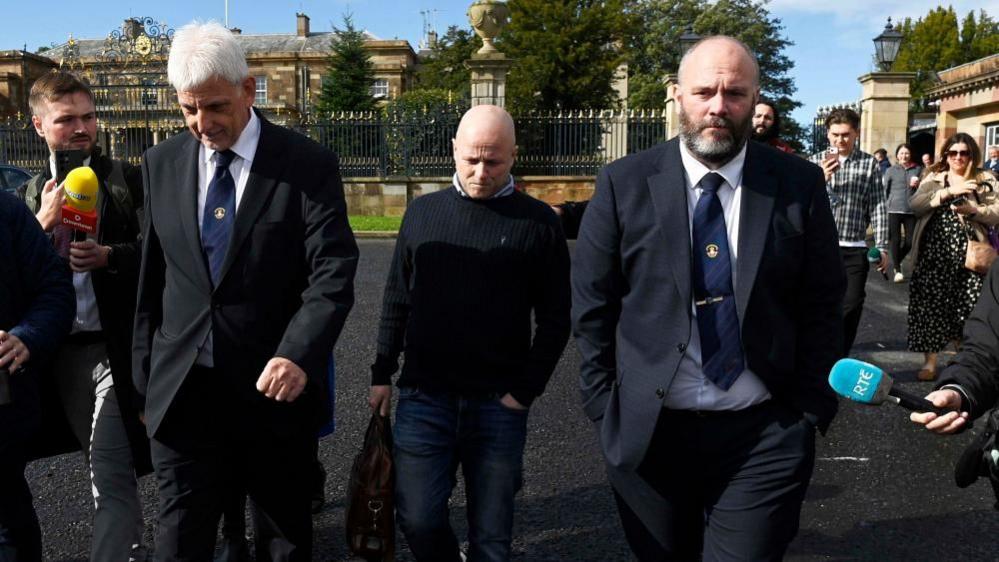
Talks aimed at resolving the Drumcree dispute are expected to continue, as Portadown District Master Nigel Dawson says “there are currently no proposals on the table.”
Both sides were given a document during separate meetings with the Secretary of State, Sir Chris Bryant, on Wednesday.
After its meeting, the chairman of the resident’s coalition said his group would agree to it, if the Orange Order did.
On Sunday, an Orange Order parade from Drumcree into Portadown did not happen because of a large protest on the mainly-nationalist Garvaghy Road.
Protesters have remained on the Garvaghy Road, although in much smaller numbers, and the Orange Order have maintained a presence at Drumcree, about a mile away.
On Thursday, The Nolan Show revealed details of what was in the document.
The BBC understands it said the Orange Order had the legal right to walk the Garvaghy Road, the residents would accept that legal entitlement and publicly accept that it was wrong to block the Orange Order from walking down the Garvaghy Road, but in return the Orange Order would choose not to walk down the road anyway.
On Wednesday, the Democratic Unionist Party’s (DUP) Carla Lockhart told the Press Association that: “What’s on the table is not acceptable.”
Talks with the secretary state are not likely to resume until later. Sir Chris had flown home on Wednesday night for private reasons but it is understood he intends to return to Hillsborough Castle on Thursday evening.
-
What is the Garvaghy Road dispute all about?
-
Published1 day ago
-
-
O’Neill returns to Garvaghy Road as police investigate Sunday’s ‘unlawful protest’
-
Published16 hours ago
-
-
Drumcree negotiations are ‘nowhere near dead’ – NI secretary
-
Published1 hour ago
-
The Police Service of Northern Ireland’s (PSNI) Chief Constable Jon Boutcher will address the dispute at a public meeting of the Policing Board in Belfast on Thursday.
The parade dispute is expected to dominate the agenda.
Board members will want to hear the chief constable’s security assessment of the situation, and will receive an update on the PSNI’s criminal investigation into the protest which blocked the Garvaghy Road.
One of the board members, Sinn Féin’s Deirdre Hargey, was photographed taking part in the protest and unionists have said she should be barred from attending the meeting.
What happened on Wednesday?
Talks continued at Hillsborough Castle between the Secretary of State Sir Chris Bryant and members of the Orange Order and the Garvaghy Road Residents’ Coalition.
Chief Constable Jon Boutcher said a “large scale criminal investigation” was under way into the unlawful blocking of Garvaghy Road, which prevented Sunday’s parade.
First Minister Michelle O’Neill has been accused by the DUP leader Gavin Robinson of breaking the law in taking part in demonstrations on Sunday.
In response, O’Neill said on Wednesday if she is investigated then “so be it, that’s the chief constable’s job”.
“I can only focus on what I’m focusing on right now which is – I’ve made a choice to be here top stand on the Garvaghy Road with these residents and I will continue to do so.”
Speaking after a meeting with the chief constable, Robinson said the DUP have given him their expectation “that within days, if not a week, we need to see the positive out workings of [the investigation]”.
How did we get here?
 Image source, PA Media
The Orange Order, the most prominent of the loyal orders associated with Protestants in Northern Ireland, holds thousands of parades every year and the vast majority pass off without incident.
However, many Catholics see the marches as sectarian and object to them passing through, or close to, Catholic or nationalist areas.
The Garvaghy Road had been part of the Drumcree route, but by the mid 1990s nationalist residents protested against the parade. The row sparked some of the most serious public disorder in Northern Ireland’s history and was linked to several murders.

The Drumcree dispute was one of Northern Ireland’s most serious parading disputes during the 1990s, when stand-offs over attempts by the Orange Order to march along the Garvaghy Road were accompanied by riots, roadblocks and killings.
When the Orange Order was prevented by police from walking down the route in July 1995, there was a tense stand-off. It was the same for the next three years.
Violence related to the dispute resulted in riots, roadblocks and murders across Northern Ireland.
In 1998, the newly-established Parades Commission ruled that the Orange Order should not march down the road – a decision upheld for the last 28 years.
The row reemerged last month after a court case in which a ruling by the Parades Commission was overturned, and a fresh application was lodged.
On Friday, the commission decided the march could go ahead with restrictions in place. However that decision was challenged in several Belfast courts on Saturday, before finally being given the go ahead just hours before it was due to take place.
-
-
Published2 days ago

-
-
-
Published2 days ago

-
-
-
Published3 days ago

-
Disclaimer : This story is auto aggregated by a computer programme and has not been created or edited by DOWNTHENEWS. Publisher: BBC