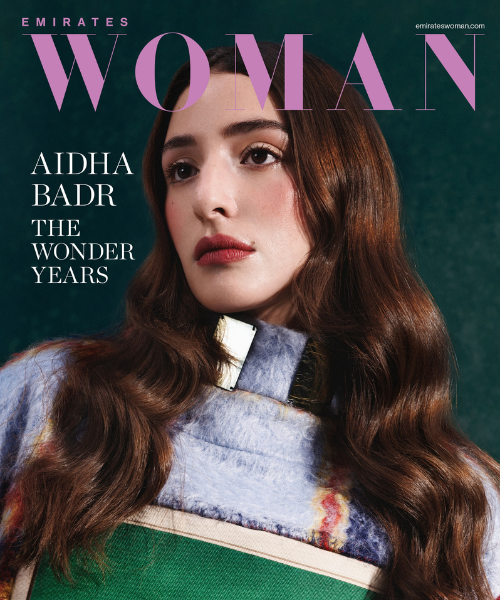
Sometimes the stars align so perfectly that it’s hard not to believe in fate, destiny, and just how small the world truly is. When I decided that the cover star for our Discovery Issue needed to be the artist Aidha Badr, I knew who I had to call to photograph the feature – Amer Mohamad. For months he has been regaling me with photos of his new apartment, and the one piece of art that anchored his interiors: a massive, wall-effacing painting of Badr herself, reclining, her undulating locks flowing down her shoulders, a serene, inscrutable Mona Lisa-like expression on her face and her form framed by a sky-blue backdrop of fluffy (slightly horse-shaped) white clouds. Titled Somebody Up There Loves Me, the self-portrait was painted last year as part of her I’m Never Coming Back exhibition at Firetti Contemporary. That is where Mohamad spotted it and knew he wanted to make it part of his life.
Top, Cropped Top with Tuxedo Tail, Louis Vuitton
“Honestly it was the best coincidence that I could ever have asked for,” says Badr about the kismet moment when she first met Mohamad on set. “I was so honoured that somebody who loved that painting, who had a deep admiration for my work, would be the one photographing me for this cover. I truly admire his work and I love that he loves my work. The energy is very reciprocated – I love you, I love you too.”
And then they were off, two artists collaborating across a series of surreal sets designed to visually reinforce the artistic touchpoints Badr references in her work. It made for a day full of positive creativity with Badr game to perch atop a fabricated red moon (a colour she often turns to), drape her body in a backdrop of sky, and cover herself with faux cumulus clouds. Each new surrounding a fresh opportunity to experiment, play, and find pure joy in unfettered artistic self-expression. By the end of the day the duo were almost finishing each other’s sentences.
It’s this sort of artistic energy, as well as the deep-seated urge to create, that has always powered Badr. When she was a child she remembers how much the need to have a creative outlet fuelled her mother, an accountant by trade, who – after she had put Badr and her brother to bed – would stay up late into the night sketching. Often Badr would creep out of her room to observe her mother. “I was such a nosy kid, so I would stay up and watch her,” she recalls. Living in Alexandria, in Egypt, her mother often drew Cleopatra, or whatever was lying around the house, which meant Ancient Egyptian relics and iconography. Then one day Badr took one of her mother’s drawings to school.

Top with Ruffles and Bottoms with Seam Pompom, all Louis Vuitton
“I showed it to the rest of the kids and they were all blown away – because I told them that I had drawn it,” she says with a laugh and then pauses. “And I honestly, I kid you not, I actually have spent the rest of my life chasing that feeling.”
Her mother’s path led away from art school, but never away from art. Her creativity became a thread woven through Badr’s childhood, turning ordinary moments into something magical and worth remembering. “She’s always baked very interesting desserts and pastries, she’s always made drawings for me and my brother, she would always write stories and poems. My mother is just a creative person.” That lesson of the importance of finding avenues of artistic expression in life, and never letting go of something you are passionate about, stuck with Badr and informed her world view. Her father, by contrast, worked in cyber security, but as Badr puts it, “what he lacked in artistic creativity, he made up for in creative solutions.” And he was his daughter’s fiercest advocate. “He could tell what I was going to be – maybe even before I did,” she says. He stayed up with her through her art finals. When she got a bad grade on one of her exams, he had the paper sent back to Cambridge to be remarked. The school revised it upward. Her parents, Badr says, stopped caring so much about the grades she got in physics and maths entirely. “As long as I was doing good in art class, they were happy.”

Top, Fitted Blazer; Hat, Knit Bonnet, all Louis Vuitton
So this Egyptian-American, Brooklyn-born, Alexandriaraised, Kuwait-schooled, Cyprus-loving, Dubai-based 30-year-old went all in on a career as a full-time artist. First getting a degree in visual communication, then a BFA, then an MFA. “It’s just the only thing that I knew how to do,” she reflects, “and it’s the only thing that I was good at.”
Her first job out of university was teaching art in Kuwait, starting with kindergarten and ending, after a colleague quit, as the art teacher for the entire school. She loved it with a completeness that surprises her still. “It was probably my favourite job and I would always want to go back to teaching,” she shares. What she loved was seeing how her pupils all approached art from unique perspectives. “I enjoy giving an assignment and then seeing how each person would come up with something different.”
The teaching also got into her work. “My style was heavily influenced by my students, especially the little kids,” she says. “I’ve always been more free-handed and intuitive with my art.” Back then she painted in oil, which she still does, and loathed acrylic, which she still does. “I love the richness and I loved the pigment and I loved everything about it. And I loved the flexibility and forgiveness of oils most of all.”

Dress, Jumper Dress with Abstract Collar and Cuff, Louis Vuitton
Her first solo show, FOMO, opened at Artspace in Kuwait in 2018, and it was almost entirely self-portraits. The reason is more pragmatic than the work suggests. She had graduated, moved countries, and was doing what every young painter does in the beginning, which is to borrow from other artists. “You seek inspiration from somebody else and none of it feels like you. It really doesn’t,” she says. “And I was like, the only thing that I have control over is myself. This is something that has not been painted before. I’m not getting inspiration from somebody else. It’s just purely me.” She has been her own subject ever since, with one exception: a best friend named Dana, who happens to look just like her. But what those FOMO paintings were actually processing was a death in the family. Badr’s grandfather, Mohammed, died in 2016 while she was still at university, and he was one of the great loves of her life. They had lived down the street from each other in Alexandria when she was growing up. And later they wrote letters to each other, dispatched via anyone travelling between Egypt and Kuwait. “He just made me feel seen and heard,” she recalls. “Amidst all the grown-ups he was the one grown-up that really understood me.”

Bag, Multipass, Louis Vuitton
The list of what her grandfather taught her, when Badr recites it, has nothing to do with the world of art. Rather, they were important life lessons that shaped her. “How to be attentive, how to love people, how to be generous with my time, how to listen without rushing to speak, how to move through the world with kindness,” she recalls. She has even written an entire memoir about him. He is also why she paints clouds. “I would always do my best to be a better person in this life so I could be reunited with him in heaven one day,” she shares. But over time the symbolism of her clouds has shifted. They have come to represent purity and possibility, becoming something lighter in spirit. “More recently, I think they represent childlike wonder, because you can look up at the clouds and they’re always changing and shifting and then you can kind of just get a glimpse of something fun,” says the artist.
Now, after living for four years in Dubai, Badr has seen a shift in her work. Her intuitive style of painting has given way to rigour. “I think location, whether you like it or not, affects the way that you create art or the person that you become,” she explains. “Before I wasn’t planning things meticulously. I just painted what I felt like and it was beautiful and good and pure. Now, being here, the environment around me has inspired me to perfect my craft and reach very meticulous levels of perfection and refinement.” She drafts and redrafts now. “It’s very rare that I freehand something.”

Top, Cropped Top with Tuxedo Tail, Louis Vuitton
Which is why the small painting she holds up mid-conversation matters so much to her. She saw a star-shaped cloud over Dubai recently, went home and painted it. “It was one of the only recent paintings where I felt like my true self,” she says. “I see something, I’m inspired by it and I have this sense of awe and then I paint it. But with the rest of my body of work, I find myself reworking and reworking to make it pristine.”
If the death of her grandfather brought clouds into her art, the birth of her daughter Il’lyna brought a new spirit animal into her life. The painting that started Badr’s solo show at Firetti Contemporary with Hunna Art last autumn, I’m Never Coming Back, arrived in a dream. The artist dreamt she was in Lebanon, standing on a cliff above open water, unable to jump. “And then I saw a horse in the water and I just decided to follow it,” she shares.
Badr woke up knowing exactly what to paint: a full-grown horse standing over a toy horse, clouds behind them arranged into the words “I’m not the same and I’m never coming back”. “That truly is what it feels like to be a mom,” she admits. “It’s a version of yourself that you have to grow into and it’s also, in a way, grieving your past self. But not a lot of people want to talk about grief when it comes to motherhood.”

Dress, Jumper Dress with Abstract Collar and Cuff, Louis Vuitton
The horse, she explains, is doing double duty. “The real horse is standing over the toy horse and it shows grace and protection. And then the toy horse is playful, and it could be interpreted as okay, this is my former self and my past. Or it could be me and my daughter.” What followed, across the series, was an exploration of the role of motherhood. “Going about motherhood with grace and elegance and, in a way, being performative about it,” the artist shares. The joke is that the performance worked. “I pretended motherhood is so easy, until it actually became easy,” she says. “I think it takes a lot of psychological reprogramming to reach that state.”
Did motherhood change her as an artist? “I don’t think it changed me as an artist, to be completely honest with you. I wish it had.” What it changed was the dedication she gives to creating her pieces. “It made me take my art more seriously because I wanted to set a good example for my daughter,” she says, invoking her mother, who never let go of her passions. “I want my daughter to grow up seeing me do what I love, and to know that there’s room for all of it – being her mom, being an artist, being myself.” Today her daughter, not yet two, goes with the artist everywhere. “It’s nice to have a little person with you that you do things not just for, but because of.”

Top with Ruffles and Bottoms with Seam Pompom, all Louis Vuitton
On the horizon Badr has a group show opening in Ibiza later this month, for which she has made one very large self-portrait and a handful of smaller pieces. The body of work is about Cyprus, where she lived for two years and where, she says, she felt most herself. “Those paintings were about grief and my departure from the island,” she explains, noting that she has a tendency not to process things and emotions as they happen, but to get a grip on them later through her artwork. “It always hits me a few years down the line,” she admits.
It is the third distinct moment of grief that she has described in under an hour, and when I point that out, Badr doesn’t shy away from this observation. Because what she wants people to take from the work is not resolution. “I think my work speaks about a lot of universal feelings and a lot of universal truths,” she says. “Grief, loss. I want my work to resonate with people on that level, and maybe not so much give them closure, but sort of remind them of something else.”

Dress, Abstract Patchwork Dress; Bag, Multipass Mini, all Louis Vuitton

Bag, Bundle Trunk, Louis Vuitton

Top, Fitted Blazer; Hat, Knit Bonnet, all Louis Vuitton
And still, there is also a hope that her work, no matter its starting point, will also find a way to be uplifting. “I would like to give people a sense of childlike wonder,” says Badr again about her pieces. “Even though my work looks very serious sometimes, it’s always about kind of unserious and childish topics.” And in the end it is this dichotomy of light and dark, of surreal and serious, that makes Badr’s work so powerful. After all, don’t we sometimes curse the clouds above, forgetting they are only holding the water that feeds tomorrow’s light?

Full look Louis Vuitton
Senior Editor: Jessica Michault
Photographer: Amer Mohamad
Set Designer: Egor Andryushin
Fashion Stylist: Riya Kumar
Hair Stylist: Dani Hiswani
Makeup Artist: Jean Kairouz
Videographer: John Melencion
Photographer’s Assistant: Yasir Ali Shah
– For more on luxury lifestyle, news, fashion, and beauty, follow Emirates Woman on Facebook and Instagram.
Images: Supplied
Disclaimer : This story is auto aggregated by a computer programme and has not been created or edited by DOWNTHENEWS. Publisher: emirateswoman.com