
MotoGP riders are heading into uncharted territory at this weekend’s Japanese Grand Prix, with several factors making any past data largely redundant.
Although the Motegi Mobility Resort has been an annual fixture on the calendar since 2014, with recent races establishing Ducati as the dominant brand, there is genuine uncertainty in the paddock about how the weekend will fold out.
Resurfaced track
The chief reason why riders don’t know what to expect from this weekend is the new asphalt, with the entire track having been resurfaced between the end of 2025 and the beginning of 2026.
While several other championships have raced at Motegi in the last six months or so, including the Asia Road Racing Championship and the All-Japan Superbike Championships, teams don’t have much data about the new asphalt to work on.
The only exception, however, is Honda, which conducted a private test at Motegi just over a month ago. The Japanese brand, which owns the track via its MobilityLand subsidiary, ran both its current 1000cc bike and the upcoming 850cc prototype at the 4.8km circuit, with development rider Takaaki Nakagami on testing duty.
It’s perhaps no surprise that Honda has drafted in the 34-year-old as a wildcard this weekend, with his experience likely to give the team a head start over its rivals.
Nakagami revealed that the resurfacing had been successful in smoothing out all the bumps, but warned against riders suddenly expecting the track to offer high grip.
“The new surface, which is really good, was positive,” he explained. “Also, the previous surface had no bumps but it will be fully flat now. It’s not very grippy, but a little bit different feeling, and also it’s a good thing, that.
“At least we have a base set-up, which is better than nothing, so, something that is working well during the private test.”
Different tyre range
Michelin tyres
Photo by: Gold and Goose Photography / LAT Images / via Getty Images
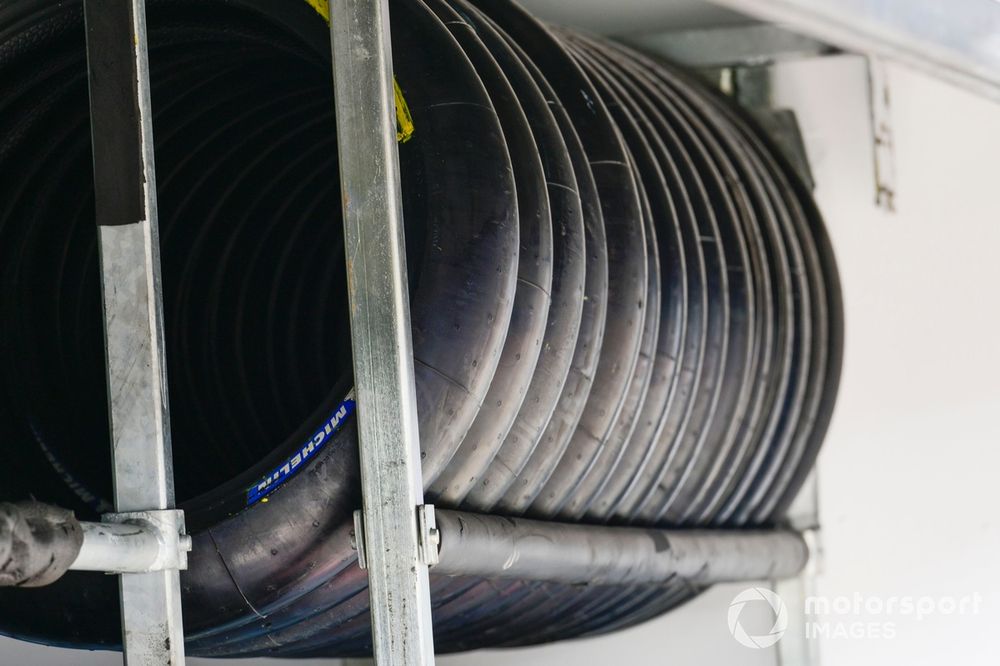
The resurfacing has also had an unintended consequence, with Michelin tweaking its tyre range for Motegi. All three rear tyres are a step harder than last year, while the hard also features a similar reinforced casing to Spielberg.
How these new tyres will react with the new surface remains a question mark for riders up and down the grid.
“We will especially try to understand the new tarmac,” said Gresini’s Alex Marquez. “Here, holes or bumps were never a big issue. It was more like issues from low grip, so we’ll see if with the new tarmac if it’s a little bit better.
“But also, we’ll have harder tyres on the rear, so we need to understand what the difference is and how we need to adapt.”
This is another area where Nakagami and Honda have an advantage, having already accumulated experience on the stiffer rear tyres at Motegi.
“The good thing is that the tyre allocation this weekend is a little bit different than last seasons, so at least we already completed some laps to test it,” he said. “We got some data, so maybe we can use it, so I don’t know how much advantage I had, but we are ready to get a good performance.”
While all three rear tyres are stiffer than last year, Michelin’s reinforced hard compound is the most extreme option in the range. But riders see no incentive to run the hard tyre this weekend, especially with softs and mediums more than capable of lasting the distance.
“It’s not an option,” Jack Miller said of Michelin’s hard compound for Motegi. “If we’re using that tyre, I pack up and go home. I’m being sarcastic, but at the same time, I’m not. We’ll see what we can do this weekend.”
Weather
Weather could again play a big role at the Japanese GP, with a 40% possibility of rain on Sunday afternoon. Conditions could quickly change in Motegi, which is located just 70km west of the Pacific Ocean.
We want your opinion!
What would you like to see on Motorsport.com?
– The Motorsport.com Team
Disclaimer : This story is auto aggregated by a computer programme and has not been created or edited by DOWNTHENEWS. Publisher: motorsport.com




