
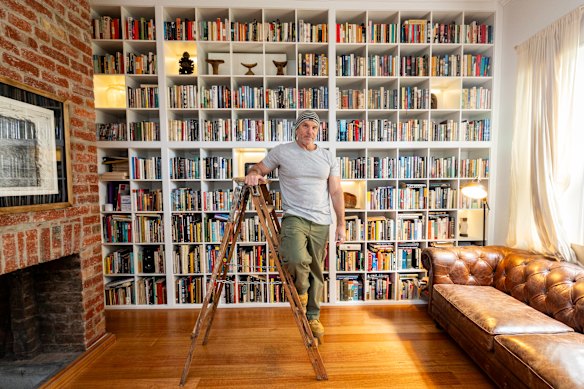
In a digital age, paper books are as popular as ever. But why do we hang on to them after we’ve read them? And what’s a “bibliomaniac”?
Danny Yee faced a dilemma 15 years ago when he and his partner moved from Sydney to Britain: what to do with all the books he’d amassed over the years? If you’ve ever moved house, you’ve probably been in the same predicament. They’re heavy, they take up space, they’re a pain to shift. If you’ve actually read the books, then why keep them – will you ever read them again? Then there are those books you’ve accumulated but never opened and probably never will, possibly stacked neatly on that Ikea bookcase or languishing in a holding pattern on your bedside table.
The Japanese have a word for this: tsundoku, from tsunde-oku, meaning to pile things up for later, and dokusho, the reading of books. If you have older children, there’s probably a Harry Potter or 10 on a shelf somewhere destined to never again be pored over. Some volumes might even date back to a burst of optimism in your own youth when you thought you’d have the time and inclination to brave Finnegan’s Wake, Infinite Jest or War and Peace … but never did.
Before he went overseas, Danny Yee, an IT specialist, estimates he had 3000 volumes, the result of simply acquiring books over time. “When I was a teenager, my trip home from school took me past Tyrrell’s Bookshop in Crows Nest in Sydney, which at that time was a general secondhand shop where most paperbacks were $2. And my pocket money was a (then) generous $10 a week, so I could buy pretty much a book a day.” When he moved to the UK, he shipped only the books he hadn’t read, put the rest in storage and planned to give away any that remained unread when he returned to Sydney. In the end, he never moved back. “So we ended up shipping the rest of the books, which had been sitting in boxes under my mother’s house for some time.”
For some, collecting books is a passion that scratches a particular collecting itch. But many of us occupy a middle ground: our books are not necessarily prized possessions but are somehow too valuable to throw away, even if, technically, they’re not worth much at all (and op shops probably won’t even take them). Why do we hang on to them? And what’s the difference between a bibliophile and a “bibliomaniac”?
In the age of Kindle, why have paper books?
Like the first Apple iPod music player, launched in 2001, which promised “1000 songs in your pocket”, Amazon’s Kindle e-reader and similar competitors offer overwhelming convenience compared to their paper-based, or analogue, predecessors: even a basic e-reader can hold 3000 books while models with extra memory can contain 20,000 or more, equivalent to that of a small municipal library (perhaps they should have called it the Tsundoku). Lightweight, waterproof and with a built-in light so you can read in the dark, these must be better, surely, than a traditional book in every way.
Well, not necessarily. “For disposable fiction, the sort of thing that you might read on a plane or a beach, or you read it once, the e-reader is a good format,” concedes Tim White, owner of the specialist food and wine bookstore Books for Cooks and president of the Australian and New Zealand Association of Antiquarian Booksellers. “But for things that require illustration, that have a design component, the physical, I think, really matters, particularly for illustrated nonfiction.”
‘We are seeing a resurgence in collectors, particularly young collectors. Gen Z and younger are interested in the physical object’.Bookseller Tim White
Sydney writer, editor and designer Yvonne Frindle makes the same concession. She maintains a personal work library – mostly focused on music, the arts and design – of around 1500 physical volumes. She buys e-books only when it’s expedient but doesn’t mind the format for fiction because it’s linear: “You start at the beginning, you read to the end, and that’s it,” she says. “But I don’t find the e-book format very friendly for non-fiction books when I’m working because I like to have them around me, open on the floor, and to be able to consult multiple books at once. The physicality of the book and where information sits in a book is really important to me.”
Indeed, bookshops continue to flourish. The Japanese chain Kinokuniya recently expanded from its sole Australian outpost in Sydney to Melbourne, where a concept store offering “a carefully curated selection of Australian and international literature, Japanese and Chinese language books, manga, children’s books, stationery, gifts and lifestyle products” will become a permanent large-scale offering in 2028.
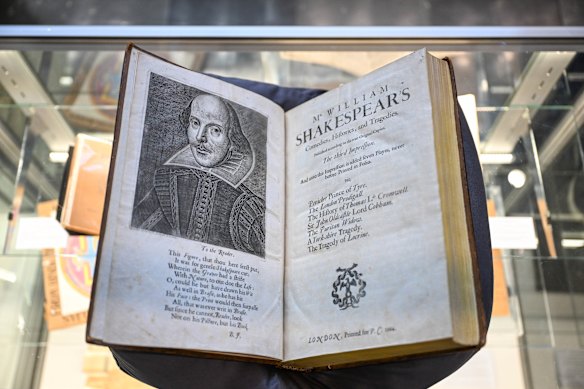
Much as vinyl has made a comeback – including in the popularity of earnest “listening rooms”, anchored by old-school turntable hi-fi systems – so has a connection to paper books endured. “We are seeing a resurgence in collectors, particularly young collectors,” says White. “Gen Z and younger are interested in the physical object. We had a record number turn up to [Melbourne’s] Rare Book Fair this year [Sydney’s is from October 22] and the people who attended were much younger, on average, than we had experienced ever before.”
Amos Groth’s company, Groth and Sons, designs and builds bespoke home libraries. “A collection isn’t simply information,” he tells us. “It becomes autobiographical. You can look along somebody’s shelves and learn something about them: what interested them at 20, what they studied, where they’ve travelled, what they inherited, what they became curious about.”
For Alastair Lamb, a Melbourne librarian and collector, his books at home are an ever-present visual callout. “If they’re physically around me and they just occupy the space, they’ll occupy my mind in some way. The more I’ve read and the more I feel attached to certain books, I think I understand what they mean, that you can kind of be changed over time by a book, not even necessarily by reading it from cover to cover, but even just having its spine poking out at some level. That is the first stage of engaging with a physical book, right? It’s there, asking to be flipped through again or reminded about. Probably I won’t read this book for 10 years, but then 10 years down the line, you can say, “I had that book on my shelf for 10 years and it’s finally time to read it”, and then you do, and it’s wow!”
When did home libraries become a thing?
The ancient Mesopotamians, who lived 4000 years ago in what we now know as Iraq, had proto-libraries at home: a room where they stored cuneiform tablets. By 335BCE, we know from historical records that the philosopher Aristotle had amassed a private collection of medical and technical texts, which did not survive.
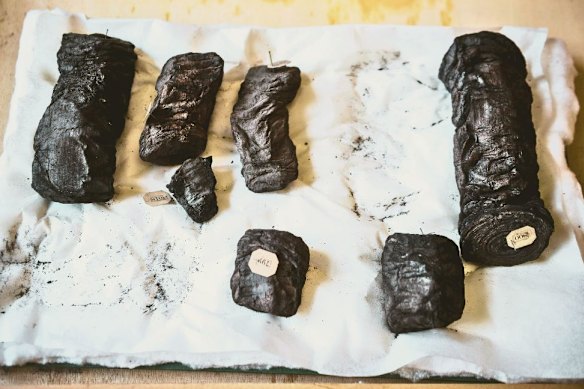
The earliest intact library are the 1800 papyrus scrolls from a Roman villa in the city of Herculaneum that were carbonised, and miraculously preserved, during the eruption of Mount Vesuvius in 79CE, which buried Pompeii. The catch: the scrolls, discovered in the 18th century, were rolled up and any attempt to unravel them has reduced them to fragments, even dust. Yet they are slowly being deciphered using a form of X-ray and AI (so far, they’ve had a lot to say about the philosophy of Stoicism).
While the printing press replaced scribes in the 1440s, it was not until the 1900s that libraries, as we recognise them today, flourished in wealthier households across Europe – stately rooms crammed with luxurious leather-bound volumes that were as much status symbol as they were a reference resource.
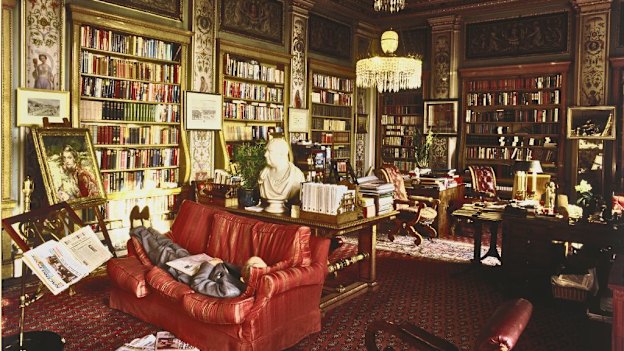
Flash forward and COVID somehow turbocharged interest in physical books, both as an antidote to infernal screens and, thanks to the sudden prevalence of video calls, the odd trope of appearing on camera in front of a bookcase, adding what The New York Times described as a “patina of authority”. It occasionally backfired when eagle-eyed viewers spotted something ridiculous or controversial behind the talking head. Former British prime minister David Cameron, for one, was sprung reshuffling his bookcase so his memoir featured prominently.
For some, the books are never meant to be read but are displayed as decor. What interior designers call “book drenching” or a “book wrapt” aesthetic conjures a cosy, antiquarian mood in which every wall and available surface is piled with books, which might have been purchased by the metre (yes, that happens). There have even been somewhat extreme trends to display volumes with the spines facing inwards or the whole lot wrapped in cream paper dust jackets for a uniform look.
‘The act of acquisition is only the first step. Using and enjoying what you’ve acquired is key.’Bookseller Barbara Hince
Yet none of the dozen or so book lovers and dealers we spoke with for this Explainer places much emphasis on appearances. “Only a handful of buyers are choosing books to decorate their homes,” says Barbara Hince, who manages Kenneth Hince Old & Fine Books in Hartwell, Melbourne. “Almost all are motivated by the personal engagement we get from reading – engagement in language, expression and ideas, and with human civilisation and creativity. The act of acquisition is only the first step. Using and enjoying what you’ve acquired is key. Building a collection isn’t static; it’s fed by your interests, which evolve as you continue reading and collecting.”
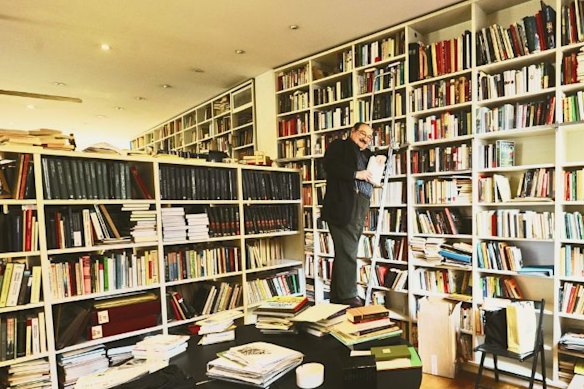
Far more front of mind for many is simply how to store their burgeoning collections. The Italian writer Umberto Eco admitted he had a “fairly sizeable” library, “large enough that in my case that somebody entering our house can’t help but notice it; actually, it takes up the whole place … the visitor enters and says, ‘What a lot of books, have you read them all?’” (Ten years after Eco’s death, more than 30,000 of his books are now housed in the Palazzo Poggi in Bologna, arranged just as he had them in his home studio, by the “good neighbour” principle: in unlikely but potentially inspiring combinations. Closer to home, a new library recently opened at the Museum of Old and New Art (MONA) in Hobart, many of the 30,000-odd volumes belonging to founder David Walsh, with a high-tech system allowing books to be arranged by any logic, yet still be findable.)
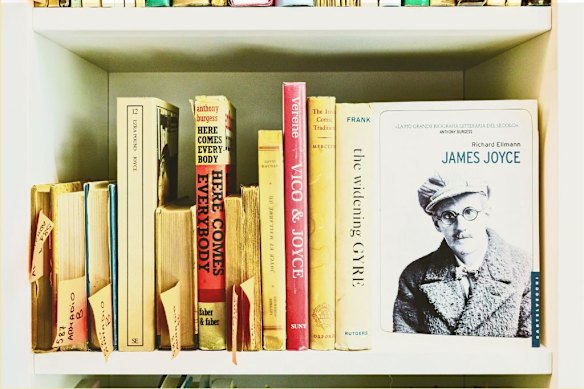
These days, Danny Yee, who has reviewed more than 1600 books at his old-school website dannyreviews.com, tries to stick to a “one in, one out” policy, disposing of enough volumes to maintain equilibrium. “It’s not a gargantuan library,” he tells us, though many of his shelves are double-stacked.
‘A successful library is a room for people, not books.’Home library designer Amos Groth
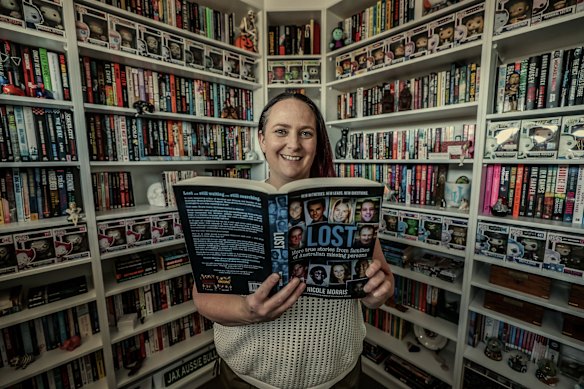
Tammy Egglestone, a Melbourne collector of true crime, has filled a spare bedroom with floor-to-ceiling bookcases, a couch for reading and a coffee table to park works-in-progress. “They’re all my babies,” she says. “Even if I didn’t love a book or I didn’t finish it because it was just not for me, it’s still in my collection. I have this weird obsession with my books. I don’t loan them out to anyone. I don’t even let my husband touch them. If he comes in, I’m like, ‘Why are you in this room? Get out’.”
Says Groth, “there is a temptation to think that a home library is fundamentally a storage problem. I think that’s the wrong starting point. A successful library is a room for people, not books. The books provide its character, but there still needs to be somewhere comfortable to sit, somewhere to read, good lighting, sensible access and often somewhere for conversation. Some of the best libraries we’ve made aren’t silent little temples to literature. They’re very social rooms.”
How do people catch the collecting bug?
For some book collectors, the line between bibliophile (those who love books) and bibliomaniac (those who, for whatever reason, are compelled to collect them) can be perilously narrow. What to make of the American book collector Richard Macksey, a professor at Johns Hopkins University in Baltimore, who amassed around 51,000 titles by the time of his death in 2019, among them valuable first editions of Herman Melville’s Moby Dick and T.S. Eliot’s Prufrock and Other Observations, worth many thousands of dollars, but who had also apparently forgotten about several other first editions by 20th-century poets and novelists he had left sitting “on a shelf in the laundry room”, reported The New York Times.
Or Tom Verlaine, frontman for 1970s punk band Television, a collector of a different ilk, who died in 2023, having amassed a library of 50,000-plus titles about literature, art, the occult and spirituality almost entirely gleaned from discount bookstores (alongside some 4000 vinyl albums).
‘Hoarding is an issue but collecting is, I think, endemic to the human condition. It gives us comfort.’Bookseller Tim White
Books for Cooks’ Tim White describes collecting as “a gentle madness”. “Hoarding is an issue but collecting is, I think, endemic to the human condition. It gives us comfort.”
What people focus on is often eclectic but rarely random. Yvonne Frindle’s library has a functional role, but she’s also drawn to “weird stuff” within her areas of interest, often acquiring “obscure books that are maybe out of print, or that I suspect I wouldn’t be able to borrow or buy if I needed them in the future”.
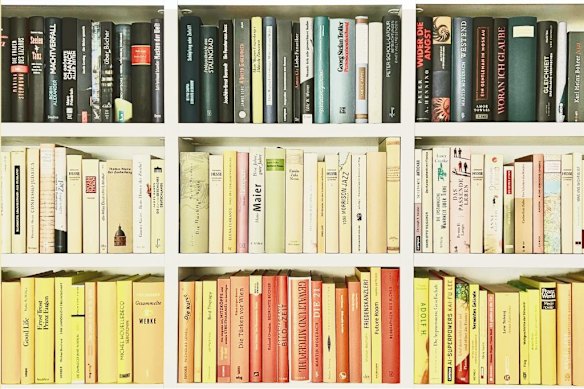
Yee has somehow amassed a collection of Hungarian and South Korean literature in translation. For Tammy Egglestone, it was the Frankston serial killer in Melbourne, from the early 1990s on, that hooked her on true crime. She now some 600-odd crime volumes in her purpose-built, 850-book library. “I became fascinated with understanding why someone, particularly a serial killer, does what they do. From there, I started reading everything I could get my hands on when it came to true crime. Over the years, my collection has just continued to grow.” She has already read six books about Erin Patterson’s “mushroom killer” trial, which she attended. “I like to read all the evidence and hear everything for myself, and then form my own opinion based on what I’ve learned.”
Sydney accountant Margaret Lokmer collects books on nationalism, stemming from her uni days when she researched ethnicity and the pursuit of national identity, with a focus on the Bosnian conflict of the early 1990s. “There are the ones you devour and plan to re-read, there are some you use as a reference book, you think, oh, that might have something in it – but there’s many there that I haven’t read,” she admits.
Melburnian John Cleaves has a vast assortment of original pulp-crime paperbacks from the 1940s and 1950s alongside biographies of musicians, a few shelves of World War II histories and a collection of the adventures of the fictional flying ace Biggles, a throwback to his childhood. “And we’ve got a shed out the back that’s also full of books,” he adds. “I started to collect when I started work [in financial management] in 1960 at the Melbourne Town Hall, opposite Collins bookshop, and I used to go in there and I started buying books. And after a while, I worked out if you went to a secondhand shop, they were a lot cheaper.”
‘I’ve got all of J.D. Salinger’s works, not only Catcher in the Rye, which I’ve got six copies of, different covers. How could I part with one?’Collector Mary-Jane Boughen
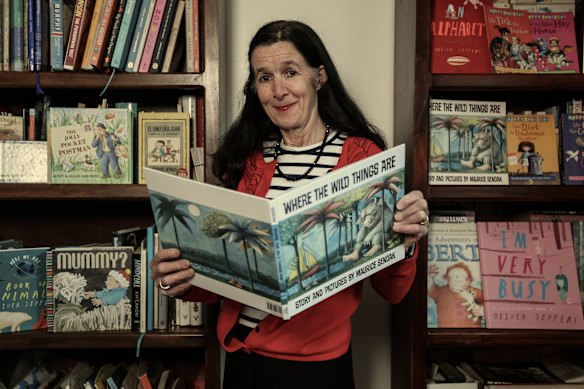
Mary-Jane Boughen, a Melbourne high-school teacher who has studied children’s literature, has a collection of picture books, particularly the works of Oliver Jeffers, Bob Graham, Raymond Briggs (“I’ve got everything”) and Maurice Sendak, author of the classic Where the Wild Things Are, in several languages. “I have four children. One went to Spain for a year, and he returned with the Spanish version. And then my other son went to Sweden and found me the Swedish version. I’ve got the Maori version, the German version. It’s interesting to look at it in other languages, compare the sound effects, and so on.” Oh, “and I’ve got all of J.D. Salinger’s works, not only Catcher in the Rye, which I’ve got six copies of, different covers. How could I part with one?”
Some collectors delight in mint signed editions, others in volumes that tell the story of the previous owners, crammed with bookmarks, handwritten notes (marginalia), forgotten bus tickets and other ephemera. “My favourites are the books where the author or an early owner has added something that enhances the book’s significance,” says Barbara Hince. “As an example, an 1878 two-volume study of Indigenous tribes in Victoria to which a man who published his own work on the same subject a decade later has added manuscript observations and opinions – books which transport you back to the time of their creation.”
Cookbooks are especially revealing, says Tim White: “An owner’s name, clippings, annotations, sometimes swear words, often explanatory notes or alternatives where they’ve scaled the recipe up or down or because grandfather doesn’t like sultanas, these tell unique stories. A perfect copy is important to understand the physical history of the book from a publishing, author-orientated process, but so is understanding its social context and how it’s actually been used.”
‘It’s a great feeling to go into an op shop and find a book that you know is, like, a $1000 book and you pay three bucks.’Collector Kevin Kennedy
For Kevin Kennedy, a public servant from Melbourne’s Preston, much of it is about the thrill of the chase. His prey of choice is rare Australian publications, rare children’s books and modern first editions – think Tim Winton’s Cloud Street from 1991 – preferably scoured from op shops or garage sales, though he will cough up for (close to if not) market value on the internet if it’s otherwise impossible to complete a set. “But to be honest, I prefer just to go out and do the op shops. It’s a great feeling to go into an op shop and find a book that you know is, like, a $1000 book and you pay three bucks.”
It’s not about the money, though. “In the end, it doesn’t come down to that – I don’t think I’ll ever sell them.” Kennedy caught the bug while working in quirky inner-city bookshops in the early 1990s. “They were pretty cool, hip little places to work,” he recalls. “It was a different era back then. Writers and artists and all sorts of weird people would come in on the weekends and we’d sit there and smoke and drink coffee. I learnt very quickly what was worth money and what’s not. My love of collecting started there and I pretty much haven’t stopped.” Most of his collection is housed in a floor-to-ceiling bookcase that’s seven metres wide, dominating a room, “and there’s books in piles that I have to put away”. How many does he have today? “Honestly, I haven’t got a clue.”
‘You can either be a collector or a seller, but you really can’t do both.’Bookseller Marshall Silver
Perhaps oddly, while some of the professionals in the book trade are collectors, others aren’t. “You can either be a collector or a seller, but you really can’t do both,” says Marshall Silver, owner of Sydney’s Rare Aviation Books, who estimates he has had between five and seven thousand volumes pass through his hands. “I avoid the temptation to buy it and hold it for myself because I feel it’s more important to make it available to customers who are starting their collections.”
Neither does Barbara Hince collect. “As a dealer, I can range across a greater number of subjects and genres, depending on what’s offered to me. I get satisfaction from finding the right home for a book. Also, as a merchant, I need cash-flow.” Conversely, Tim White has around 10,000 books of his own at home, not just food and wine but ancient travel guides, books in medieval Japanese, a huge collection of 1920s so-called “pocket books”, cheap volumes “designed for the person who’s getting in a third-class carriage on a railway to go to work and needs a book”. Not to mention his “sizeable” collection of books … about books. “I’m a bibliophile.”
Ultimately, says Amos Groth, a rewarding personal collection “isn’t curated overnight. It accumulates slowly. There are books bought because somebody recommended them, books inherited from parents, books from university, books associated with particular places or periods of our lives, books we’ve never quite got around to reading and books we’ve read so many times they’re falling apart. That’s why I don’t think the home library is disappearing. The information contained in books can certainly be digitised. The life contained in a collection can’t.”
Get fascinating insights and explanations on the world’s most perplexing topics. Sign up for our weekly Explainer newsletter.
Disclaimer : This story is auto aggregated by a computer programme and has not been created or edited by DOWNTHENEWS. Publisher: www.smh.com.au



