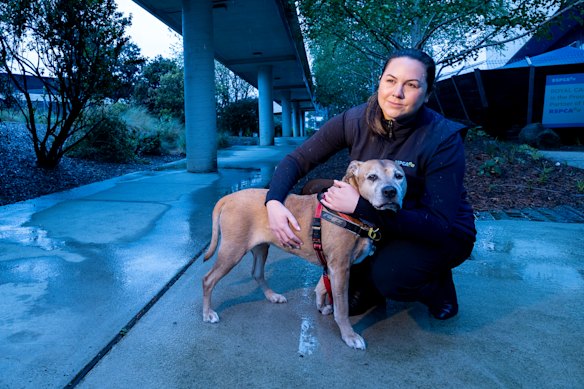

The day Lauren Roberts met a little dog named Mylo was the moment she realised animals being harmed by family violence perpetrators to control their human victims was not just statistically likely, but real.
As an animal welfare inspector with the RSPCA, Dr Roberts was called by a vet treating a Maltese cross for what the clinician was told was a “clipping injury” caused by a grooming accident.
“The vet said, ‘The story we received doesn’t quite match the injuries we’re looking at’,” Roberts said. She soon began to suspect both the badly wounded dog and his female owner were victim-survivors of violence.
After several conversations with the distressed owner, Roberts learnt the woman’s adored pet had indeed been stabbed by her intimate partner, “and shortly after that, she showed me her thigh, which was black and blue”, Roberts said.
“It was then really clear and obvious this was a case of domestic and family violence, and the dog had been injured deliberately – that victim-survivor loved that little dog and [hurting him] was clearly an intentional act to harm [the owner] further.”
That matter became an issue for police, who charged the perpetrator with offences including animal cruelty. For Roberts, it became a turning point.
“Even though you know the data, and you know 70 per cent of families where domestic and family violence exists have pets, when you get confronted with it and realise, ‘My god, this isn’t just a statistic, it’s in front of me’ … it’s almost surreal,” Roberts said.
“That was the moment for me when I went, ‘Things have to change’. We can’t work in isolation and have animal and human welfare organisations working so separately.”
In the two years since, the inspector has examined what can happen to pets in dangerous homes where women (statistically the main victim-survivors affected) are trying to flee. Roberts has learnt that many violence victims are torn about leaving dangerous homes, or decide to stay because they can’t take their pets to crisis accommodation and won’t risk leaving them.
She has arranged emergency boarding care so survivors can flee without fear to human shelters, and set out to create a network of foster carers though the RSPCA, which can urgently take and nurture victim-survivors’ pets even if animals are traumatised by what they have experienced.
In 2024, Australian Institute of Family Studies (AIFS) research noted that harming or threatening to harm pets is a recognised family violence method. Professor Kate Fitz-Gibbon, an international expert in violence against women and children, confirmed the importance of pets’ safety to survivors’ wellbeing.
“Threatening, harming or killing a pet can be a very deliberate form of coercive control. I have interviewed numerous victim-survivors who described perpetrators who targeted pets they loved to frighten, or punish them. And critically, to instil fear by showing the harm he is capable of enacting,” Fitz-Gibbon said.
“Perpetrators may threaten to hurt [pets] if a woman leaves, refusing to let her take them, harming them as punishment, or using access to the animal to maintain contact after separation. Abuse of a pet needs to be understood as part of a broader pattern of coercive and controlling behaviour.”
Fear for pets’ lives can make women too scared to leave, Fitz-Gibbon said, and this can be and is exploited by perpetrators to keep intimate partners under control.
“Victim-survivors shouldn’t have to choose between their own safety and the safety of a much-loved pet. Knowing that an animal can be taken somewhere safe, confidential and properly cared for can make it more possible for a victim-survivor to leave an abusive partner,” she said.
In a 2024 report into how fears for pets are a barrier to escaping family violence, AIFS researcher Kylie Butler said many victim-survivors report staying with a perpetrator longer, not leaving at all, or returning out of fear for a pet’s safety – especially if the animal has to be left behind.
Dogs and cats are the most targeted, but any family animal that the victim-survivor has a connection to can be at risk, including birds, fish and horses, Butler found. Violence towards pets can include threats or actual physical or sexual abuse, verbal abuse or deliberate neglect.
Victoria Police family violence risk assessment data showed that between July 2020 and June 2025, there was an 81 per cent increase in the number of incidents where a perpetrator threatening or harming a family pet was identified as a risk factor.
Roberts’ plan to get pets and people to safety is taking shape. She now oversees the RSPCA’s new philanthropy-funded program, SafePaws, which received start-up funding from the Petbarn Foundation.
In five months, 59 women, with 104 animals between them, have been referred to the SafePaws program by family violence support workers. So far, the program has arranged 310 nights of emergency boarding for 24 of those animals. Roberts hopes donations will help cover the cost of a full-time staffer for the program.
Not all owners required emergency boarding for their pets, and some only needed supplies, preventative vet care or advice, which are all offered as part of the program.
Jody, a family violence survivor whose cavoodle, Ronnie, ran across a busy road to follow her when she fled a violent home with three young children, said such a service would have been a huge help had it been available when she left several years ago.
Jody (who cannot be identified as her children are now on family court orders) wrestled with her former partner for the car keys to get away, failed, but managed to run away on foot, followed by Ronnie. Thankfully, the small dog was not hit as he chased her and caught up, but he is still recovering from neglect and abuse.
“He has a lot of anxiety now, and is quite an anxious dog around people – there’s knock-on effects for dogs as well,” said Jody of her nine-year-old pet.
Support for pets living with family violence is vital for them, and their owners. “It’s so important; they get impacted, and they also feel the pain you are feeling,” she said. “This also impacts the children. They need to know their pet’s safe as well, their pet is often the one thing that is constant. He brings them joy and peace of mind.”
If you or anyone you know needs support, you can contact the National Sexual Assault, Domestic and Family Violence Counselling Service on 1800RESPECT (1800 737 732), Lifeline 131 114, or Beyond Blue 1300 224 636.
Start the day with a summary of the day’s most important and interesting stories, analysis and insights. Sign up for our Morning Edition newsletter.
 Wendy Tuohy is a senior writer focusing on social issues and those impacting women and girls.Connect via X or email.
From our partners
Disclaimer : This story is auto aggregated by a computer programme and has not been created or edited by DOWNTHENEWS. Publisher: www.smh.com.au