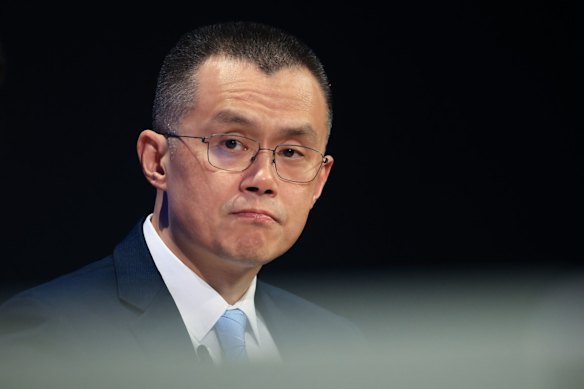
Abu Dhabi, United Arab Emirates – One morning in June, cryptocurrency mogul Changpeng Zhao pulled up to the St. Regis resort in Abu Dhabi, United Arab Emirates, in a Nissan SUV.
Zhao is the richest man in crypto, worth an estimated $US114 billion ($164 billion), and he lives in a villa nearby, with nine bedrooms, four bodyguards, a chef and a yacht.
But he also likes to play the part of a “normal dude”, as he often describes himself, and that day he had offered to give me a personal tour of the city.
Zhao, to be clear, isn’t a normal dude. Not long ago, US authorities brought a criminal case against him for his management of Binance, a crypto exchange depicted in court papers as a haven for Russian money launderers, Iranian sanctions evaders and Islamic State terrorists. Zhao pleaded guilty and escaped with his fortune intact. After serving a four-month prison sentence, he returned to Abu Dhabi, still Binance’s majority shareholder and still the most powerful figure in the industry.
These days, Zhao, 49, moves through the world like a head of state, flying around Asia on his private jet to advise governments on crypto regulation.
Zhao’s most influential allies are a pair of powerful ruling families. One is the clan that runs the UAE, which wants his help creating a technology powerhouse in the desert. The other is the Trumps.
Last year, Binance forged a business relationship with World Liberty Financial, the crypto start-up founded by US President Donald Trump and his three sons. World Liberty generated $US799 million for Trump last year — his single most lucrative asset. Trump pardoned Zhao last October, a move widely criticised as a quid pro quo.
Known in the industry as “CZ”, Zhao often avoids reporters, but he met me several times this year, eager to put a friendlier gloss on his career at Binance, which still hasn’t stanched the flow of dirty money.
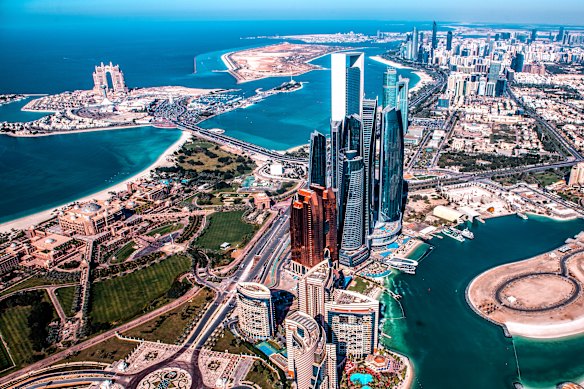
For years, his true calling has been what academics term “jurisdictional arbitrage” — moving from country to country in search of a legal framework pliable enough to accommodate his appetite for risk and growth. In Abu Dhabi, he may have found an ideal base of operations. As we drove into the city, we passed a string of impressive compounds and drove towards the presidential palace, Qasr Al Watan, whose striking white dome resembles the Taj Mahal.
Zhao was growing animated. “Democracy has been hailed as, like, the holy grail for the last couple hundred years, but democracies are inefficient,” he said. “If you get a benevolent dictator, it’s actually extremely efficient. There’s very little debate going on. You don’t waste time on a lot of frivolous stuff.”
Lately, this top-down model of business and politics, simultaneously medieval and ultramodern, has gained traction in the United States. On a trip to Abu Dhabi last year, Trump called the nation’s ruler, Sheikh Mohammed bin Zayed Al Nahyan, “a very strong man” and “a man of vision like few others”.
Zach Witkoff, the son of one of Trump’s top advisers, put it more bluntly at a crypto conference in Dubai, United Arab Emirates, in May 2025. “We really need to take a page out of His Highness’ and the Emirates’ book,” Witkoff said. “They are just an amazing example of how you can lead with innovation while also maintaining your family values.”
One day early this year, Zhao was working when the windows began to shake. He got up and walked onto his balcony, where he saw a trail of smoke in the sky. Zhao lives on Saadiyat Island, an enclave of Abu Dhabi across the Persian Gulf from Iran, which had just fired a missile at the UAE.
It was the start of a geopolitical crisis that has destabilised the region, but Zhao was not overly concerned. He returned to work.
Until he settled in the UAE, Zhao was a man without a country. He was born in China, then moved to Canada with his family at the age of 12. After attending McGill University, he worked a series of technology jobs. In July 2013, over a poker game in Shanghai, a colleague suggested he check out “this new thing called bitcoin”.
After a few months of study, Zhao made a radical bet. He sold the family home — a three-bedroom apartment in Shanghai where he and his wife were raising two children — and ploughed the $US900,000 in proceeds into bitcoin.
Zhao went on to work at a succession of crypto start-ups in Asia. In July 2017, Zhao founded Binance. Within a few months, it was the largest exchange in the world, a title it has never relinquished.
Binance’s success rested on two pivotal insights. The first was that crypto investors were drunk on risk and would never be satisfied swapping dollars or yen merely for an equivalent amount of crypto. For years, Binance has operated as a margin exchange: Traders can borrow money to place high-risk, high-reward bets on the prices of bitcoin and other popular tokens.
The second insight was simpler yet more consequential. Many crypto investors didn’t want to identify themselves, and Binance didn’t ask them to. For its first four years, the company allowed customers to open accounts without providing even the most basic KYC — the “know your customer” information that traditional companies require to prevent financial crime.
The result was an extremely lucrative free-for-all: a platform where unvetted investment products were available to unvetted traders. As the market boomed, Binance took a cut of each transaction; the company quickly reached $US1 billion in profits, according to Zhao’s self-published memoir, Freedom of Money.
Zhao was suddenly a crypto celebrity. But he has never been widely understood outside the industry. When he recounts his most contentious moments, Zhao portrays himself as a kind of passenger — a crypto nerd overwhelmed by success, a naive outsider.
It is not always a convincing performance. In June, Zhao told me that he had “never really wanted” to break the law in Binance’s explosive early years, when the company’s lax controls allowed a procession of bad actors to launder money. “It’s just my lack of experience in that area,” he said.
That image isn’t compatible with the evidence US prosecutors collected in their investigation into Binance. In court, they quoted an admonition that Zhao had given his underlings: “Better to ask for forgiveness than permission.” Privately, Zhao had discussed ways to obfuscate that Binance served American users even though it wasn’t licensed in the US, according to legal filings. “Don’t leave anything in writing,” he told a subordinate.
Royal treatment
Zhao paid a visit to the UAE in 2021, after years of roaming around Asia. In 2017, he and his Binance colleagues had been forced to flee China, as the government prepared to announce a ban on crypto exchanges. A stint in Japan hadn’t worked out either, nor had Singapore. Then Zhao’s friend, Gabriel Abed, a businessperson who served as the ambassador to the UAE for Barbados, made a suggestion. He told Zhao to check out Dubai.
Immediately, Zhao saw how the UAE treated the rich and powerful. He arrived in Dubai on a Saturday morning in October, and within hours, a government minister, Omar Sultan al-Olama, came to visit. He offered Zhao a so-called golden visa, which grants 10 years of hassle-free residency. A doctor was summoned to conduct the blood test required of all visa holders. Applications often take weeks to process; Zhao was approved in less than 12 hours.
Not everyone in the UAE is treated so generously. Over the years, the nation’s leaders have conducted mass surveillance, outlawed even the mildest forms of dissent, and overseen a labor market where foreign workers are frequently exploited and abused.
But for Zhao, it was the beginning of a comfortable new life. Before founding Binance, he had separated from his wife, who moved to Tokyo with their children. He started a relationship with one of his colleagues, He Yi, a marketing executive. While his older children attended college in the US, Zhao and He raised a young family in the UAE.
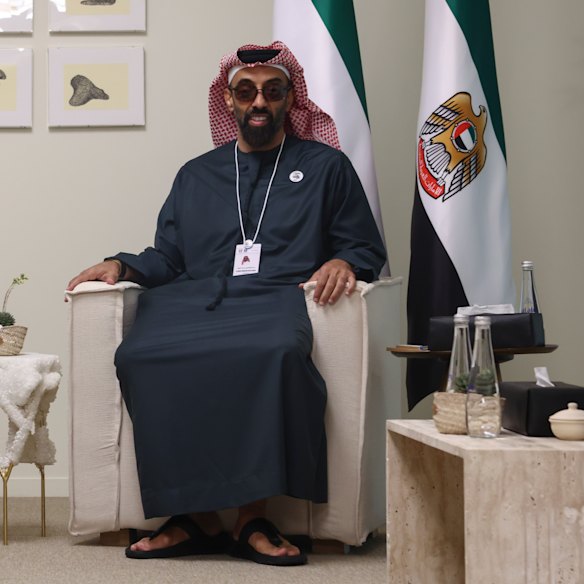
Zhao got to know a group of Emirati leaders who were curious about technology. Eventually, he worked his way up to the brother of Sheikh Mohammed, Sheikh Tahnoon bin Zayed Al Nahyan.
During these early encounters, the sheikhs would pitch Zhao on the UAE, asking what they could do to help him. Soon, Zhao was preaching the nation’s virtues to the broader billionaire community. He encouraged artificial intelligence mogul Sam Altman to set up a corporate presence in the UAE, warning that other countries would treat him with hostility.
Billionaires gravitate to the UAE for billionaire reasons. The country doesn’t levy an income tax, and it’s considered extremely safe, at a time when crypto investors have been targeted by kidnappers in Europe and the US. But for Zhao, the UAE held another important advantage: It had no extradition treaty with the US.
In either late 2022 or early 2023, he recalled, an Emirati royal asked him over dinner whether he wanted citizenship. Zhao sent in some documents and waited. Months later, a government emissary arrived at his house, holding a box with passports for Zhao and his family.
He had reason to be wary: The noose around Binance was tightening. US prosecutors were collecting evidence that the exchange’s lax protocols had allowed scammers, hackers and sanctions evaders to move money. In private messages obtained by the government, Binance employees spoke with astonishing candour about the exchange’s shady clientele.
Zhao hired a team of lawyers to broker a deal with the US Justice Department. His new passport gave him considerable leverage. After a couple of years in Dubai, he moved an hour-and-a-half south to Abu Dhabi, closer to the nation’s centre of political power.
Eventually, his legal team struck a bargain with the US government. Zhao would plead guilty to violating the Bank Secrecy Act, an anti-money-laundering statute, and step down as CEO. (The company would pay a $US4.3 billion penalty.) Despite the generous terms, he was frustrated with his lawyers and didn’t think he deserved any prison time at all.
Still, it was an excellent outcome for Binance. At the sentencing hearing in the spring of 2024, Zhao delivered a contrite statement: “I deeply regret my failure, and I’m sorry.” The judge gave Zhao a four-month sentence, calling him “a dedicated family man and a giving person”.
As the rare felon with virtually unlimited resources, Zhao was ideally positioned to suffer as little as possible. He was assigned to Lompoc II, a low-security facility in California. Before he reported to prison, Zhao assembled a team of advisers, who schooled him in the subtleties of cellblock politics. One of them, Michael Santos, exchanged letters with other inmates, who agreed to help Zhao get his bearings inside. “CZ, you’re a guy who’s understood people and had thousands of employees,” Santos told him. “You’re not going to lose those skills when you walk in here.”
In August 2024, Zhao left Lompoc for a halfway house. But a complication with his immigration status meant he had to spend his last two weeks at a local jail. On the day of his release, an officer escorted him outside, where his mother, sister and assistant were waiting. They drove to a nearby airport and deposited him on a private plane bound for Abu Dhabi.
Zhao returned to a world that was shifting in his favour. A crypto-friendly administration was poised to take power in Washington, DC. Shortly before the election, Trump had founded World Liberty as a joint enterprise with the family of Steve Witkoff, a real estate mogul who was preparing to serve as White House envoy to the Middle East. Soon, America’s newly empowered dealmaker-diplomats were spending lots of time in the UAE.
As he drove me around the city, Zhao paused to point out the ADNEC Centre, a conference hall that hosted a gathering of crypto enthusiasts in December 2024.
“This is where I met Eric Trump,” he said. At the venue, he recalled, a Trump booster named David Bailey had introduced him to the president’s middle son, a leader of World Liberty. It was a casual conversation, with no official agenda.
Their interests were about to align. The UAE had been working to transform from a petrostate into a powerhouse in emerging technologies, a project spearheaded by Sheikh Tahnoon, who oversees $US1.5 trillion in Emirati sovereign wealth. Before he went to prison, Zhao had held talks with Peng Xiao, one of the sheikh’s top lieutenants, about selling the Emiratis a stake in Binance, the ultimate union between his company and his political guardians.
Sheikh Tahnoon is chair of a venture capital fund called MGX, which specialises in AI. Early last year, MGX agreed to invest $US2 billion in Binance, a deal that valued the company at $US75 billion, according to a person familiar with the matter. MGX viewed Binance as the perfect bridge between crypto and AI.
Zhao told me that he wanted to settle the deal in bitcoin. The Emiratis worried that it was prone to drastic price swings that would complicate the transaction. They preferred to pay Zhao in stablecoins, a type of cryptocurrency designed to maintain a price of $1.
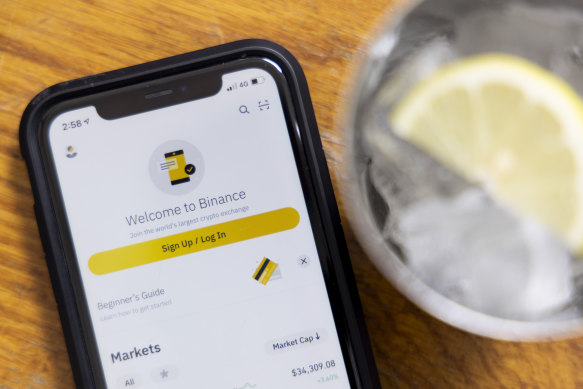
What happened next is widely disputed — and likely to become the subject of a congressional investigation if the Democrats win control of the US Congress in November. According to MGX, the fund evaluated several stablecoins before selecting USD1, a coin created by World Liberty, citing “business suitability”.
It was a stunning choice, given that USD1 was completely untested, with no track record. Last year, The Wall Street Journal reported that Binance had specifically asked MGX to pay in USD1; Zhao said MGX had made the decision.
But all the parties had an incentive to cut World Liberty into the transaction. A UAE-backed investment firm had taken a 49 per cent stake in the start-up in January 2025, days before Trump’s inauguration; Sheikh Tahnoon got a seat on World Liberty’s board. Around the same time, the Emiratis were negotiating with the White House to secure the export of the valuable computer chips that power AI. Binance also had business in front of the Trump administration. With its legal troubles receding, the company wanted to escape some of the restrictions imposed in the 2023 settlement.
Democrats in Congress condemned the deal as “stablecoin corruption”. An issuer like World Liberty makes money by accepting cash deposits from crypto traders, giving them stablecoins in return and then investing the deposits to generate a yield. With the $2 billion from MGX and Binance, World Liberty instantly became one of the world’s largest stablecoin companies, a boon to the Trump and Witkoff families. “It’s just such a craven effort to curry favour,” said Democratic Senator Richard Blumenthal, who has investigated Zhao and Binance. “Unprecedented in its scope and scale of corruption.”
Zhao is adamant that nothing untoward occurred. He said he no longer held the USD1, which he used to invest in bitcoin and other assets. “I assume that President Trump has very good lawyers, and the set-up where the sons run businesses and the father is the president is completely kosher,” he told me.
Two weeks after the $US2 billion transaction, the White House agreed to share access to the chips, overcoming concerns from some US national security officials.
Privately, Witkoff also told an acquaintance that Zhao deserved a pardon, according to a person familiar with the conversation. Zhao had filed the relevant paperwork and was waiting for the president’s verdict. The outcome would have enormous implications for Binance. After Zhao pleaded guilty, the exchange’s dormant US operation lost state-level licences. A pardon could help the company pitch itself to regulators. (A White House spokesperson said Witkoff did not play a role in the pardon process.)
As early as December 2024, Zhao’s legal team had been working with Brett Tolman, a prominent lawyer, to explore the possibility of clemency, according to two people familiar with the matter and documents reviewed by The New York Times.
Ultimately, Binance paid $US2.1 million to a lobbying firm run by Ches McDowell, who is close to the president’s elder sons, for services including “executive relief”, according to public filings. A World Liberty spokesperson said the company had “zero involvement in any decisions on pardons”.
Since prison, Zhao has split his time among a range of ventures, including his tech investments and his travels as a kind of crypto diplomat, helping promote the industry in countries where he’s often treated like royalty.
Zhao downplays his involvement in Binance; the company’s plea deal prohibited him from “operating or managing” the business. But it’s obvious that Binance remains a major part of his life. One of the two co-CEOs appointed to replace him was He — the mother of his three young children.
Two years ago, in a gesture towards traditional governance, Binance established a board of directors with three supposedly independent trustees. One of them is also the board’s chair — Gabe Abed, the friend who first recruited Zhao to the UAE.
Lately, Binance has faced new accusations of impropriety. The company fired or suspended four compliance officials last year, after they reported that nearly $2 billion had flowed from customer accounts to a cluster of entities with ties to Iran — a possible repeat of the sanctions evasion that led to the US criminal case in 2023. The company disputed the employees’ findings and denied that anyone had been disciplined for raising concerns. The Justice Department said later that two Chinese firms had used Binance to launder the proceeds of Iranian oil sales, though it didn’t file any charges against the exchange.
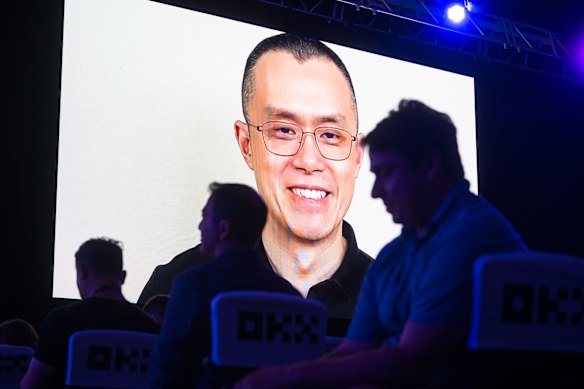
Zhao has the confidence of someone who has glided away from trouble over and over, a consummate winner in an era that often rewards brazen rule-breaking. In his memoir, he writes for a page and a half about his belief in “simulation theory”, the notion that we might all be living in someone else’s imagined reality.
That belief has given Zhao some detachment from the stresses of everyday life. It’s possible we’re versions of Super Mario, he writes, running around an artificial landscape. He tries to live by a simple mantra: “It’s just a game.”
This article originally appeared in The New York Times.
Disclaimer : This story is auto aggregated by a computer programme and has not been created or edited by DOWNTHENEWS. Publisher: www.smh.com.au