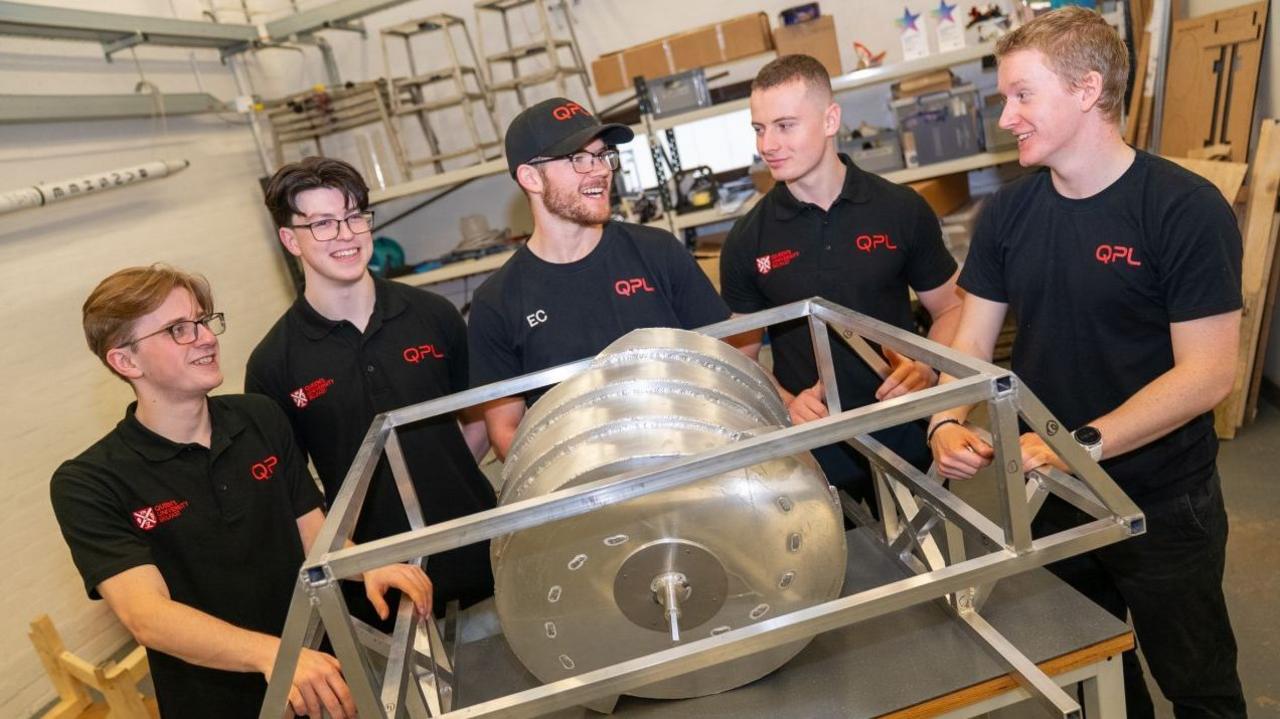
Queen’s University students blast off to US for Nasa robotics competition
-
Published
Could a robot designed by young engineering students from Northern Ireland end up on the Moon?
A team, from Queen’s University Belfast (QUB), are heading to Florida later this month to take part in a Nasa ‘lunabotics’ competition.
Lunabotics is a university-level competition for teams to use the Nasa systems engineering process to design, build, and operate a lunar robot.
The students created a lab-built robot that they will bring to the competition to find out how it would deal with future moon missions.
The robots will be expected to dig up lunar material, drive over obstacles and use the material to form a wall.
Jack Fitzpatrick, who’s studying for a PhD in mechanical engineering, said “it’s a great feeling” to have been invited and they’re looking forward to the opportunity to take part.
 Image source, Queen’s University Belfast
The team of 10 QUB students made it to the competition following their win at the competition earlier this year.
They’ll be competing at the University of Central Florida against university teams from Australia, India and the US.
 Image source, Queen’s University Belfast
Jamie Smith is a third-year electrical and electronic engineering student.
He explained that the team was divided into three groups for software, electronics and mechanical.
Jamie was the software team lead for this project. He said their main task was to control the rover then provide the autonomous capabilities towards it.
And, they had to build rover simulations to test their software before they actually got one.
Jack, however, is part of the mechanical side.
“We analyse that something is physically strong enough, it’s well built enough to survive this environment, it’s going to have the traction to drive in this environment,” he explained.
 Image source, Queen’s University Belfast
Jamie explained they designed the 52 kg aluminium frame robot rover and took it compete at a competition in Milton Keynes.
“We got on very well. We ended up winning the competition and had great fun,” he said.
Then a few weeks later, they were invited to compete at Nasa’s international Lunabotics competition.
Jack said that being asked to go was a “great feeling” and “a real opportunity to demonstrate everything that you’ve learned”.
“It’s just a great opportunity to represent Northern Ireland, the UK and really Europe abroad as we are the only European team that will be there,” Jack explained.
Both of the students said their success was a reflection of both themselves and also the university and the School of Mechanical and Aerospace Engineering.
What does the robot actually do?
Jamie explained that the main objective of the rover is that should be able to drive itself around a lunar-simulated room.
“That means it should start at a point, figure out where it is within this room, travel to an excavation point, so in that point, it will pick up then some sand which is meant to be lunar-simulant.
“It’ll pick up the sand and then deposit it at another location, and it’s meant to do this all by itself.”
Jack explained that the purpose of this is to simulate how real rovers carry out these kind of tasks on the moon.
“It’s being able to autonomously operate on the moon and build environments for humans to later habitat. And that’s the real drive behind why this competition exists,” he explained.
So are they feeling confident they can bring home another win?
Jack explained that there have been several precursor competitions in different countries and this competition takes the top tier of those competitions and brings them together “to really showcase the talent” that there is internationally.
“We are the winning team from the United Kingdom competition and we will be representing the UK and, by extension, Europe at this competition.”
“We may not win the competition this year but we’re building a base upon which we can improve year on year and maybe come back in a few years and really come through with a winning design,” he said.
Caolán Boyle, Head of Robotics at QPL, said the team is “exceptionally proud and excited”.
He said “hundreds of hours have gone into making the rover mission ready for the event”.
-
-
Published27 May

-
-
-
Published19 September

-
-
-
Published1 April

-
Disclaimer : This story is auto aggregated by a computer programme and has not been created or edited by DOWNTHENEWS. Publisher: newsrss.bbc.co.uk