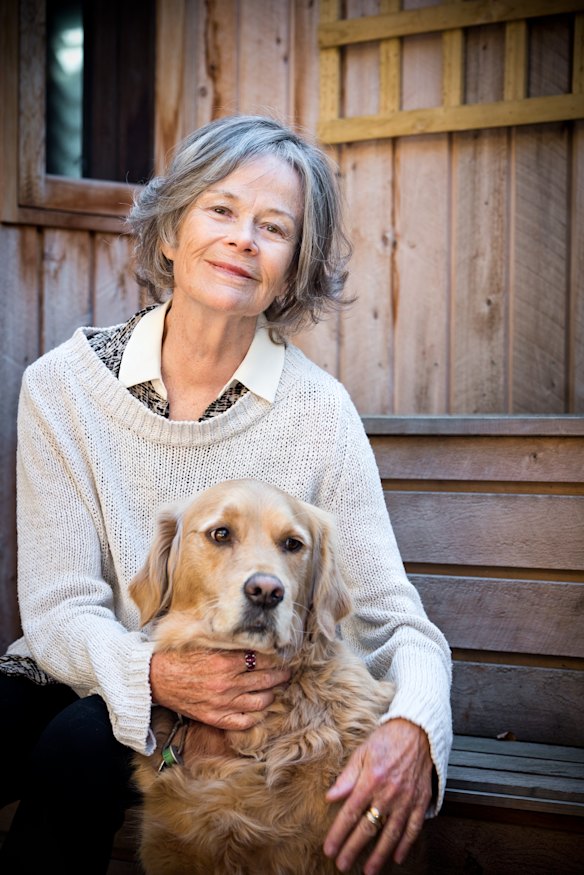

Hilary McPhee – a legend of the Australian literary industry who nurtured the careers of writers including Helen Garner and Tim Winton – died on Thursday, aged 85.
McPhee Gribble, the publishing house she founded with Diana Gribble in 1975, shaped a generation of iconic Australian writers – among them Kathy Lette, Dorothy Hewett, Kaz Cooke, Drusilla Modjeska, Jennifer Dabbs and John Misto. Their slate of influential novels includes Winton’s Cloudstreet, Garner’s Monkey Grip and Lette and Gabrielle Carey’s Puberty Blues.
“I published my first four books with McPhee Gribble. Hilary was a fine editor. I’ll always be grateful for that,” says Garner.
Winton was just 24 when he first walked into the McPhee Gribble offices, housed in a converted factory in Melbourne’s Fitzroy. The young novelist had come to the publishers by way of literary agent Caroline Lurie, after his first publishers Allen & Unwin didn’t want him to write a collection of short stories.
“I was excited and daunted,” says Winton of their first meeting. He was already aware of McPhee’s prowess as the publisher of Monkey Grip.
With Winton working from Western Australia, much of their decades-long partnership unfolded through letters. The pair were corresponding until not long before her death, reminiscing about their time together.
“Her handwriting is very familiar to me, it was always pencil on the page, and she was a sensitive and canny editor. She knew when to push, and she was someone you could trust,” says Winton.
He recalls McPhee showing up unexpectedly at a reading of his in 2024 for his novel Juice.
“She didn’t have any airs and graces, you know, there was the great Hilary McPhee waiting for it to be signed. And she wrote to me afterwards saying how proud she was and how pleased she was to be there.”
Together, McPhee and Gribble were trailblazers in the old boys club of Australian publishing. As McPhee wrote in her 2019 memoir Other People’s Words: “The strong men in publishing liked to call in the late afternoons with bottles of wine and kindly advice: stick to packaging, do horse books or ballet books … put together some recipes … get a good-looking, famous sheila to front them for you …”
Nikki Christer, a publisher who inherited Picador from McPhee (and its writers such as Winton, Lily Brett and Kate Grenville), describes her predecessor and mentor as a “curious”, “loyal” and “incredibly generous” editor with a “deep respect for the writer’s voice”.
“She was part of a generation that transformed Australian publishing. When she and Di created McPhee Gribble, it was largely dominated by overseas publishers and imported books. And so she helped create a publishing culture that put Australian writers and therefore Australian stories at the centre,” she says.
In 2001, Christer published McPhee’s first memoir, Other People’s Words.
“It was a really interesting experience to be on the other side of the great editor who then became the writer. She had her own ideas about it … I did find I was slightly intimidated by her as I think we all were. Not that she made you intimidated, she just was a grand figure of Australian publishing,” Christer recalls.
“She had that way of looking at you where she would close her eyes and lift her chin, and you would know that you’d said something stupid. She didn’t suffer fools.”
McPhee is survived by three children – Sara, Rupert and John. Her business partner and friend, Diana Gribble, died in 2011.
Born in Melbourne in 1941, McPhee’s first foray into the world of publishing was as an editorial assistant at literary journal Meanjin, while studying history and literature at The University of Melbourne.
During these student years, she cultivated wide interests, including launching a small magazine, Theatre, and embarking on archaeological expeditions.
In 1964 – her final year at university – McPhee married artist Peter Freeman, with whom she would have two children.
The pair travelled around Europe and the Middle East before settling in London for a time where McPhee worked at the British Council compiling exhibition books.
Returning to Australia in 1969, McPhee worked at Penguin Australia, then McKinsey management consulting firm as their first female writer, before starting her own publishing house with Gribble, whom she had met through the women’s movement.
Both young mothers, their Fitzroy offices had a crèche, unusual for the time.
“When they got too adventurous – climbing out windows and appearing naked on the first floor, escaping from their childminder – they were sent to childcare very quickly. But for quite a while, we did have children in the office, and it was wonderful having them there. We had a nursery that they slept in and a marvellous woman who’d raised six children looking after them,” McPhee told Kill Your Darlings earlier this year.
A licensing arrangement with Penguin, publishing the hit children’s book series Practical Puffins (which went on to sell three million copies worldwide), helped keep them afloat in their early years as they set about platforming young Australian voices.
The pair published hundreds of titles under their imprint, including those of young Indigenous authors, and fostering the fledgling careers of editors and publishers like Sophie Cunningham and Sue Hines.
Speaking to this masthead in 2022, 46 years after a then unknown Helen Garner walked into their offices, McPhee said:
“Helen arrived one day on her bicycle with two copies of the manuscript of Monkey Grip in green foolscap folders. This is what writers did in those days, you gave publishers two copies. Di and I each took a manuscript home, read it overnight and rushed in the next day and said we’ve got to publish it.”
In 1979, McPhee, Gribble, Joyce Nicholson, Anne O’Donovan and Sally Milner founded Sisters Publishing, a mail order feminist book club that published poetry and fiction “by women, for women”.
But by the 1980s, recession hit the Australian publishing industry and the pair signed a co-publishing deal with Penguin before selling McPhee Gribble entirely to Penguin in 1989.
McPhee stayed on for a few years before moving to Pan Macmillan, where she ran the Picador imprint until 1994 when she was headhunted by then prime minister Paul Keating to become the first female chair of the Australian Arts Council.
There, she played an instrumental role during a turbulent time for the council – leading a controversial restructuring under Keating.
After John Howard was elected prime minister in 1996, he attempted to shut the council down, a feat which McPhee later said embarrassed her terribly when she received an Order of Australia for her services to literature in 2003.
As well as penning two memoirs, McPhee published Wordlines (2010), a selection of contemporary Australian writing, and an annotated edition of filmmaker Tim Burstall’s 1950s diaries, Memoirs of a Young Bastard. In 1998, she received an honorary doctorate of letters from Monash University.
She served on the judging panel of prestigious awards including the Miles Franklin Literary Award, the Victorian Premiers Award and the Melbourne Prize, and was director and acting editor for a time of online political journal New Matilda.
In 2006, fleeing a failed marriage, McPhee moved halfway around the world, chasing a writing project in the Middle East and immersing herself in the lives of other, solo-living women in Italy and England. She detailed the terrifying solitude of this time in her memoir Other People’s Homes.
The Australian publishing industry may not look quite the same as it did in 1976, when McPhee entered the scene, but it’s no doubt all the better thanks to her sharp eye and fierce belief in the people who make it what it is. Her enormous legacy lives on in the pages of Cloudstreet, The Children’s Bach (McPhee’s favourite of Garner’s works) and countless others.
The Booklist is a weekly newsletter for book lovers from Jason Steger. Get it delivered every Friday.
From our partners
Disclaimer : This story is auto aggregated by a computer programme and has not been created or edited by DOWNTHENEWS. Publisher: www.smh.com.au