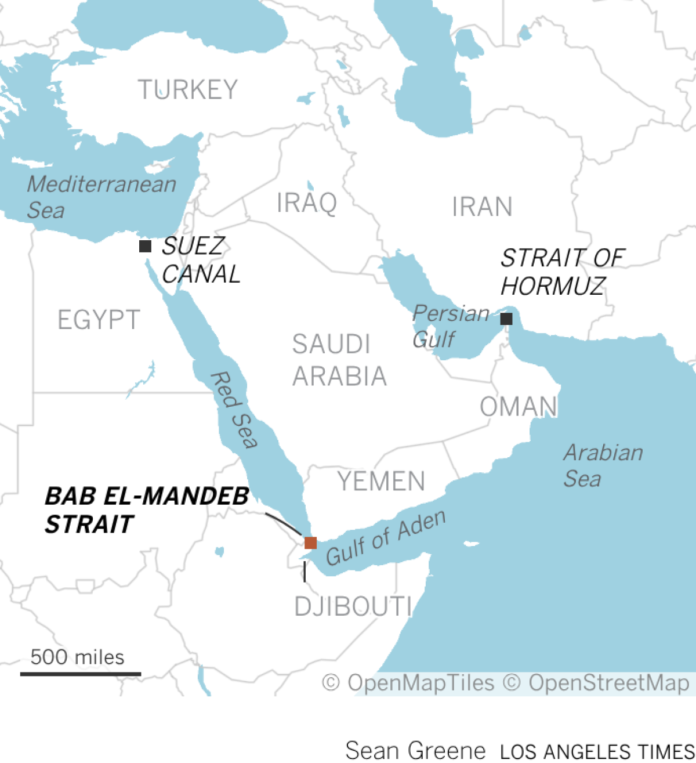
BEIRUT — Yemen’s embattled government and a Saudi-led coalition have launched a major campaign aimed at dislodging Iran-backed Houthis who had recently seized vital parts of Yemen’s Red Sea coast.
The offensive, which had already reclaimed territory overlooking a key waterway, marks a sharp escalation in what thus far been an ancillary conflict in the wider U.S.-Israeli war on Iran.
In a televised address on Sunday evening, Rashad al-Alimi, head of the Yemeni government’s Presidential Leadership Council, announced a military operation to “extend the authority of the state and its institutions over the entire national territory.”
The operation would continue, he said, “until the country is liberated from the control of terrorist militias.”
The campaign comes almost a month after a blitzkrieg offensive by the Houthis saw Saudi-backed government forces collapse in disarray and give up wide swaths of territory along the Red Sea coast, including the Bab el-Mandeb Strait, an important maritime chokepoint.
The Houthis also made important gains inland, all but besieging the strategic city of Taiz, Yemen’s third-largest city, in a move that augured more Houthi advances.
On Sunday, the group said it seized Turbah, a garrison town that lies on the sole supply route linking Taiz to Aden, a key port on the Arabian Sea.
On Monday, Yemen’s military spokesman Majed al-Nuzaily said that “Operation Yemen Dawn” had launched more than 1,100 attacks against Houthi positions. He added that pro-government factions succeeded in clawing back Mokha, the town of Bab el-Mandeb and a nearby airport from the Houthis — claims the group denied.
Video posted on social media by activists accompanying pro-government factions depicted what was said to be the aftermath of attacks on Houthi positions along the Red Sea coast.
“They ran away into the sea. We captured some of them, and the rest were killed,” said one fighter from the Giants Brigade, a pro-government group.
Meanwhile, Maj. Gen. Turki al-Maliki, a military spokesperson for the Saudi-led coalition, said in a post on X that 100 warplanes participated in a Monday raid that destroyed 324 “high-value targets.”
Later, he said the warplanes were providing “air protection” over the Bab el-Mandeb Strait as well as “round-the-clock air support for Yemeni armed forces on the ground.”
When it was first formed in 2015, the Saudi-led coalition consisted of nine nations, including the United Arab Emirates, Qatar and Bahrain along with Egypt, Jordan, Morocco, Sudan and Senegal.
The fighting represents the sharpest escalation since a 2022 ceasefire between the Houthis, Yemen’s government and Saudi Arabia broke down in July.
Officially known as Ansar Allah (“Supporters of God”), the Houthis occupy much of Yemen’s north — its most populated section — and have long clamored for greater control over the rest. Iran has incorporated the rebels as members of its anti-U.S. coalition, the so-called Axis of Resistance, and has provided weapons, training and other aid to the Houthis, which belong to a branch of Shiite Islam.
The Yemeni government is a fragile body that, despite being internationally recognized, has no real foothold in the country it ostensibly rules.
In the days after the ceasefire broke down, the Houthis announced a blockade on Saudi shipping, and launched attacks crippling Saudi Arabia’s oil export infrastructure. That included the East-West Pipeline, the main conduit Saudi Arabia has used to circumvent Iranian and American closures of the Strait of Hormuz.
Then in early September, the Houthis scythed through the Red Sea port of Mokha, along with Dhubab, Bab el-Mandeb and Perim Island. The offensive essentially granted the group control over the Bab el-Mandeb Strait — a move that rocked energy markets already made skittish by the U.S. and Israel’s war on Iran.
Vessels using the Suez Canal must pass through the strait to reach the Mediterranean Sea to the north or Arabian Sea to the south.
This week’s offensive is not the first time the Yemeni and Saudi governments have tried to roll back the Houthis.
After the Houthis took over the capital, Sanaa, in 2014, Saudi Arabia, the UAE and a coalition of Arab nations launched a bombing campaign in support of anti-Houthi forces. That campaign managed to expel the rebels from Aden, but the Houthis — tough mountain fighters who received Iranian training to field and eventually manufacture drones and missiles — proved a difficult adversary.
The war turned into a grinding conflict, killing hundreds of thousands of people and spurring successive health crises and famine. In 2022, after years of stalemate, the government and rebels signed on to a ceasefire.
With front lines frozen, infighting among pro-government factions — which had never been the happiest of allies — broke out into open war, causing a still-unresolved rift between Saudi Arabia and the Emirates.
Experts say those dynamics are likely to bedevil the government’s ambitious plans for a march on Sanaa.
“The government doesn’t have the capabilities, the materiel, nor the cohesion of the forces,” said Hisham Al-Omeisy, a senior Yemen advisor at the European Institute of Peace. He added that previous assaults — when the Saudi-led coalition was larger, there was less fragmentation in anti-Houthi forces and the Houthis were less capable — couldn’t achieve the war objectives the government has now placed.
“It would require a lot more investment, not only from Saudi Arabia, but also from the U.S,” he said.
In any case, Al-Omeisy said Saudi Arabia was not looking for a “zero-sum game” involving the Houthis’ defeat, but was likely more interested in rolling back some of the group’s recent gains.
“They want a better hand for when they sit down for negotiations — and inevitably there will be negotiations,” Al-Omeisy said.
In recent weeks, Saudi Crown Prince Mohammed bin Salman — the de facto leader of Saudi Arabia — reached out to President Trump for the U.S. military to attack the Houthis. But Trump demurred, appearing unwilling to provoke a new front in the war of Iran.
In remarks to the press on Monday, Secretary of State Marco Rubio said the U.S. intended “to live by” the defense and security agreement it has with Saudi Arabia, but would not go into details about any U.S. involvement in the current campaign.
He added that the U.S. was expecting the counteroffensive would happen.
“Obviously the Saudis have come under Houthi attack and see the threat that that poses, and they have a right to defend themselves,” he said.
There have since been reports of some 200 U.S. military advisors stationed at planning centers in Saudi Arabia, along with U.S. tankers providing aerial refueling capabilities for Saudi warplanes. But it all falls short of the military involvement Bin Salman reportedly wants.
With the U.S. on the sidelines, Saudi Arabia has turned to other nations, including Turkey and Pakistan, with which it recently signed a tripartite, NATO-style mutual defense agreement.
On Monday, Turkish officials and Pakistan’s foreign and defense ministers and army chief met with their counterparts in the Saudi capital, Riyadh, to discuss how to “institutionalize” the pact, according to official statements.
But observers expect the participation would be limited to protecting Saudi Arabia’s borders from ground assault by the Houthis or providing air-defense equipment against ballistic missiles and drones.
More to Read
Disclaimer : This story is auto aggregated by a computer programme and has not been created or edited by DOWNTHENEWS. Publisher: latimes.com