Updated ,first published
Angus Taylor has vowed to cut 650,000 temporary migrants and attract skilled, tax-paying arrivals to upend the migration program without a recession. But Home Affairs Minister Tony Burke and the corporate lobby warned the plan was backed by questionable assumptions and could inflict economic pain.
Taylor, whose position could come under pressure if One Nation retains its lead on the Coalition, told this masthead Pauline Hanson’s plan for negative migration was undecipherable, setting up an election contest over migration overhauls between Labor and the two conservative parties.
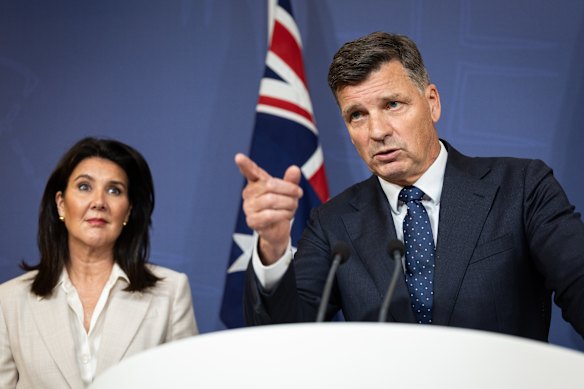
“We have done the policy hard yards on this and we have a credible plan,” he said on Tuesday afternoon, contrasting with Pauline Hanson’s more hardline and uncosted proposal last month that put pressure on Taylor to take a firmer line.
“Australians deserve to know what the numbers will be, how it will be paid for and how any policy will be delivered.”
The opposition’s larger-than-expected reduction down to a net migration figure of 100,000, revealed by this masthead on Monday, creates a three-way contest over a policy area that has become central to heated cultural and economic arguments in many nations.
Hanson, who is gaining support among voters who want lower migration, backflipped last month and said she would push for more people to leave Australia than arrive for three years, before settling at a 130,000 net figure. Labor overhauled its visa rules in August to get the yearly intake down from 292,000 to 225,000. Taylor landed on 100,000, much lower than previously flagged, before rising to 160,000 in future years as housing construction ramped up.
This puts the Coalition somewhere in the middle of the three proposals, while the Greens have rejected the need to engage in what it calls the “race to the bottom” on migration.
Taylor heralded the plan as “the biggest cut to immigration in the history of this country”. At 100,000, the yearly intake would mirror the early Howard era before the uncapped system was introduced, fuelling population growth that outstripped similar advanced economies.
“Australia should be a home, not a hotel,” Taylor told reporters on Tuesday, echoing ally Tony Abbott, who has long warned of arrivals joining “hotel Australia, not team Australia”.
The opposition refused to release its full costings which Taylor said proved the plan would actually improve the budget by $260 million over four years. This figure relies on cutting bridging visas by nearly 400,000 and effectively ending temporary graduate visas, of which there were 270,000 this year.
In concert with these drastic cuts, the permanent program of 185,000 visas would remain steady, while skilled temporary workers would rise by about 100,000, including through new special-projects visas.
Coalition sources, who declined to release the workings, said the cuts to temporary graduates created a hit of about $3.5 billion to the budget. However, this was offset by the growth in skilled workers, a cohort Taylor argues pays three times more tax on average.
The Coalition says the economic impacts could be even more marginal because health, education and other critical sectors will be safeguarded.
A key measure to push people offshore is a proposal to force temporary visa applicants to leave Australia before applying for another visa. The Coalition also snatched a policy from Labor requiring asylum seekers to apply for protection in their first 30 days in the country.
However, Taylor’s economic claims were heavily contested by Labor. The government is expected to argue the opposition plan would cost the budget $34 billion over four years.
Burke told this masthead that Taylor’s plan to force temporary visa holders offshore would make it harder for workers to switch employers even if they had a good job lined up, a claim repeated by Australia Industry Group’s Innes Willox. Burke said Australia would attract fewer skilled workers under the Coalition plan, contradicting Taylor’s plan.
“How do you claim [to bring in] extras [temporary skilled workers] for what is already a demand-driven program? Or more outrageously, how do you claim this when you’re actually making it more difficult [to enter the skilled program]?” Burke said.
“This is like saying we’re going to have 60,000 more tourists, when we already take as many tourists as apply.”
Hanson said the major parties had ignored migration for years and “they’d prefer it if they didn’t have to talk about it at all”.
“Their record on mass migration is clear,” she said.
Nationals leader Matt Canavan said Australia needed to assert its sovereignty, casting the policy as an extension of John Howard’s border protection stance and Tony Abbott’s boat turnbacks.
“Australia is a country, not a campsite,” he said.
The Coalition would repeal Labor’s cap on the number of working holidaymakers staying longer than a year. Instead, backpackers who do no work in the regions would be charged a higher visa fee – a measure designed to deter British backpackers, whose numbers have ballooned since the rural work requirement was waived in the Morrison-era free trade agreement.
Immigration expert Abul Rizvi said Taylor’s 100,000 figure was a “carefully calibrated political target that has very little to do with policy”.
“They should be congratulated for having a go. I think they’ve tried to be sensible, but they’re making claims that they won’t be able to sustain.”
Rizvi said it was sensible to target temporary graduates because there were too many visa holders relative to places in the permanent migration program.
However, he said the Coalition’s ambition to get the numbers down from 270,000 to 10,000 went too far given that graduates were a crucial pipeline for workers in aged care, health and regional jobs.
The bridging-visa backlog also needed attention, but Rizvi said the Coalition’s claim they could bring it down from 440,000 to 20,000 was unrealistic. There are 90,000 family-visa applicants in that list, for example, whose visas could not be processed quickly without a corresponding increase in the permanent program.
“They’ve spelled some things out, but it doesn’t all make arithmetical sense, and the fact they haven’t mentioned the labour market is a gaping hole,” Rizvi said. He argued deeper cuts to international students and New Zealanders would be required.
“If the labour market remains as strong as it has at the moment, 100,000 NOM [net overseas migration] over two years is impossible. It just won’t happen,” he said. “The Coalition will be under so much pressure from the business community that they will roll over very quickly.”
Andrew McKellar, the chief executive of the Australian Chamber of Commerce and Industry, said the Coalition was right to prioritise critical skills, but the scale of cuts would hurt.
“Business rejects the false binary that Australia must choose either fewer migrants with higher skills or more migrants with lower skills,” he said.
Economist Saul Eslake said it was plausible that replacing lower-earning graduates with skilled workers would offset some impact on the budget from reducing the overall number of tax-paying migrants.
“But I don’t see anything that tells me it can completely offset [the impact]. I would suspend my judgment until I see the PBO costings, and question why they haven’t been released with this policy,” he said.
Cut through the noise of federal politics with news, views and expert analysis. Subscribers can sign up to our weekly Inside Politics newsletter.
 Paul Sakkal is Chief Political Correspondent. He previously covered Victorian politics and won a Walkley award and the 2025 Press Gallery Journalist of the Year. Contact him securely on Signal @paulsakkal.14.Connect via X or email.
 Brittany Busch is a federal politics reporter for The Age and The Sydney Morning Herald.Connect via email.
 Natassia Chrysanthos is Federal Political Correspondent. She has previously reported on immigration, health, social issues and the NDIS from Parliament House in Canberra.Connect via X or email.
From our partners
Disclaimer : This story is auto aggregated by a computer programme and has not been created or edited by DOWNTHENEWS. Publisher: www.smh.com.au