Chandigarh at 73: From a Post-Partition Dream to India’s Iconic City Beautiful
October 7, 2026
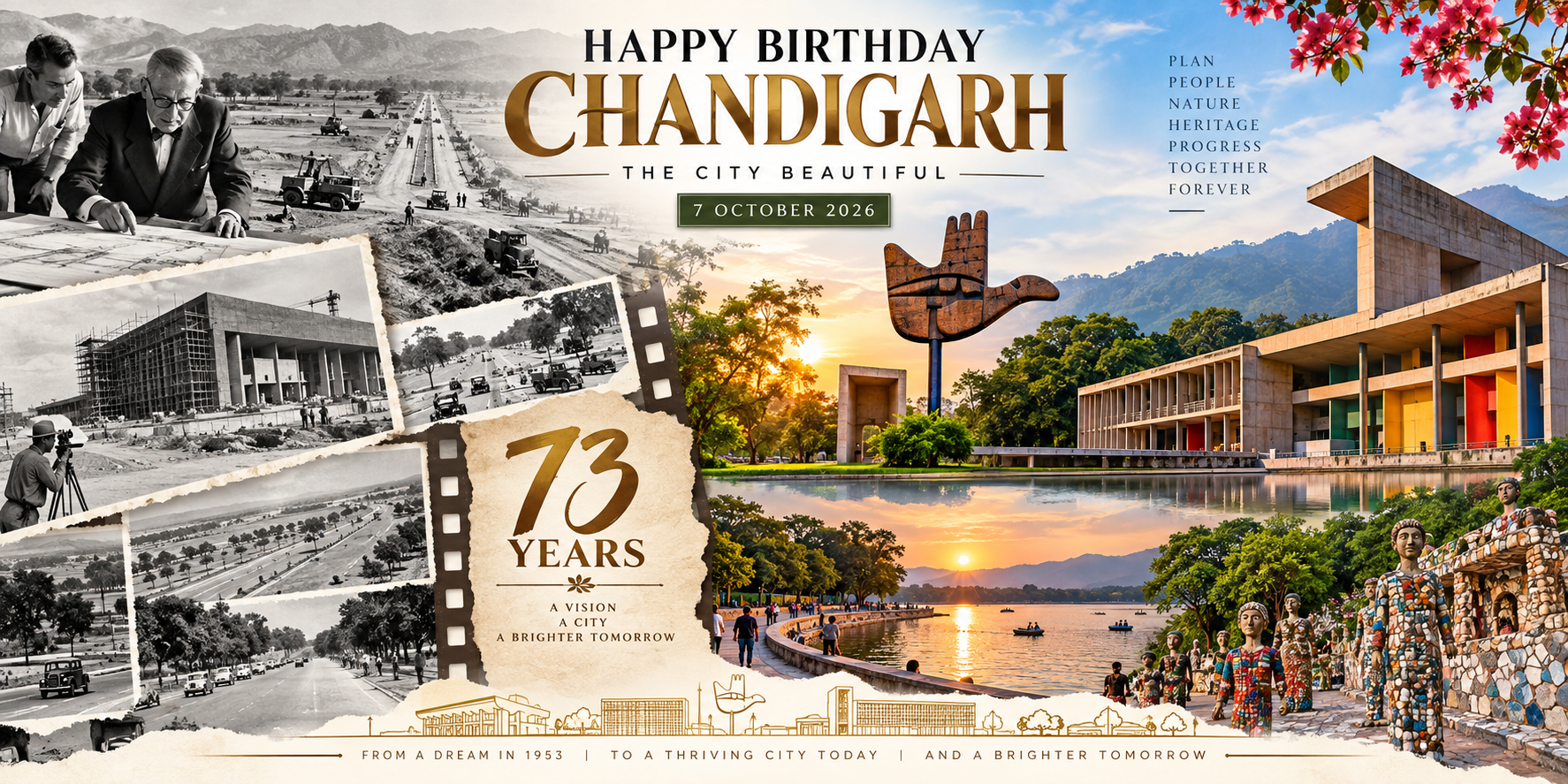
Chandigarh — a city of broad avenues, carefully planned sectors, abundant greenery, striking modernist buildings and the Shivalik Hills rising majestically in the distance — celebrates its birthday today.
Seventy-three years ago, on October 7, 1953, Chandigarh was formally opened by India’s first President, Dr. Rajendra Prasad. What stood before the country at the time was not merely another administrative headquarters. It was an ambitious experiment in nation-building: a city conceived in the aftermath of Partition and designed to represent the hopes, confidence and modern aspirations of a newly independent India.
Today, Chandigarh is much more than the capital of Punjab and Haryana and a Union Territory in its own right. It is an architectural landmark, a cultural meeting point, an educational and administrative centre, and one of India’s most recognisable examples of planned urban development.
Its story is therefore not simply the story of a city. It is the story of Partition, independence, modernism, migration, architecture, planning, politics, culture and the changing aspirations of India itself.
Before Chandigarh: A Land With an Ancient Past
The modern city may be young, but the land on which Chandigarh stands has a remarkably old history.
According to the Chandigarh Administration, the region has a prehistoric past. The gently sloping plains were once associated with a large lake surrounded by marshland, and fossil remains discovered in the area point to a rich aquatic and amphibian environment. Evidence also indicates that the region was inhabited by people associated with the Harappan civilisation roughly 8,000 years ago.
Centuries later, the wider region became part of the historic Punjab landscape and witnessed the rise and fall of different political powers.
The land therefore carried a history long before anyone imagined the geometric sectors, roundabouts, government buildings and tree-lined avenues that would eventually make Chandigarh famous.
The city that exists today, however, was born from one of the most traumatic events in India’s modern history.
Partition Created the Need for a New Capital
When British India was partitioned in 1947, Punjab was divided between India and Pakistan.
Lahore, the historic capital of undivided Punjab, became part of Pakistan. East Punjab, on the Indian side, was consequently left without its traditional capital.
India’s newly independent leadership faced an extraordinary challenge.
A new capital was required — but the government did not simply want to shift the administration temporarily to another existing city. The idea emerged to build an entirely new capital that could embody the spirit of independent India.
The Chandigarh Administration describes the city as a product of Prime Minister Jawaharlal Nehru’s vision. Nehru wanted the new city to symbolise a free India and represent confidence in the future rather than remain tied to the architectural and urban traditions of the colonial past.
For thousands of people displaced by Partition, the new capital was also part of the larger process of rebuilding life in East Punjab.
Thus, Chandigarh was conceived at the intersection of two enormous historical forces:
the devastation of Partition and the optimism of independence.
Why Was Chandigarh Chosen?
Finding the right location was not easy.
In 1948, the Punjab Government appointed a committee under Chief Engineer P. L. Verma to examine possible locations for the new capital.
Several existing towns were considered unsuitable because of factors including vulnerability, water availability, accessibility and their ability to accommodate a rapidly growing population.
The site eventually selected at the foothills of the Shivalik range offered a remarkable combination of advantages.
It had:
- A relatively gentle slope
- Access to water
- Fertile land
- Natural drainage
- A moderate climate
- Proximity to Delhi
- A spectacular view of the Shivalik Hills
- Space for a completely new city
The location also offered something that was extremely important to the planners: the opportunity to start from scratch.
Instead of forcing a modern city into an old urban structure, planners could design the streets, neighbourhoods, institutions, housing and green spaces according to a comprehensive plan.
That opportunity would ultimately make Chandigarh one of the world’s most significant experiments in modern urban planning.
The First Planners: Albert Mayer and Matthew Nowicki
The first major planning assignment went to the American firm associated with Albert Mayer and Matthew Nowicki.
Mayer and Nowicki developed an initial concept based around neighbourhood units or “superblocks.” Their plan had a fan-shaped layout, adapted to the geography of the site.
The neighbourhood concept attempted to make everyday life more self-contained, with housing, markets and open spaces located within accessible units.
But the project suffered a major setback when Matthew Nowicki died in an aircraft accident.
Albert Mayer subsequently withdrew from the project.
A new chapter was about to begin.
Enter Le Corbusier
In 1951, responsibility for the city’s planning was transferred to a team headed by the celebrated Swiss-born French architect Le Corbusier, whose birth name was Charles-Édouard Jeanneret.
He was supported by several important architects and planners, including:
- Pierre Jeanneret
- Maxwell Fry
- Jane B. Drew
They were also supported by a group of talented Indian architects and planners, including M. N. Sharma, A. R. Prabhawalkar, U. E. Chowdhary, J. S. Dethe, B. P. Mathur, Aditya Prakash and N. S. Lanbha.
Together, they transformed the Chandigarh project.
Le Corbusier did not merely design individual buildings. He approached the city as an integrated organism.
Chandigarh as a Human Body
One of the most fascinating aspects of Chandigarh’s planning philosophy is Le Corbusier’s analogy between the city and the human body.
According to the Chandigarh Administration:
- The Capitol Complex was conceived as the city’s head.
- Sector 17 became the heart.
- The Leisure Valley, parks and green spaces functioned as the city’s lungs.
- Educational and cultural institutions represented the intellect.
- The road network formed the city’s circulatory system.
- The Industrial Area represented the city’s viscera.
This was not simply an artistic metaphor.
It reflected a fundamental principle of Chandigarh’s planning: different activities should have clearly defined spaces while remaining connected to one another.
Residential areas were separated from major traffic routes. Commercial centres were strategically positioned. Parks and green corridors were incorporated into the urban fabric.
The result was a city designed around living, working, recreation and movement.
The Famous Sector System
Perhaps the most immediately recognisable feature of Chandigarh is its sector system.
The original city was organised into sectors, with the first phase consisting of Sectors 1 to 30.
The sectors were designed to function as neighbourhood units. The roads around them created boundaries that helped separate fast-moving traffic from internal residential life.
Le Corbusier’s planning principles emphasised human scale and accessibility.
The Chandigarh Administration’s Edict of Chandigarh describes the city’s sectors as approximately 800 metres by 1,200 metres, creating neighbourhoods that were intended to provide a balanced environment for residents.
The numbered-sector system subsequently became one of Chandigarh’s greatest practical successes.
Instead of streets carrying complicated names and irregular addresses, Chandigarh’s grid made navigation relatively straightforward.
Even today, asking someone to meet in “Sector 17,” “Sector 22” or “Sector 35” immediately communicates a location to most residents.
The Seven Vs: Chandigarh’s Unique Road Network
Another distinctive element of Chandigarh is its hierarchy of roads.
Le Corbusier’s circulation plan was based on the famous 7Vs, or seven categories of roads designed for different kinds of movement.
The objective was to prevent every street from performing the same function.
Major roads handled faster traffic, while smaller roads served neighbourhoods.
Pedestrians, cyclists and local traffic were given space within the broader system.
Later, the V8 concept was added for cycling and pedestrian movement.
The philosophy was straightforward but revolutionary for its time:
A city should move efficiently without allowing traffic to overwhelm everyday human life.
The Capitol Complex: Chandigarh’s Architectural Crown
If Chandigarh has an architectural heart that captures its global reputation, it is the Capitol Complex in Sector 1.
The complex includes three monumental structures:
The Punjab and Haryana High Court
The High Court building became one of the defining structures of Chandigarh’s modernist architectural identity.
The Secretariat
The enormous Secretariat represented the administrative machinery of the new capital.
The Legislative Assembly
The Assembly building was designed as one of Le Corbusier’s major architectural statements, combining monumental scale with bold geometric forms.
The three buildings stand within a large open composition against the backdrop of the Shivalik Hills.
But the Capitol Complex is not merely a collection of government offices.
It was intended to express the ideals of democracy and the authority of a newly independent nation.
The Open Hand: Chandigarh’s Most Powerful Symbol
Among Chandigarh’s many monuments, perhaps none is more closely associated with the city’s identity than the Open Hand Monument.
Its message is beautifully simple:
“Open to give, open to receive.”
The Open Hand became Chandigarh’s official emblem and represents peace, reconciliation, generosity and the willingness to exchange ideas.
In many ways, the symbol captures the city’s original philosophy.
Chandigarh was created after one of the most devastating episodes in India’s history, yet it was designed around the idea of looking forward.
The Open Hand therefore became more than an architectural object.
It became a statement about the kind of future the planners hoped the city — and the country — would embrace.
Chandigarh Becomes a Global Architectural Landmark
Chandigarh’s architecture eventually attracted international attention.
In 2016, the Capitol Complex became part of UNESCO’s transnational World Heritage property, “The Architectural Work of Le Corbusier, an Outstanding Contribution to the Modern Movement.”
UNESCO recognised the complex as part of a wider group of 17 sites associated with Le Corbusier across seven countries.
The recognition confirmed something Chandigarh had demonstrated for decades:
It was not simply an Indian administrative city.
It was an important chapter in the history of global modern architecture.
The Birth of the City Beautiful
The foundation stone of Chandigarh was laid in 1952.
Then came the milestone that Chandigarh celebrates every year.
On October 7, 1953, President Dr. Rajendra Prasad formally declared the city open.
That date is remembered as Chandigarh’s birthday.
The city had moved from blueprint to reality.
What had begun as an answer to the loss of Lahore was becoming a completely new urban experiment.
1966: Chandigarh Gets a Unique Constitutional Identity
Another defining chapter arrived more than a decade later.
On November 1, 1966, the reorganisation of Punjab created the states of Punjab and Haryana, while Chandigarh became a Union Territory.
At the same time, Chandigarh acquired the unusual distinction of serving as the capital of both Punjab and Haryana.
This arrangement continues today.
As a result, Chandigarh occupies a unique position in India’s political geography:
It is a Union Territory and also the capital of two states.
The arrangement has made the city an important administrative and political centre far beyond its physical size.
Chandigarh’s Transformation After Le Corbusier
Le Corbusier died in 1965, but his influence remained embedded in the city.
Pierre Jeanneret, who had played a major role in the city’s architectural development, returned to Switzerland that same year. M. N. Sharma subsequently became Chandigarh’s first Indian Chief Architect.
Over the decades, Chandigarh continued to expand.
New sectors emerged.
Residential neighbourhoods grew.
Educational institutions expanded.
Commercial areas developed.
Hospitals, government offices, shopping centres and recreational spaces multiplied.
Yet the challenge was always the same:
How could Chandigarh grow without destroying the principles on which it was built?
That question remains relevant even today.
Sector 17: The Heart of Chandigarh
For generations of Chandigarh residents, Sector 17 has represented the city’s social and commercial heart.
The central business district was designed around spacious pedestrian areas, shopping facilities, offices and public spaces.
For decades, Sector 17 was where Chandigarh came together.
Families went shopping there.
Young people met there.
Visitors arrived there.
Public celebrations were held there.
The fountains, plazas and broad pedestrian spaces created an urban experience very different from the crowded bazaars and congested streets found in many older Indian cities.
Even as modern malls and newer commercial areas have emerged, Sector 17 retains an important place in Chandigarh’s collective memory.
The Green City
Perhaps the most remarkable thing about Chandigarh is that its beauty is not dependent entirely on monumental architecture.
Its trees, gardens, green belts and open spaces are equally important.
Le Corbusier’s philosophy incorporated “Sun, Space and Verdure” as fundamental planning principles.
The city was designed to preserve generous open spaces and greenery rather than allowing every available parcel of land to be built upon.
That philosophy helped create Chandigarh’s characteristic atmosphere:
wide roads + mature trees + open spaces + low-rise development + modern architecture.
The combination is one reason why Chandigarh continues to be described as India’s “City Beautiful.”
Sukhna Lake: Chandigarh’s Natural Soul
No history of Chandigarh would be complete without Sukhna Lake.
Created as a major recreational landscape, Sukhna became one of the city’s most beloved public spaces.
Morning walkers, runners, cyclists, families, photographers and tourists have all made the lake part of their daily lives.
The lake also demonstrates another important feature of Chandigarh’s design philosophy: the city was not meant to be only a place of offices and residences.
Nature, recreation and public life were intended to be part of the urban experience.
Today, Sukhna Lake remains one of the city’s most recognisable landmarks.
The Rock Garden: An Unexpected Artistic Revolution
Then there is the extraordinary Rock Garden.
Created by Nek Chand Saini, the Rock Garden is unlike almost anything else in Chandigarh.
What began from the imaginative reuse of discarded materials evolved into a vast artistic environment containing sculptures, courtyards, pathways and architectural spaces.
Broken bangles, tiles, electrical waste, industrial objects, discarded ceramics and other materials were transformed into art.
The Rock Garden became a powerful reminder that creativity does not necessarily require expensive materials.
Its philosophy is almost the opposite of conventional monumental architecture:
What society throws away can become something beautiful.
Over time, the Rock Garden became one of Chandigarh’s most famous tourist attractions and an inseparable part of the city’s identity.
Chandigarh and Education
The city’s importance extends far beyond government.
Chandigarh became a major educational centre, home to institutions such as Panjab University and Punjab Engineering College, alongside other schools, colleges and research institutions.
The city also became known for major medical institutions, including the Postgraduate Institute of Medical Education and Research (PGIMER).
This educational and institutional ecosystem helped transform Chandigarh into a destination for students, academics, professionals and families from across northern India.
A City Between Punjab and Haryana
Although Chandigarh is geographically surrounded by Punjab and Haryana, it has developed an identity of its own.
Its culture reflects the wider Punjabi region, while its population has become increasingly diverse over the decades.
People from Punjab, Haryana, Himachal Pradesh, Delhi, Uttar Pradesh, Bihar, Rajasthan and many other parts of India have made Chandigarh their home.
That diversity has created a distinctive urban culture.
Punjabi traditions coexist with modern metropolitan lifestyles.
Traditional food sits alongside cafés and global cuisines.
Local markets exist alongside large shopping centres.
Punjabi music shares space with contemporary cultural events.
And the old Chandigarh of the 1950s and 1960s continues to coexist with the rapidly changing city of the 21st century.
Chandigarh’s Architecture: Concrete, Geometry and Light
Chandigarh’s buildings are often immediately recognisable.
Exposed concrete.
Geometric forms.
Deep shadows.
Massive structures.
Brise-soleil.
Open plazas.
Strong horizontal and vertical lines.
These characteristics form part of what has come to be known as the Chandigarh style.
But the architecture was not simply about appearance.
The designers had to respond to Chandigarh’s climate, sunlight, heat and seasonal conditions.
Le Corbusier’s architecture attempted to control the relationship between the sun, building surfaces, ventilation and human activity.
The result was a form of modern architecture adapted to the Indian environment.
The Edict of Chandigarh
Perhaps one of the most important documents associated with the city’s legacy is the Edict of Chandigarh.
It was intended to guide present and future generations in protecting the principles behind the city’s planning.
The objective was not merely to preserve old buildings.
It was to preserve the ideas that made Chandigarh different.
The principles include respect for human scale, sector planning, open spaces and the city’s relationship with nature.
The challenge is particularly important today because Chandigarh is no longer the small planned capital imagined in the early 1950s.
It is a growing metropolitan region.
Development pressures are constant.
Traffic is increasing.
Commercial demands are changing.
Land is valuable.
Technology and lifestyles are evolving.
The question is how to modernise while preserving what made Chandigarh special in the first place.
Chandigarh in the 21st Century
Today’s Chandigarh is considerably different from the city of 1953.
The population has grown.
The surrounding urban region has expanded dramatically.
The Chandigarh-Mohali-Panchkula region has increasingly functioned as an interconnected metropolitan area.
Modern malls, corporate offices, restaurants, educational institutions, healthcare facilities and technology-driven businesses now coexist with the original sectors.
The city has also become an important destination for tourism.
Visitors arrive to see:
- The Capitol Complex
- Open Hand Monument
- Sukhna Lake
- Rock Garden
- Rose Garden
- Leisure Valley
- Sector 17
- Le Corbusier Centre
- Museums and cultural institutions
- The city’s distinctive architecture and urban landscapes
Chandigarh’s appeal lies precisely in this combination of history and contemporary life.
The Challenges Facing the City Beautiful
Celebrating Chandigarh also means acknowledging its challenges.
The city was planned for a particular population and a particular era.
Today’s Chandigarh faces pressures that its original planners could not have fully anticipated.
Traffic and parking
The increasing number of private vehicles has placed pressure on Chandigarh’s carefully planned roads and parking infrastructure.
Urban expansion
The original city was designed as a relatively compact planned settlement. Its relationship with rapidly expanding Mohali and Panchkula has created a much larger urban ecosystem.
Heritage preservation
Modern buildings that were once considered contemporary are now increasingly recognised as heritage.
Maintaining them while meeting modern safety, accessibility and technological requirements is a complicated task.
Changing lifestyle
The city has evolved from a quiet administrative capital into a modern urban centre with changing expectations for housing, entertainment, commerce and mobility.
Environmental pressures
Protecting Chandigarh’s trees, green belts, water bodies and open spaces is essential if the city is to retain the environmental character that defines it.
What Makes Chandigarh Different?
Many cities are planned.
Many cities are green.
Many cities have beautiful buildings.
Very few combine all three on such a large scale.
Chandigarh’s greatest achievement may therefore not be any single building.
It is the relationship between buildings, roads, greenery, public spaces and human beings.
The city was designed to make the ordinary experience of urban life — walking, shopping, working, studying, travelling and relaxing — more organised and more pleasant.
That is why Chandigarh continues to attract architects, urban planners, historians and tourists from around the world.
73 Years Later: Has the Dream Survived?
On its 73rd birthday, Chandigarh is simultaneously an old city and a young one.
It is old enough to have generations of families who have spent their entire lives here.
Yet compared with India’s ancient cities, it remains remarkably young.
Its buildings have acquired history.
Its trees have matured.
Its sectors have developed their own personalities.
Its residents have created traditions that were never written into Le Corbusier’s original plans.
In that sense, Chandigarh has grown beyond its architects.
Le Corbusier provided the framework.
Pierre Jeanneret and the wider team helped give it architectural character.
Indian architects, planners, administrators and residents carried the project forward.
And generations of Chandigarh’s citizens have ultimately turned the planned city into a living community.
From the Trauma of Partition to the Confidence of a New India
Perhaps the most remarkable part of Chandigarh’s story is where it began.
In 1947, India had emerged from colonial rule amid violence, displacement and the division of Punjab.
Only a few years later, the country was building an entirely new capital.
That decision reflected extraordinary confidence.
The message was that the future could be built deliberately.
Chandigarh became an experiment in that belief.
Its architecture broke with the past.
Its roads rejected the chaos of unplanned growth.
Its sectors introduced a new approach to neighbourhood life.
Its public buildings attempted to embody democratic institutions.
Its gardens and green spaces sought to bring nature into the city.
And its Open Hand symbolised an outlook of giving, receiving and reconciliation.
Chandigarh’s Enduring Legacy
More than seven decades after its formal opening, Chandigarh remains one of the most ambitious urban experiments undertaken in independent India.
The city’s greatest legacy is not that every aspect of the original plan has remained unchanged.
It is that the fundamental idea of planning for people, nature and public life continues to influence how the city is understood.
The Chandigarh Administration itself describes the city as one of the major experiments in modern urbanism and emphasises the importance of preserving its architectural and planning legacy.
UNESCO’s recognition of the Capitol Complex further confirms the international importance of Chandigarh’s architectural heritage.
But perhaps the most meaningful measure of Chandigarh’s success is much simpler.
Ask someone who has lived there what Chandigarh means, and the answer is often not about architecture.
It is about the trees, sectors, morning walks, schools, markets, gardens, Sukhna Lake, familiar roundabouts, neighbourhoods and memories.
That is when a planned city becomes a real city.
Happy Birthday, Chandigarh
On October 7, 2026, Chandigarh completes 73 years since its formal opening in 1953.
From the ruins and upheaval of Partition emerged a city that sought to represent a different future.
From a landscape near the Shivaliks emerged a modern capital.
From the drawing boards of architects came sectors, boulevards, gardens and monumental buildings.
From Le Corbusier’s vision emerged a city that eventually became known around the world.
And from concrete, greenery, art and human ambition emerged something that is difficult to reproduce anywhere else:
The City Beautiful.
Chandigarh today is not exactly the city Le Corbusier imagined in the 1950s — nor should it be.
Cities must evolve.
But its enduring challenge and responsibility remain clear: to grow without losing its soul.
As Chandigarh celebrates its birthday today, its greatest achievement may be that after 73 years, the original idea still resonates — that a city can be more than a collection of buildings and roads.
It can be a statement of hope.
It can be an experiment in better living.
It can be architecture and nature working together.
And it can stand as a reminder of what a newly independent nation once dared to imagine.
Happy 73rd Birthday, Chandigarh — the City Beautiful.