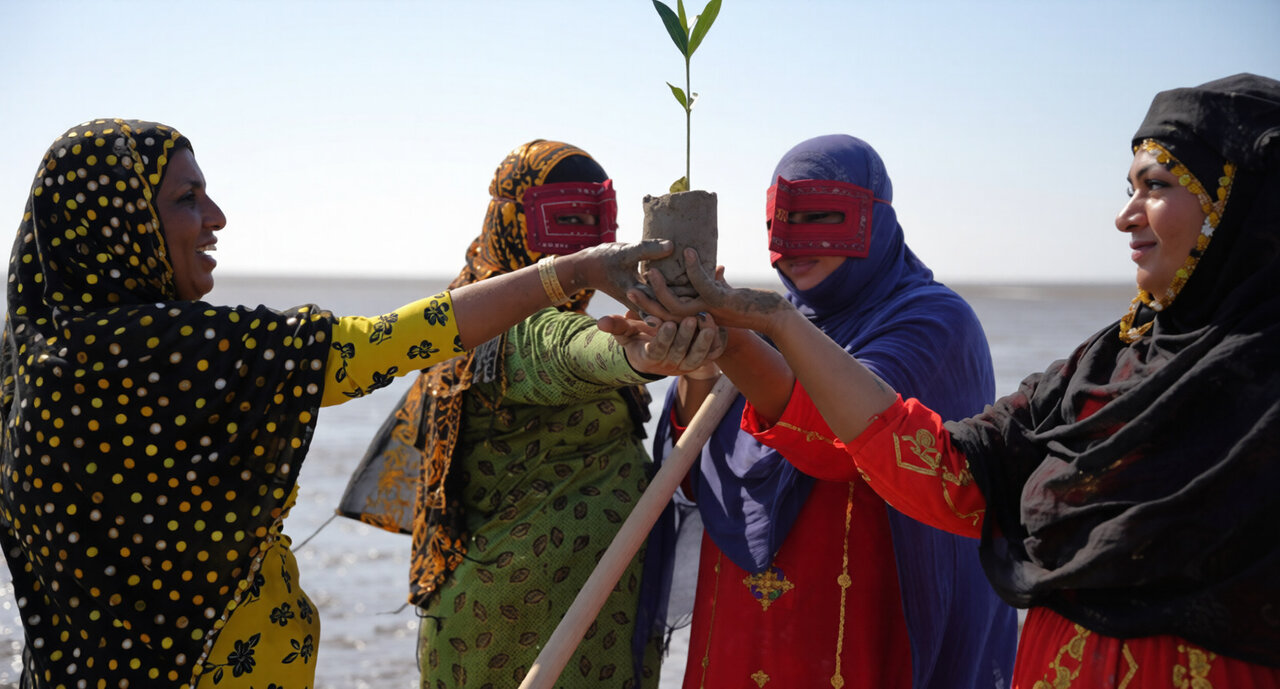
TEHRAN – Rural women in southern Hormozgan Province are taking an active role in restoring mangrove forests and protecting the Shour–Shirin–Minab International Wetland, one of the country’s ecologically important coastal habitats.
In the village of Tiab, local women have been trained to collect mangrove seeds, prepare soil, raise seedlings and manage nurseries as part of an initiative designed to link environmental conservation with sustainable livelihoods.
The project was implemented by Mashgh Afarinesh Va Toseye Paydar with support from the GEF Small Grants Programme (SGP) of the United Nations Development Programme (UNDP) and funding through the ICCA-GSI. It was carried out in cooperation with the Provincial Natural Resources and Watershed Management Organization, UNDP reported.
Training sessions and practical workshops equipped participants with the skills needed to establish and maintain a small-scale mangrove nursery. The initiative subsequently resulted in the establishment of Tiab’s first women-led mangrove nursery, with a capacity of around 1,500 seedlings.
The nursery has provided a practical means of contributing to ecosystem restoration while creating an opportunity for local women to generate supplementary income through environmentally sustainable activities.
For those involved, the work has also created a strong personal connection with the environment.
“We nurtured these seedlings with our own hands, just like our own children,” said Mehri Zarei, a member of the Tiab Women’s Green Nursery. “Planting each mangrove felt like giving birth to hope all over again. When I placed the roots into the mud, I felt as if I was becoming a mother once more, this time, to the Earth.”
The project has also promoted cooperation among communities in the region. Women from Tiab have shared their experiences with groups in neighboring villages, including Chah Sahari, where similar activities have been introduced.
The exchange has enabled the participating communities to share practical knowledge on mangrove seed collection, irrigation and nursery management, helping build local capacity for long-term conservation.
The experience in Tiab highlights the role that community-led initiatives can play in addressing environmental challenges while strengthening rural livelihoods. By involving women directly in conservation and restoration activities, the project has helped turn local participation into a practical tool for protecting one of southern Iran’s valuable coastal ecosystems.
Disclaimer : This story is auto aggregated by a computer programme and has not been created or edited by DOWNTHENEWS. Publisher: tehrantimes.com