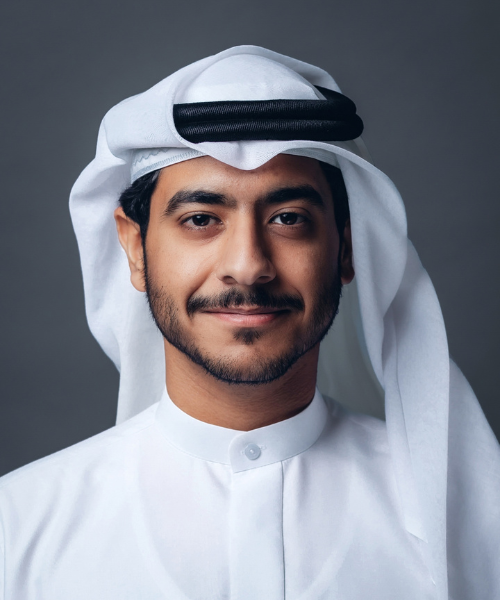
As someone who has devoted his professional life to uncovering the history of the UAE and telling it with care, curiosity and conviction, Ammar Albanna is acutely aware that every piece inside Zayed National Museum, where he currently serves as an associate curator, is part of a much wider narrative.
“We would visit old Dubai a lot, we’d go around looking at the houses in Bastakiya, looking at old forts in the UAE,” he recalls of his formative years. “I had a very practical, outdoorsy childhood, where we’d go look and find and dig.” Those early explorations laid the foundations for a career in archaeology and curation, one that now places him at the heart of how the UAE narrates its own past to the world.
He attended university at Sorbonne Abu Dhabi, drawn by its programme in archaeology and art history. Yet as he moved deeper into his studies, he noticed a gap. “A lot of focus was on the very generic topics of archaeology and art history, and it was prominently Western or European,” he explains. “Coverage of this region or the Arabian Gulf was very brief.” That brevity was a turning point that ignited a determination to fill in the blanks. “It led me to want to take the initiative to focus more towards something more relative to me.”

That passion now finds its fullest expression at Zayed National Museum, the national museum of the UAE, located within Abu Dhabi’s Saadiyat Cultural District. “It is our duty now to showcase the whole history of the UAE,” he says proudly. “You need a place where you can portray all these stories that stem from the great values, the principles, the lessons we always learn and extract from Sheikh Zayed.”
As an associate curator, Albanna’s day-to-day work is a careful balance between scholarship and storytelling. Zayed National Museum is not a traditional, object-in-a-case institution. It is, as he describes, a place where scientific research, oral history, and multimedia interpretation are woven together. “We’re a very narrative-based museum, where we mix between the scientific and the, let’s say, oral history, where you have many different forms of sending the ideas through, whether it’s visual, audio, media.”
For Albanna, the real power of his role lies in bridging the gap between specialist knowledge and public understanding. “A piece of pot can easily be displayed,” he explains, “but it is much more important to find out where it came from, why it was made, who was using it… extracting all of that information from a simple object is our main goal to better understand the people using the pot, other than just the pot itself.”

Beneath the exhibition design and research lies a clear conviction: protecting the past is essential to understanding who we are now, and who we might become. “Safeguarding our history will always be a priority,” Albanna affirms. “It’s evidence that we do have settlements, we do have history, our people have settled in the region here for thousands of years.” He sees Zayed National Museum as a space where younger generations can reconnect with their roots. “We use the word roots a lot, but there must be a place where these roots dive deep in,” he reflects. “Human practices and human nature don’t really change; they just keep advancing and evolving. But our values, whether they’re from our community, from our leadership, from our ancestors, they’re always linked.” For Albanna, the responsibility of his work is matched by a deep sense of pride every time he watches visitors encounter the museum’s collections. Seeing people who arrive with only a vague notion of the UAE’s past walk away with a richer understanding is, he admits, quietly affirming. “It’s really relieving, and it gives you a sense of accomplishment,” he says. Those moments act as a “slight pat on the back,” as he puts it, and fuel his determination to keep going: to expand the narratives, to refine how stories are told, and to ensure that the country’s history is not just preserved, but truly felt by those who experience it. What does Albanna hope is the key takeaway for visitors? “I’d say definitely to learn more,” he says. “I personally would like curiosity to push people to find out more, take in the information and delve deeper into their own domain.”

At the end of our conversation, we move away from Albanna’s work at Zayed National Museum, into his interests beyond archaeology and history, which feel like a natural extension of his professional preoccupations. “I enjoy film photography, analogue photography,” he says. “It’s that idea and concept of documenting your day to day, documenting general architecture, so it’s a mix between the archival, archaeological, and a bit of art history.” Even in his downtime, he is archiving, framing, and composing, capturing the present as tomorrow’s memory.
– For more on how to look smart and live smarter, follow Emirates Man on Facebook and Instagram
Images: Supplied
Disclaimer : This story is auto aggregated by a computer programme and has not been created or edited by DOWNTHENEWS. Publisher: emirateswoman.com