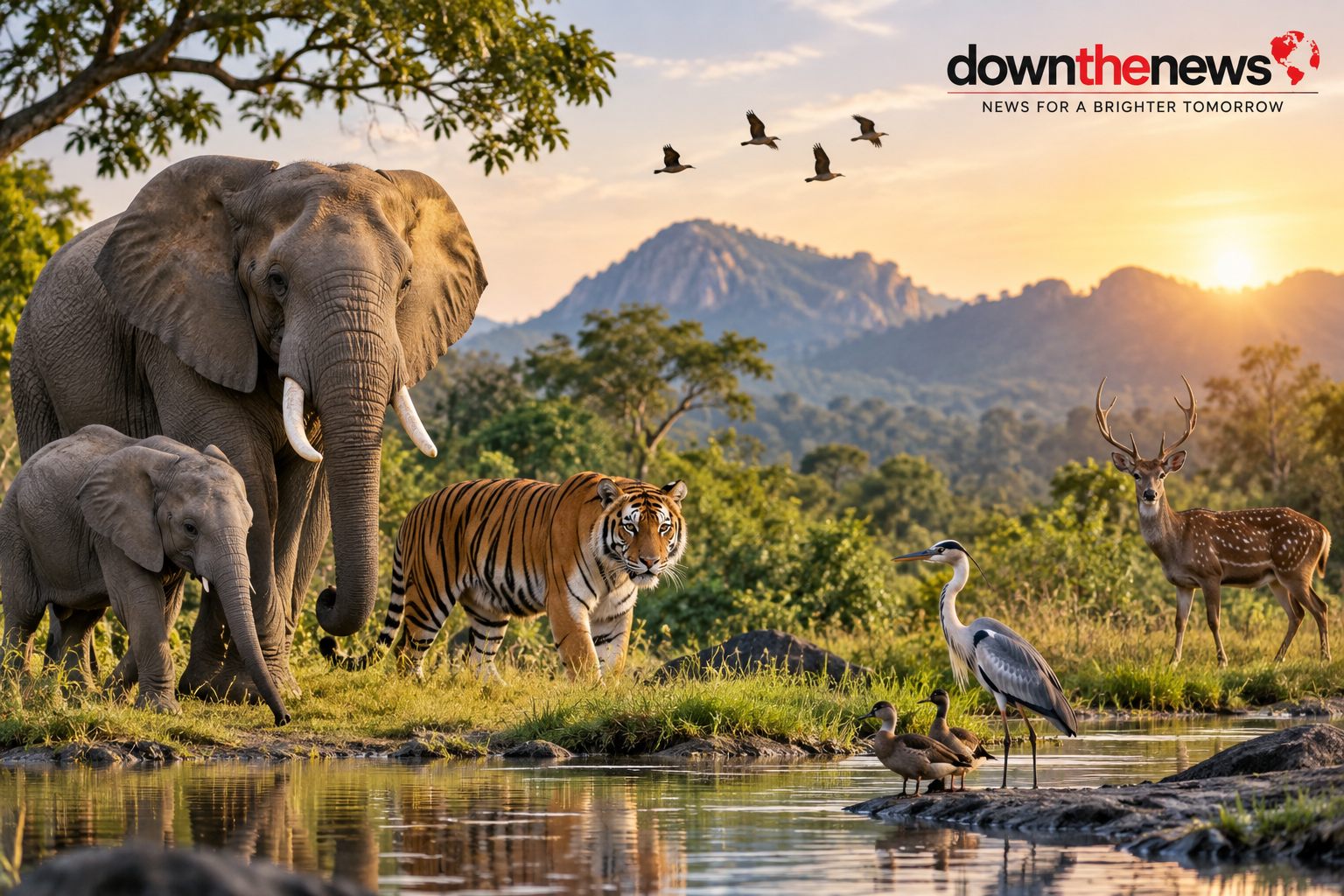
🐅 Top 20 Animal & Wildlife News Stories
Friday, October 9, 2026
India & World Wildlife News | DownTheNews
Today’s wildlife news highlights important conservation developments, endangered-species protection, animal rescues, habitat destruction and new scientific discoveries. From India’s tiger recovery initiatives to wildfires threatening orangutans in Indonesia, these stories reveal both the challenges facing wildlife and the efforts to protect it.
🇮🇳 India Animal & Wildlife News
1. India Expands Tiger Conservation With New Reintroduction Programme
India has begun a phased tiger reintroduction programme at West Bengal’s Buxa Tiger Reserve, with a tigress transferred from Bihar’s Valmiki Tiger Reserve. The initiative aims to rebuild a viable, self-sustaining tiger population in the historic North Bengal landscape. Wildlife officials will need to monitor the animal’s adaptation, prey availability and interactions with local communities as the programme progresses.
2. Two Cheetahs Released Into Madhya Pradesh’s Veerangana Durgavati Tiger Reserve
India has expanded its cheetah conservation landscape with the release of Vyom and Neera into Veerangana Durgavati Tiger Reserve. The reserve becomes the country’s third cheetah habitat after Kuno National Park and Gandhi Sagar Wildlife Sanctuary. The expansion is intended to establish additional suitable habitat and reduce the long-term risks associated with concentrating the population in a limited number of locations.
3. Great Indian Bustard Recovery Receives Important Boost
India’s efforts to save the critically endangered Great Indian Bustard have reached an important milestone following the release of two captive-bred males into Rajasthan’s Desert National Park on October 4. The species faces serious threats from habitat loss, disturbance and collisions with power lines. The release is part of a long-running captive-breeding and rewilding programme involving conservation authorities and scientific institutions. Experts say that protecting the birds after release and restoring suitable grassland habitat will be essential for long-term recovery.
4. Wildlife Week Concludes With Fresh Calls for Public Participation
India’s Wildlife Week, observed from October 2 to 8, has concluded with renewed calls for communities, educational institutions and conservation organisations to participate in protecting biodiversity. Activities across the country have included wildlife-awareness programmes, biodiversity walks and discussions about threatened species. Conservation experts emphasise that public participation is essential for reducing habitat destruction, preventing illegal wildlife trade and improving coexistence between people and animals.
5. Red-Crowned Roof Turtle Conservation Gets Attention in Kanpur
A conservation seminar focusing on the critically endangered red-crowned roof turtle marked the conclusion of Wildlife Week activities in Kanpur. The species, scientifically known as Batagur kachuga, is associated with river habitats, particularly the Chambal River system. Habitat degradation, pollution and other pressures have threatened its survival. Conservationists highlighted the importance of protecting nesting areas, improving river conditions and involving local communities in safeguarding the species.
6. Palamu Residents Seek Faster Compensation for Wildlife Damage
A delegation in Jharkhand’s Palamu district has urged authorities to speed up compensation for residents suffering losses caused by wildlife. Encounters between wild animals and rural communities can result in damaged crops, destroyed property and threats to livelihoods. The demand highlights a central challenge in wildlife management: ensuring that conservation policies also provide timely support to people affected by human-wildlife conflict. Better compensation systems can help reduce resentment towards wildlife and encourage communities to cooperate with forest officials.
7. India Presents Encouraging Signs in Global Wildlife Conservation
The latest Living Planet Report 2026 from WWF highlights a sharp global decline in monitored wildlife populations but identifies India as a source of hope for conservation. Recovery efforts involving tigers, greater one-horned rhinoceroses and Ganges river dolphins demonstrate how sustained protection, habitat management and coordinated conservation programmes can produce results. However, experts caution that continued investment and ecosystem protection are necessary to maintain these gains.
8. Elephant Corridors Remain a Major Priority for India’s Wildlife Protection
India continues to face challenges involving elephant movements through forests, agricultural land, tea estates and human settlements. Recent tracking initiatives in Assam have mapped elephant movements to improve early-warning systems and help authorities identify areas where conflict is likely. Wildlife crossings, improved communication with communities and protection of traditional migration routes are important measures for reducing collisions, crop damage and dangerous encounters.
9. India Strengthens Efforts to Protect Endangered Grassland Birds
The Great Indian Bustard’s reintroduction programme has renewed attention to the conservation of India’s fragile grassland ecosystems. These habitats support numerous birds, mammals, reptiles and insects but are frequently affected by infrastructure development, land-use changes and agricultural expansion. Conservationists argue that protecting individual species will be difficult unless the larger ecosystems on which they depend are also preserved.
10. Human-Wildlife Conflict Highlights Need for Community-Based Conservation
The demand for compensation in Palamu illustrates a broader issue affecting wildlife conservation across India. As human settlements and agricultural activities expand into wildlife habitats, encounters between people and animals can become more frequent. Experts increasingly advocate a combination of early-warning systems, habitat protection, rapid-response teams, public education and transparent compensation procedures to help communities and wildlife coexist.
🌍 World Animal & Wildlife News
11. Wildfires in Indonesian Borneo Leave Wildlife Struggling for Water
Wildfires in West Kalimantan, Indonesian Borneo, are leaving wildlife with fewer sources of fresh water as forest pools dry up and some water sources become brackish. Animals are reportedly being driven towards villages and coastal areas in search of water. The fires are adding pressure to already vulnerable ecosystems, including forests that provide habitat for orangutans and other threatened species. Conservationists warn that continued habitat destruction could increase human-wildlife encounters and make survival more difficult for animals already facing shrinking forest cover.
12. Scientists Report Discovery of a Giant Water Lily Species
A plant selfie taken in a Colombian jungle helped researchers identify what has been described as a remarkable new giant water lily species. The discovery highlights how much remains unknown about biodiversity in tropical ecosystems, even in areas that have attracted scientific interest for decades. Identifying new species is important not only for understanding evolution but also for establishing appropriate conservation measures when newly recognised plants have limited distributions or face environmental threats.
13. Scientists Estimate 180,000 Giant Tortoises on a Seychelles Island
A new wildlife report has drawn attention to an estimated 180,000 giant tortoises on an island in the Seychelles. Giant tortoises play important ecological roles, including influencing vegetation and helping shape island habitats. Population estimates can assist conservation managers in monitoring ecological changes, planning habitat protection and understanding how these animals interact with other species. The reported figure also highlights the importance of careful field research when assessing large populations of long-lived wildlife.
14. Global Wildlife Populations Have Declined by 73%, WWF Warns
WWF’s Living Planet Report 2026 has delivered a stark warning about the condition of the world’s biodiversity. The report found that the average size of monitored vertebrate wildlife populations declined by 73% between 1970 and 2022. The analysis covers mammals, birds, fish, amphibians and other vertebrates across thousands of species. Habitat destruction, overexploitation, pollution, invasive species and climate change are among the major pressures identified. Scientists stress that this figure represents the average change in monitored population sizes, not the percentage of individual animals that have disappeared worldwide.
15. Freshwater Wildlife Faces the Sharpest Population Decline
The WWF report identifies freshwater ecosystems as particularly vulnerable, with monitored wildlife populations in rivers and lakes declining by an average of 85% between 1970 and 2022. Freshwater animals face threats from pollution, dams, water extraction, habitat fragmentation and changes in river flows. These losses can affect fish populations, amphibians, aquatic mammals and the wider food webs on which communities depend. Experts say protecting wetlands, restoring river connectivity and improving water quality are essential to reversing the trend.
16. Tiger, Sea Turtle and Tuna Recoveries Offer Hope for Conservation
Despite the global biodiversity crisis, WWF highlights the recovery of several species as evidence that conservation can work. Wild tiger numbers are estimated to have increased from approximately 3,200 in 2010 to around 5,700 in 2026. Green sea turtles and bluefin tuna have also benefited from protection and management measures in some regions. These examples demonstrate the value of habitat conservation, anti-poaching operations, fishing regulations and international cooperation. However, scientists caution that success for individual species does not eliminate the wider threat of biodiversity loss.
17. Indonesia’s Critically Endangered Orangutans Face Growing Fire Threats
Fires in Indonesian rainforests are raising concern for Bornean orangutans, whose habitat is already under pressure from land conversion and fragmentation. Orangutans depend on forest ecosystems for food, nesting sites and movement between feeding areas. When fires destroy forest cover, the animals may become trapped in shrinking habitat or move closer to human settlements. Conservationists are calling for stronger fire prevention, forest protection and rapid intervention in areas where threatened populations are at risk.
18. Hong Kong Installs Artificial Nests to Help Cockatoos
Conservationists in Hong Kong are installing artificial nesting structures to provide homes for cockatoos and study their behaviour. Suitable nesting cavities can be scarce for birds that depend on mature trees and particular habitat conditions. Artificial nests can help researchers monitor breeding activity, understand how birds use urban and semi-natural environments, and identify practical ways to support vulnerable populations. The project also illustrates how cities can contribute to wildlife conservation through targeted habitat improvements.
19. Wildlife Trafficking Threatens Indonesia’s Rare Maleo Birds
Wildlife traffickers are increasingly targeting the maleo, a distinctive and threatened bird native to Sulawesi, Indonesia. Maleos bury their eggs in warm sand or soil, using environmental heat to incubate them. Their unusual reproductive behaviour can make their eggs vulnerable to collection by people. Conservationists warn that the illegal removal of eggs and birds can undermine already fragile populations. Protecting nesting grounds, strengthening enforcement and working with local communities are key measures in the effort to safeguard the species.
20. Brazil’s Angelshark Trade Raises Concerns Despite Import Restrictions
A recent investigation has found that the endangered angelshark continues to be traded at a public market in Porto Alegre, Brazil, despite an import ban. The case raises questions about enforcement, product identification and the difficulties of monitoring trade in threatened marine species. Angelsharks are vulnerable to fishing pressure because they often live close to the seabed and can be caught unintentionally in fishing gear. Conservationists say stronger inspections, accurate labelling and public awareness are necessary to reduce demand and protect threatened marine life.
🐾 Key Animal & Wildlife Takeaways — October 9, 2026
- India: Tiger reintroduction, cheetah conservation and Great Indian Bustard recovery remain major priorities.
- Global biodiversity: WWF reports a 73% average decline in monitored vertebrate wildlife populations since 1970.
- Habitat emergencies: Wildfires in Indonesian Borneo are depriving wildlife of safe habitat and fresh water.
- Endangered species: Maleo birds, angelsharks, orangutans and red-crowned roof turtles need stronger protection.
- Human-wildlife coexistence: Communities need reliable compensation, early-warning systems and support for living alongside wildlife.
- Conservation successes: Tiger, sea turtle and tuna recoveries show that sustained protection can reverse declines in some species.
The message for today: Wildlife conservation requires more than protecting individual animals. Preserving habitats, reducing illegal trade, restoring ecosystems and involving local communities are all essential to ensuring that endangered species survive for future generations.