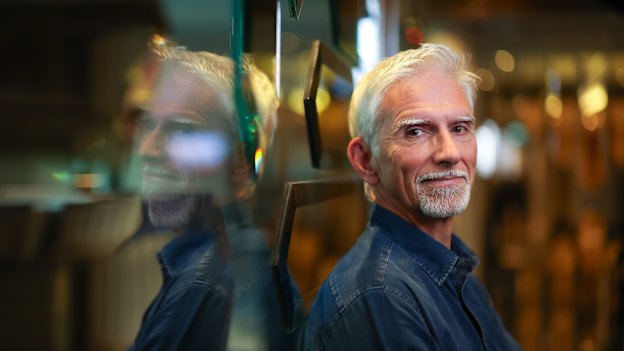
If you were to flip through the biggest moments in the Formula 1 history books – tragedy, ecstasy or controversy – Damon Hill is at the centre of many of them.
The English former F1 driver who claimed the 1996 world championship had an extraordinary career, winning 22 grands prix and racing against titans of the sport including Michael Schumacher and the late Ayrton Senna.
There’s a kind of poetic irony to his extensive list of accolades, given it was never actually meant to happen.
“I wasn’t born thinking about F1 – I actually never had an ambition to race cars,” Hill tells this masthead with a wry smile and a shake of his head. “It was always motorbikes”.

It’s a warm Thursday afternoon, and we are in a meeting room inside Crown Towers with panoramic views of Melbourne’s city skyline.
Hill travelled to Australia this month on a speaking tour to promote his eponymous new documentary, Hill, which premieres at the British Film Festival on October 28.
The film has everything traditional revheads dream of; nail-biting title fights and archival footage of dramatic crashes. But the core of Hill’s documentary centres around love and grief; exploring the death of his father, Graham, the two-time F1 world champion who tragically died in a plane crash when Damon was just 15.
Hill found out about the accident on television and had to leave the living room to tell his mother, triggering “pandemonium and horror”.
“I remember feeling that I would have liked to be with him on the plane,” Hill says in the documentary. “I didn’t want to be here, I would have given up or exchanged places with someone else on the plane.”
Hill says the process of revisiting painful memories for the documentary was raw, but also necessary.
“I went through quite a long period of reflection when I stopped racing … and I got a chance to talk through lots of stuff that was not dealt with at the time.”
Hill speaks with remarkable candour about his grief, but also leaves room for humour – joking he’s heard that some airlines who are showing the documentary chose to edit out his father’s plane crash.
“I mean, that’s pretty key to the story,” he says with a laugh. “I’m not sure if that’s true… but you’re quite welcome to look at all kinds of disaster movies on an aeroplane.”
He also speaks with deep love for his wife, Georgie, who in the film describes a 21-year-old Hill as one of the saddest people she had ever met.
“We were kind of brought together through our own experiences,” he says. “I think we both understood that there was a missing bit that the other had.”
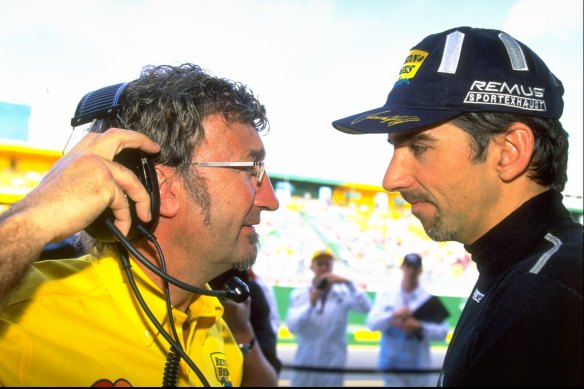
Hill had always been besotted with motorbikes, but after his father’s death, the young driver decided to switch paths and pursue an F1 career. The 30-year-old signed with Williams as a test driver in 1991, entering into one of the most revered eras of F1 history. For non-F1 aficionados, the crib notes are as follows:
Promoted to a full-time race seat with Williams in 1993, Hill won his maiden grand prix in Hungary and quickly developed an intense rivalry with Schumacher.
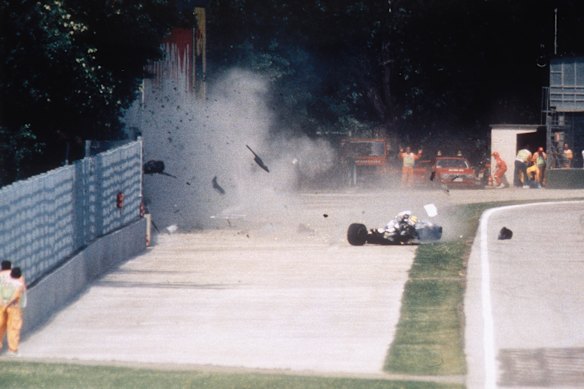
A pivotal point in his life happened in 1994. Revered champion Senna, who had switched to Williams to drive alongside Hill, died after slamming into a concrete wall during the San Marino Grand Prix at Imola.
Hill said the last funeral he had attended was his father’s, and he agonised over the decision to attend Senna’s.
Encouragement from three-time F1 world champion Jackie Stewart, who told Hill “you’ll regret it for the rest of your life if you don’t go”, changed his mind. Hill attended and was a pallbearer at the funeral.
But there was no period for rest after Senna’s death. Hill went on to fight for the world championship, losing to Schumacher by one point in the final race in Adelaide – one of the most controversial races in F1 history.
The pair collided when Schumacher turned in, sending the German’s Benetton into the barrier. With Schumacher out, Hill attempted to continue the race, but was forced to retire after damage to his Williams.
At the time, commentators declared, “The world championship has literally been torn from his hands”.
Does hill agree now with the commentators’ sentiments?
“Oh, I’ve let the whole thing go,” he said with a laugh. “I mean, it seems like another lifetime. I’ve been doing this tour, and so I’m kind of revisiting it all, and I’m trying to explain to the audience how I felt. They want to know, ‘Aren’t you furious? Weren’t you angry?’
“First, you can’t carry around anger all the time.”
“I try to put it into context,” he added. “You know, I’m trying to say, well, it’s only a sport.
“But you can’t. You’re playing this game, which is you’re supposed to take it really seriously. And of course, there are serious consequences, a lot of money at stake, and stuff. But ultimately, it’s frivolous – it’s utterly frivolous”.
Hill’s documentary ends in redemption; with the driver sensationally winning the 1996 championship. However, the film also explores F1’s dramatic financial transformation over the past three decades.
In one scene, Hill’s contract spills out of an old fax machine, with sections detailing how he should play for his own accommodation and flights.
Today’s era of F1 drivers travel on private jets, but they also deal with a dramatically heightened level of attention and scrutiny – through series like Netflix’s Drive to Survive.
“I would never wish anything to be different in my life,” Hill said after a pause.
“I don’t have any envy for them. In fact, I’m quite glad I got through it, so I feel like I’ve come out the other side.
“I think there’s more attention on everything they say.
“It’s more widely consumed … I think also there’s a lot of spin put on everything. I mean, its insane what can be made of a little scrap of information that’s actually not really there. We were lucky; we only just had the newspapers. It’s quite different now. And the newspapers, they were chip paper the next day.”
News, results and expert analysis from the weekend of sport are sent every Monday. Sign up for our Sport newsletter.
Disclaimer : This story is auto aggregated by a computer programme and has not been created or edited by DOWNTHENEWS. Publisher: www.smh.com.au