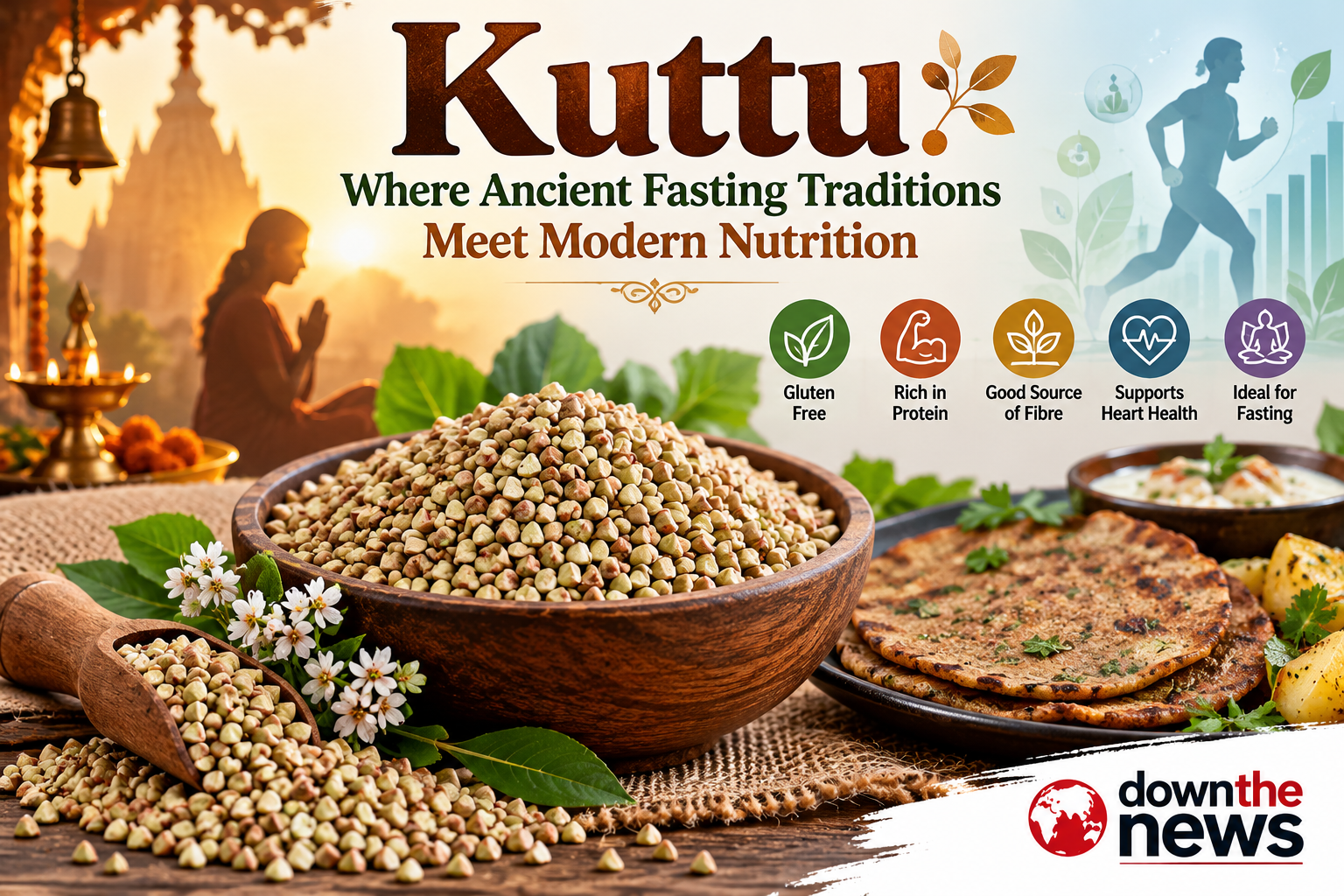
From sacred grain to contemporary superfood, the humble buckwheat continues to nourish India through centuries of tradition and changing lifestyles
Few foods tell the story of India’s relationship with fasting, faith and food as beautifully as kuttu. Known widely as kuttu atta or buckwheat flour, it has been part of India’s fasting traditions for generations. Yet today, this humble ingredient has found a new audience far beyond religious observances, thanks to growing interest in whole foods, plant-based eating and traditional grains.
Despite its name, buckwheat is not actually wheat. It is a seed-like pseudocereal and is naturally gluten-free. Its distinctive earthy flavour, satisfying texture and nutritional profile have helped it move from fasting kitchens to modern homes, health-conscious menus and contemporary food culture.
But kuttu is more than a fashionable health food. Its story reaches deep into India’s cultural traditions.
The Ancient Roots of Kuttu
Buckwheat has been cultivated for thousands of years, with its early history associated with regions of Asia. Over time, it spread across different parts of Europe and Asia and eventually became established in the Himalayan regions of the Indian subcontinent.
In India, buckwheat has traditionally been cultivated particularly in hilly and colder regions, including parts of Jammu and Kashmir, Himachal Pradesh, Uttarakhand, northeastern India and other mountainous areas.
Its ability to grow in relatively difficult conditions made it an important crop for communities living in regions where conventional cereals were not always easy to cultivate.
Unlike rice or wheat, buckwheat has a comparatively short growing cycle. This adaptability contributed to its importance as a traditional food crop in several communities.
Over generations, it became part of local food cultures in different forms — from flour and pancakes to porridge and other regional preparations.
How Kuttu Became Associated With Fasting
Perhaps the most distinctive place kuttu occupies in Indian food culture is the vrat or fasting tradition.
During many Hindu fasting observances, devotees traditionally avoid commonly consumed cereals and grains. Depending on the particular fast and regional customs, foods such as wheat, rice and certain pulses may be restricted.
Kuttu emerged as one of the ingredients commonly consumed during these periods.
This is why kuttu puri, kuttu roti, kuttu cheela, kuttu pakora and other preparations are now strongly associated with Navratri and other fasting occasions.
For generations, the use of kuttu during fasting has represented more than simply finding an alternative to everyday grains. Food during a vrat is deeply connected with ritual, discipline, devotion and community.
Families pass down recipes from one generation to another, while regional traditions determine what can be eaten and how it should be prepared.
Thus, kuttu became part of a culinary tradition where faith and nourishment shared the same plate.
Kuttu Is Not Wheat
The name can sometimes be misleading.
Kuttu is commonly translated as buckwheat, but buckwheat belongs to a completely different botanical family from wheat. It is classified as a pseudocereal, meaning it is used much like cereal grains even though botanically it is not a conventional cereal.
This distinction is particularly important because buckwheat is naturally gluten-free.
For people who avoid gluten, kuttu can therefore be an appealing ingredient. However, people with celiac disease or medically diagnosed gluten sensitivity should still pay attention to cross-contamination, particularly when buying packaged flour or eating prepared foods.
What Makes Kuttu Nutritionally Interesting?
Modern nutrition has given kuttu a new identity.
Buckwheat contains a combination of complex carbohydrates, plant protein, dietary fibre, vitamins, minerals and naturally occurring plant compounds.
It is particularly known for providing minerals such as magnesium, manganese, copper and phosphorus, although the actual nutritional value can vary depending on the form and preparation.
It also contains rutin, a plant compound belonging to the flavonoid family that has attracted scientific interest.
Its protein profile is another reason buckwheat receives attention. While it does not replace every source of protein, it contributes useful plant protein to the diet.
And because it can be prepared in numerous ways, kuttu can fit comfortably into a varied vegetarian diet.
The Fasting Paradox: Healthy Ingredient, Heavy Preparation
There is an interesting contradiction surrounding kuttu.
The flour itself can be nutritionally valuable, but some of the most popular fasting dishes made with it are deep-fried or calorie-dense.
Kuttu puris, pakoras and fried snacks may be delicious, but eating large quantities can make a meal considerably heavier.
This is an important lesson in modern nutrition: the healthfulness of an ingredient does not automatically make every dish prepared from it healthy.
A kuttu roti cooked with minimal oil and accompanied by vegetables or an appropriate protein source is nutritionally quite different from a plate of deep-fried kuttu puris served with rich accompaniments.
The ingredient matters — but so does the preparation.
From Vrat Kitchen to Wellness Kitchen
For centuries, kuttu largely appeared on Indian dining tables in specific cultural contexts. Today, its appeal has expanded.
Health-conscious consumers increasingly seek alternatives to refined flour and highly processed foods. This has encouraged renewed interest in traditional grains and pseudocereals such as buckwheat, millet, amaranth and quinoa.
Kuttu fits naturally into this movement.
It can be used to prepare:
- Kuttu rotis
- Kuttu cheelas
- Kuttu dosas
- Kuttu pancakes
- Buckwheat porridge
- Buckwheat noodles
- Baked snacks
- Gluten-free breads and baked goods
The ingredient that once appeared primarily during fasting seasons is now increasingly finding its way into everyday cooking.
Kuttu and India’s Changing Food Culture
India’s food traditions have always been remarkably adaptable.
Ancient ingredients are being rediscovered by a generation that is simultaneously interested in nutrition science, traditional wisdom and sustainable eating.
This has created a fascinating transformation in the status of kuttu.
Once associated primarily with vrat, it is now increasingly discussed in the language of whole grains, gluten-free diets, plant-based nutrition and functional foods.
But this modern interpretation should not erase its cultural identity.
For many Indian families, kuttu remains inseparable from the atmosphere of Navratri — from early morning prayers and temple visits to fasting meals prepared at home.
Its modern popularity is therefore not necessarily a replacement of tradition. Instead, it represents another chapter in the ingredient’s long history.
Kuttu in the Himalayan Food Tradition
The Himalayan connection deserves special attention.
In mountain communities, buckwheat has historically been valued because it can grow in environments where growing conventional cereal crops may be challenging.
In parts of the Himalayan region, buckwheat has traditionally been incorporated into local diets alongside other hardy crops.
Its story reflects an important principle of traditional agriculture: local communities often relied on crops suited to their environment rather than forcing the land to accommodate crops from elsewhere.
Today, as the world talks increasingly about climate-resilient agriculture and crop diversity, traditional crops such as buckwheat are receiving renewed attention.
Why Nutritionists Are Looking at It Again
Modern dietary science increasingly emphasizes dietary diversity rather than relying heavily on a handful of staple foods.
Kuttu can contribute to that diversity.
Its fibre content can support a balanced diet, while its combination of carbohydrates and protein makes it more nutritionally interesting than many highly refined flour products.
Its naturally gluten-free character also makes it useful for people who need or prefer gluten-free alternatives.
However, it is important not to turn kuttu into a miracle food.
No single ingredient can provide everything the human body needs. Kuttu works best as one component of a diverse diet containing vegetables, fruits, legumes, nuts, seeds and appropriate sources of protein and healthy fats.
The Modern Kuttu Plate
The contemporary approach to kuttu is increasingly about balance.
Instead of viewing fasting food as something that must be either indulgent or restrictive, families can combine traditional recipes with modern cooking methods.
A baked kuttu preparation, lightly cooked roti, vegetable-filled cheela or balanced meal can retain the ingredient’s traditional character while reducing excessive oil.
The result is a meeting point between ancestral culinary knowledge and modern nutritional awareness.
Kuttu and the Future of Traditional Foods
There is another reason kuttu matters today: the revival of traditional foods is closely connected to discussions about agricultural diversity and food sustainability.
As climate change, water scarcity and changing agricultural conditions challenge food systems, there is growing interest in crops that can thrive under different environmental conditions.
Buckwheat’s history demonstrates that food security does not necessarily depend on a narrow collection of globally dominant crops.
Traditional crops can offer communities additional choices while preserving culinary heritage.
This makes kuttu relevant not only to nutrition but also to conversations about biodiversity, sustainable agriculture and food heritage.
From Sacred Fast to Everyday Superfood — But With Perspective
Kuttu’s journey is remarkable.
It began as a hardy crop cultivated in parts of Asia and became woven into the food cultures of Himalayan and other Indian communities. Over generations, it acquired a special place in fasting traditions, becoming synonymous with vrat meals for millions.
Today, modern consumers are rediscovering it through a different lens.
They see buckwheat as a gluten-free, fibre-containing, mineral-rich traditional food that can complement contemporary diets.
Yet perhaps the most beautiful aspect of kuttu is that its modern popularity does not require it to abandon its past.
It can simultaneously be the flour used to make a family’s Navratri puri, the ingredient in a contemporary gluten-free pancake and a crop representing centuries of agricultural knowledge.
A Grain That Isn’t a Grain, a Fast That Isn’t Just About Food
Kuttu’s story ultimately goes beyond nutrition.
It is a story about how food carries memory.
It connects the farmer cultivating a resilient crop, the Himalayan community preserving an old culinary tradition, the grandmother preparing vrat food, the family observing Navratri and the modern consumer searching for nutritious alternatives.
In an age when food trends can disappear almost as quickly as they arrive, kuttu offers something different: a connection between the past and the present.
Its significance lies not merely in what it contains nutritionally, but in what it represents culturally.
Kuttu reminds us that some of the foods being rediscovered as modern “superfoods” were never really forgotten by traditional communities. They were simply waiting for the modern world to understand their value.