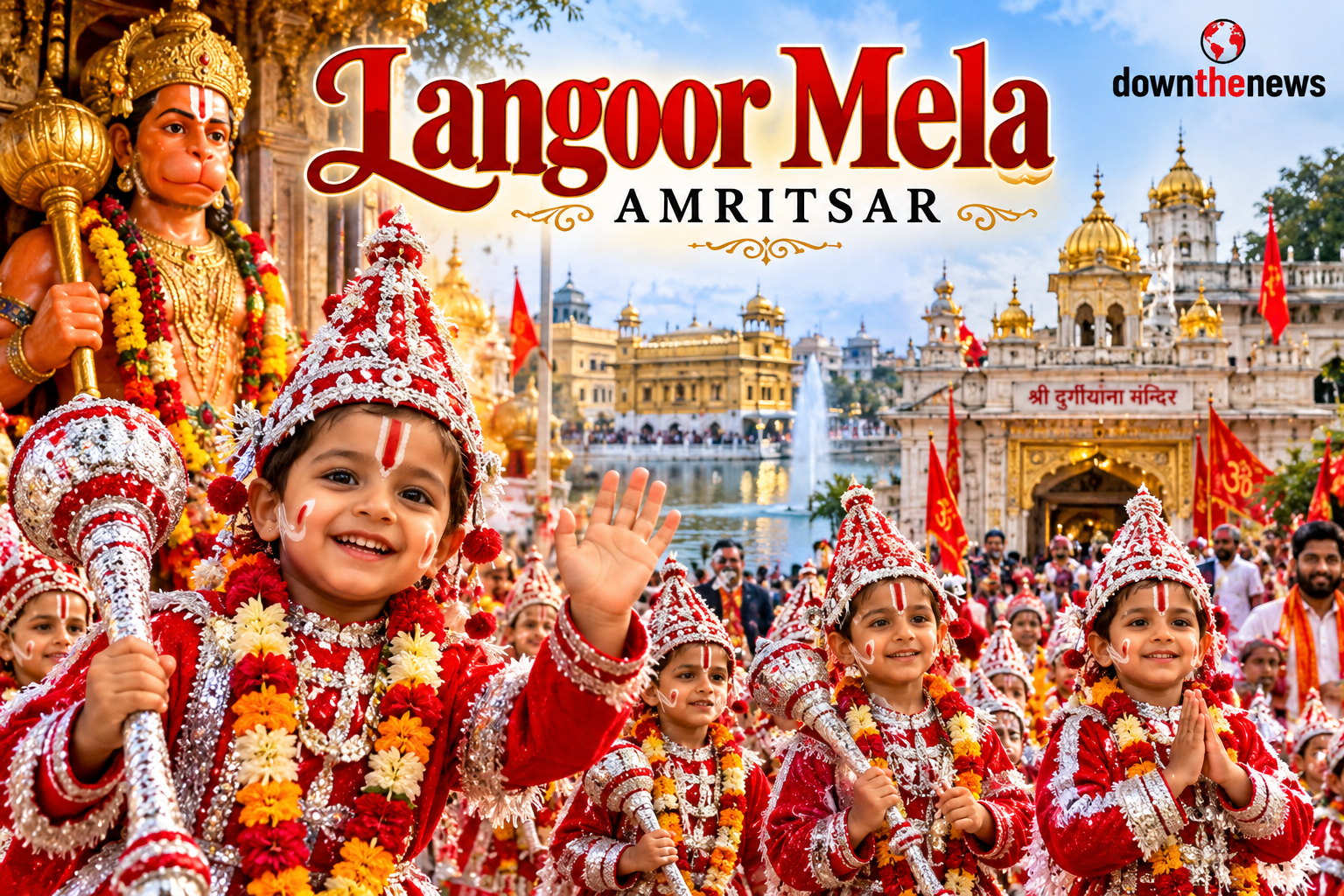
When little devotees dress as Lord Hanuman’s langoors, the holy city of Amritsar comes alive with the colours of faith, the rhythm of dhol and the timeless spirit of the Ramayana.
Every year, as the sacred days of Navratri arrive, a unique spectacle of faith unfolds in the heart of Amritsar, Punjab. The streets surrounding the historic Durgiana Temple come alive with families, devotional chants, colourful processions and hundreds of children dressed in striking red-and-silver costumes.
Their glittering headgear, traditional attire and little ceremonial accessories make them instantly recognisable. These children are participating in the famous Langoor Mela of Amritsar, a distinctive religious tradition associated with devotion to Lord Hanuman.
Unlike ordinary fairs, the Langoor Mela is deeply rooted in personal vows, family faith and the desire to express gratitude to the divine. For many families, participating in this festival is the fulfilment of a promise made in prayer. For visitors, it is an opportunity to witness one of Punjab’s most distinctive religious and cultural traditions.
Held annually during the Sharad Navratri period at the historic Bada Hanuman Mandir within the Durgiana Temple complex, the festival attracts devotees from across India and abroad.
In 2026, the mela began on October 11, coinciding with the first day of Sharad Navratri. Thousands of children and their families gathered at the temple to participate in the celebrations.
The Historical and Religious Significance of Langoor Mela
To understand the Langoor Mela, one must first understand the importance of the temple where it takes place.
The festival is centred on the Bada Hanuman Mandir, located within the larger Durgiana Temple complex in Amritsar.
The Durgiana Temple is among the city’s prominent Hindu pilgrimage sites. Its main temple, dedicated to Goddess Durga and associated deities, stands amid a sacred water tank and features architectural elements reminiscent of Amritsar’s famous Golden Temple.
According to the National Mission on Monuments and Antiquities, the original Durgiana Temple dates to the 16th century, while the present complex was rebuilt in 1921 under the guidance of Guru Harsai Mal Kapoor. Pandit Madan Mohan Malaviya inaugurated the reconstructed temple.
The Bada Hanuman Mandir has its own distinctive religious identity, closely associated with stories from the Ramayana.
For devotees, this is not merely a place of worship. It is a sacred space where mythology, family traditions and generations of religious observance come together.
The annual Langoor Mela has helped give the temple a special place in the religious life of Amritsar.
The Ramayana Connection: The Legend of Luv and Kush
One of the most fascinating aspects of the Langoor Mela is the local legend connecting the Bada Hanuman Mandir with Luv and Kush, the twin sons of Lord Rama and Goddess Sita.
According to the traditional belief associated with the temple, the site is connected with the episode in which Luv and Kush captured the horse associated with Lord Rama’s Ashwamedha Yajna.
The legend says that when Lord Hanuman came to recover the horse and bring the boys back, they tied him to a banyan tree.
The temple’s religious tradition associates this location with that episode from the Ramayana.
For devotees, the story gives the temple a powerful connection with Lord Rama, Lord Hanuman and the legendary vanara sena—the army of monkey warriors who played an important role in Rama’s campaign against Ravana.
The story also helps explain why the representation of langoors has become central to the mela.
It is important to understand that this is a religious tradition and local belief rather than a historically verified account of an event at the present temple site.
Nevertheless, its spiritual significance remains deeply meaningful to devotees, who see the temple as a place associated with the courage, loyalty and devotion of Lord Hanuman.
Why Are Children Dressed as Langoors?
The most distinctive feature of the festival is the sight of children dressed as langoors, representing the monkey devotees associated with Lord Hanuman.
The tradition is particularly connected with families who pray for children and promise to return to the temple to express gratitude if their prayers are fulfilled.
According to the belief followed by many devotees, couples who wish for a child offer prayers at the Bada Hanuman Mandir. When they are blessed with a child, they bring the child to the temple during Navratri and dress them as a langoor as an expression of thanksgiving.
Other families participate as part of their own devotional commitments and prayers for their children’s well-being.
The practice is rooted in religious faith rather than any scientifically established relationship between prayer and fertility.
For participating families, however, the experience can be profoundly emotional. It represents the fulfilment of a promise, gratitude for parenthood and a desire to seek the blessings of Lord Hanuman.
Over the years, this distinctive tradition has become the defining feature of Amritsar’s Langoor Mela.
The Beautiful Red-and-Silver Costumes
One of the most captivating sights during the mela is the colourful attire worn by the young participants.
Children traditionally appear in costumes featuring bright red fabric, silver-coloured material, decorative borders and elaborate conical caps.
Some carry small ceremonial accessories, while their families accompany them to the temple for prayers.
The costumes distinguish the Langoor Mela from other religious festivals in Punjab. When groups of children arrive together, their coordinated attire creates a striking spectacle.
The festival grounds become a sea of red, silver and gold, with the colours of the costumes contrasting beautifully against the temple’s architecture.
Parents spend time preparing the traditional outfits, while relatives often accompany the children throughout the festival.
For many families, dressing a child as a langoor is not simply a festive activity. It is an important religious commitment that has often been passed down through generations.
Ten Days of Devotion and Discipline
The Langoor Mela is not merely about colourful costumes and public celebrations.
For participating families, it involves a period of religious discipline that generally begins with Sharad Navratri and continues through the festival period.
According to the customary practices followed by many devotees, children dressed as langoors and their families observe specific rules during these days.
These may include:
- Daily temple visits: Children visit the Bada Hanuman Mandir to offer prayers and pay their respects.
- Walking barefoot: Many participating families follow the tradition of remaining barefoot during the observance.
- Simple food: Families may follow a sattvic diet and avoid certain ingredients according to their religious customs.
- Sleeping on the floor: This is another traditional practice observed by many participants.
- Maintaining religious discipline: Families try to follow a simple routine centred on prayer, devotion and self-restraint.
Specific practices can vary between families and according to the temple’s instructions.
The underlying idea is that the period should be observed as an act of devotion rather than treated simply as a festival or costume celebration.
For children, it becomes an experience of participating in a family tradition and learning about religious customs from an early age.
The Temple Comes Alive With Devotional Energy
During the mela, the atmosphere around the Bada Hanuman Mandir becomes especially vibrant.
Families arrive with their children, relatives gather for prayers, and groups of young participants move through the temple complex.
Devotional chants and the beats of the dhol add to the festive atmosphere.
Children often arrive in groups accompanied by parents and other family members. Their colourful costumes make them the centre of attention, while devotees gather to witness the distinctive tradition.
For many visitors, the most memorable part of the mela is the combination of youthful energy and deep religious commitment.
There is celebration, but there is also a strong sense of purpose. Families have often travelled considerable distances to fulfil their vows and participate in the observance.
The festival therefore brings together personal devotion and collective religious experience.
A Tradition That Has Continued Across Generations
The Langoor Mela has developed into one of Amritsar’s most recognisable annual religious events.
Although its exact beginnings are difficult to establish from the available historical records, the practice is widely described in contemporary reporting as a longstanding tradition.
Families return year after year, and some travel from other parts of India or from overseas to participate.
The mela has also become an important part of Amritsar’s cultural identity.
The city’s reputation rests on many different traditions, including its Sikh heritage, historic landmarks, bustling markets and religious festivals. The Langoor Mela adds another distinctive dimension to this cultural landscape.
Its significance lies partly in the fact that it is not simply a public spectacle organised for visitors. It is sustained by families who regard participation as a personal religious commitment.
That continuing involvement has helped preserve the festival across generations.
Langoor Mela 2026: A Living Tradition in Modern Amritsar
The 2026 edition began on Sunday, October 11, with the start of Sharad Navratri.
Recent reports described thousands of children arriving at the Bada Hanuman Mandir in traditional costumes to offer prayers.
One notable development this year was the participation of girls dressed as langoors, reflecting a change from the convention in which boys traditionally dominated the observance.
The festival continues to attract devotees from Punjab, other Indian states and abroad.
Temple authorities and volunteers also play an important role in managing the large crowds and helping visitors move through the complex.
In recent years, crowd management has become increasingly important as the mela attracts substantial numbers of participants. The temple committee has used volunteers alongside police personnel to help organise queues and maintain order. The Tribune
The continued popularity of the mela demonstrates how traditional religious practices can remain relevant even as cities and lifestyles change.
Modern transport, wider media coverage and social media have also made the festival more visible to people who might otherwise never have encountered this distinctive custom.
Yet at its heart, the observance remains centred on prayer, gratitude and the fulfilment of family vows.
The Conclusion of the Mela
The Langoor Mela traditionally concludes around the end of the Navratri observance and Dussehra period.
According to the temple’s established tradition, participants return to the Bada Hanuman Mandir for the concluding rituals.
The langoor costumes, worn throughout the period of observance, are then ceremonially removed in accordance with the tradition.
The conclusion marks the completion of the religious commitment undertaken by the children and their families.
For parents, it can be an emotional moment: the end of a period of discipline and prayer, and the fulfilment of a promise made in devotion.
The festival thus comes full circle—from a vow and an act of faith to a public expression of gratitude.
More Than a Religious Fair: The Social and Cultural Significance
The Langoor Mela is significant for several reasons beyond its religious rituals.
1. Preserving cultural heritage
The festival helps preserve a distinctive tradition associated with Amritsar. Its costumes, rituals and stories form part of the city’s living cultural heritage.
2. Strengthening family bonds
Parents, grandparents and other relatives often participate together. Preparing costumes, accompanying children and observing religious practices create shared family experiences.
3. Passing traditions to younger generations
Children are active participants rather than simply spectators. Through their involvement, they encounter the religious stories and customs that shape their families’ beliefs.
4. Bringing communities together
The mela draws people from different regions and backgrounds who share an interest in the tradition. It creates a sense of collective participation and belonging.
5. Supporting local activity
The arrival of visitors during the festival can benefit local vendors and businesses selling religious items, traditional clothing, flowers and refreshments.
The festival therefore has a cultural and social significance that extends beyond the temple grounds.
A Visitor’s Guide to Langoor Mela
For those planning to experience the festival, a few practical points can make the visit more comfortable.
Location: Bada Hanuman Mandir, within the Durgiana Temple complex, Amritsar, Punjab.
When: During Sharad Navratri, with the observance traditionally extending through the Dussehra period.
What to see: The traditional langoor costumes, temple prayers, family processions and the distinctive religious atmosphere.
Getting there: The Durgiana Temple is approximately 700 metres from Amritsar railway station, according to the district administration’s tourism information. Visitors can reach the complex by local taxi, auto-rickshaw or other local transport.
Visitor etiquette: Dress respectfully, follow temple instructions, be considerate of worshippers and ask permission before photographing children or families at close range.
Crowds: Expect busy conditions during the festival. Allow extra time for travel, follow the designated queues and keep children close in crowded areas.
The Enduring Magic of Langoor Mela
In an age when many traditional festivals are increasingly shaped by tourism and commercial entertainment, Amritsar’s Langoor Mela retains a distinctive character.
Its most memorable images are simple yet powerful: a child in a glittering red-and-silver costume, a parent holding a little hand, a family bowing before Lord Hanuman and the sound of devotional chants filling the temple grounds.
Behind every costume lies a family story. Behind every visit is an act of faith. And behind the festival itself is a tradition that continues to connect the present generation with the beliefs and practices of those who came before them.
The Langoor Mela is not merely an unusual sight during Navratri. It is a reminder of how religious traditions become woven into the identity of a city.
For Amritsar, it is another expression of the city’s remarkable spiritual and cultural richness.
As the little langoors gather at the Bada Hanuman Mandir each year, they carry forward a tradition that is as much about gratitude and family as it is about faith. In their colourful costumes and innocent devotion, Amritsar finds one of its most distinctive celebrations of the enduring bond between people, tradition and the divine.