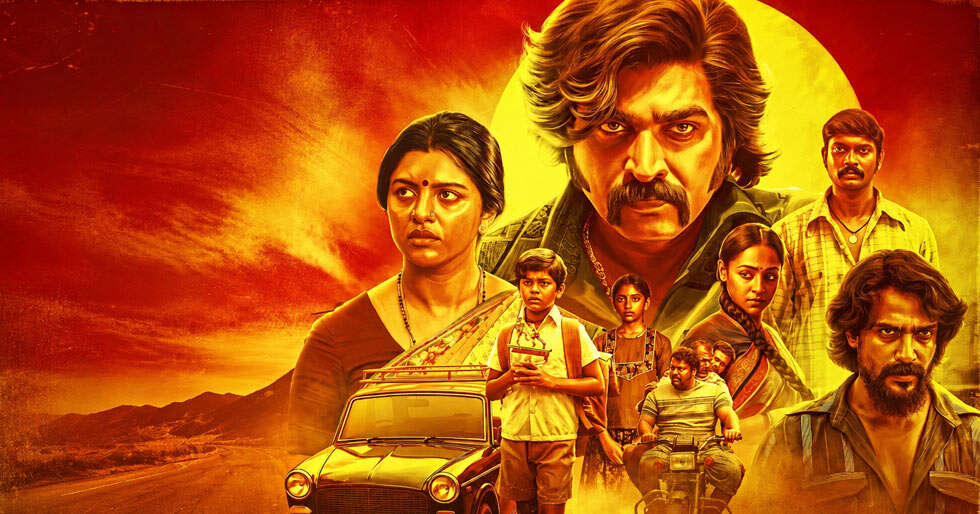
Set in Madras in 1986, Baththa reunites Vijay Sethupathi with filmmaker Balaji Tharaneetharan for their third collaboration after Naduvula Konjam Pakkatha Kaanom and Seethakaathi. The film returns the duo to character-driven storytelling, blending comedy, drama and sentiment around a familiar but engaging question: what happens when a man who has built his identity around instilling fear in others is forced to confront his own shortcomings?
Baththa, played by Sethupathi, is a local gangster accustomed to having his way, whether dealing with rivals or asserting authority within his household. However, an unexpected encounter with Sabari (Sai Prithviraj), a schoolboy, sets in motion a series of events that challenges his carefully cultivated persona.
The relationship between the two characters is the film’s most effective narrative device. Rather than introducing an equally formidable adversary to challenge the gangster, Tharaneetharan places him alongside a child whose innocence offers a different perspective on the world. The contrast creates room for humour, particularly as Baththa discovers that intimidation is not a universal solution. Their interactions gradually expose the limitations of a man who has spent much of his life believing that authority and fear are enough to command respect.
Sabari’s presence does more than provide Baththa with opportunities for comic embarrassment. The boy challenges the gangster’s assumptions without becoming a mouthpiece for the film’s moral concerns. Tharaneetharan allows their contrasting temperaments to drive the comedy, giving the relationship room to develop naturally. These lighter exchanges lend the drama warmth without making its more serious moments feel imposed by the screenplay.
Sethupathi is the film’s principal asset. He brings bluster and impeccable comic timing to Baththa, a gangster whose need to command respect often exposes his own insecurities. The actor makes the character’s petulance as entertaining as his attempts at intimidation, creating a man whose authority can unravel in unexpectedly amusing ways.
Sai Prithviraj provides an effective counterpoint to the lead actor. Sabari could easily have become a convenient device for the gangster’s transformation, but the young performer brings enough personality to the role to give their relationship some life. His exchanges with Sethupathi have an appealing spontaneity, and the contrast between their temperaments generates humour without reducing Sabari to a passive observer in his own story.
Lijomol Jose, as Baththa’s wife Kanima, brings an important perspective to the domestic narrative, while Sahasra Sree, Santhy Balachandran and Hari Krishnan contribute to the supporting ensemble. The period setting is another welcome feature. The recreation of 1980s Madras lends the story a distinctive texture, with the production design, costumes and everyday details helping establish its time and place. Rather than relying solely on nostalgia, the setting provides a backdrop for a story shaped by local relationships and personal interactions.
For all its warmth, Baththa occasionally struggles to reconcile its protagonist’s transformation with the consequences of his behaviour. The film establishes his aggression towards those closest to him, making his eventual change a potentially compelling dramatic development. However, the transition from cruelty to compassion sometimes feels more straightforward than his history warrants.
A change of heart is one thing; rebuilding the trust of those who have endured a person’s anger is another. Baththa could have explored this distinction with greater sensitivity, giving the supporting characters more room to respond to the protagonist’s transformation. By focusing largely on his personal awakening, the screenplay misses an opportunity to examine the lasting consequences of his behaviour, which could have added greater complexity to his redemption arc.
The pacing is another concern. The film finds a comfortable rhythm in its middle portions, particularly when it focuses on Baththa and Sabari. However, the momentum becomes less consistent as the narrative progresses towards the climax. Certain developments linger beyond their natural endpoint, diminishing the impact of moments that might have benefited from greater restraint.
The tonal shifts between broad comedy and earnest drama can also be conspicuous. While the humour generally emerges from the characters and their circumstances, some transitions feel abrupt, particularly when the film moves from a light-hearted exchange to a scene demanding considerable emotional investment. A more measured approach could have helped these moments land with greater conviction.
Baththa is a warm, engaging period drama elevated by the creative understanding between Balaji Tharaneetharan and Vijay Sethupathi. While the screenplay could have delved deeper into the consequences of its protagonist’s actions, the film’s central relationship, humour and performances compensate for its uneven pacing and tonal shifts. Tharaneetharan may not fully resolve Baththa’s journey, but the film finds enough humour and humanity in the gangster’s unlikely friendship to make his gradual transformation worthwhile.
Also Read: Vijay Sethupathi Reunites With Director Balaji Tharaneetharan For Baththa
Disclaimer : This story is auto aggregated by a computer programme and has not been created or edited by DOWNTHENEWS. Publisher: filmfare.com