Pictured: Winning entries for Wildlife Photographer of the Year 2026
-
Published
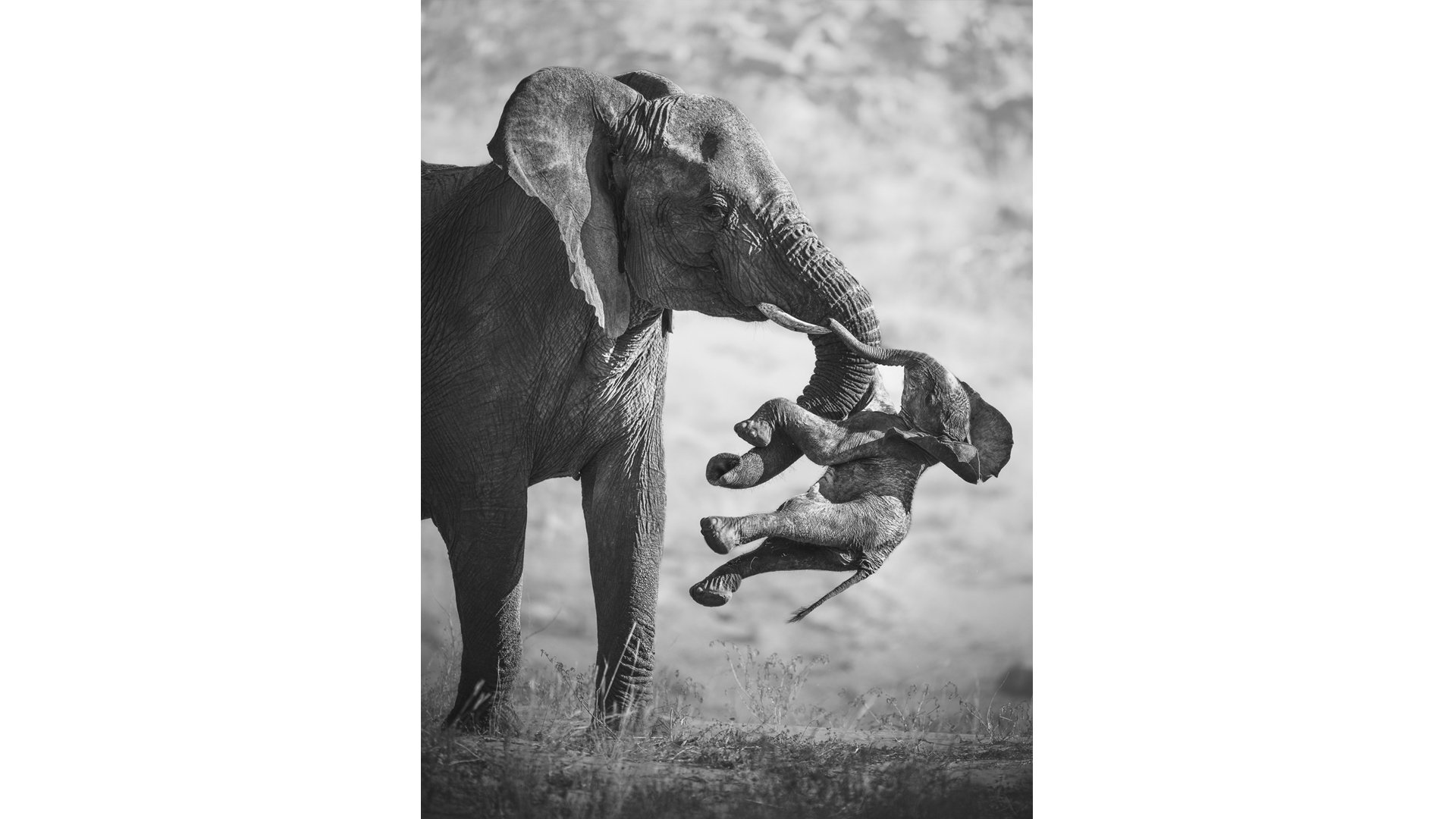
An emotional scene of an elephant carrying a deceased calf has earned Italian photographer Federico Veronesi the title of Wildlife Photographer of the Year 2026.
While tracking elephants in Namibia’s Huab River Valley, Veronesi spotted an unusual trail of drag marks across the sand of a dry riverbed.
Following the tracks, he came across a female elephant carrying a dead calf, its leg wedged between her tusk and trunk.
Initially, Veronesi assumed the elephant was the calf’s mother. But after sharing his photographs with an elephant research project working in the area, he learned that this wasn’t certain.
Researchers recognised the elephant as a female who had lost a calf several years earlier and said she had previously picked up dead calves belonging to other females.
For Veronesi, the encounter was deeply significant. “Of all the 20 years I’ve done photographing animals, this is the most heart-wrecking and fascinating and dramatic,” he said, describing it as “revealing of the depth and complexity of the emotions, the feelings of the animals.”
He hopes the image will encourage people to look beyond animals’ physical appearance and recognise them as individuals with their own relationships, memories and emotions. “It’s a small window that opens just a crack into the complexity of their world,” he said.
The competition’s annual exhibition, external opens at the Natural History Museum on Friday 16 October 2026. Keep scrolling to see more award-winning images.
Labour of love
 Image source, Oscar Whitfield
Category: Young Grand Title and 11 to 14 Years
Photographer: Oscar Whitfield, Zimbabwe/UK
Location: Zambezi National Park, Zimbabwe
Only by lying in the dust and capturing the beetle at eye level could Whitfield show how much strength its task required.
While on a family game drive in Zimbabwe, near his home in Victoria Falls, he spotted the dung beetle struggling to push a ball of dung uphill through the sand, with a trail of flies following closely behind. After experimenting with different angles and compositions, he captured a moment that reveals the extraordinary effort involved in this seemingly simple task.
“I hope that when people look at the photograph, they can see too, and maybe appreciate how much can be happening in a small moment in the natural world,” says Whitfield.
Flight of the Bumblebee
 Image source, Amelie Davis
Category: 10 Years and Under
Photographer: Amelie Davis, UK
Location: Surrey, England
You do not need a camera or a plane ticket to take an award-winning photo. Davis captured this shot in the garden using her dad’s smartphone.
The image freezes in time a single wingbeat from a common carder bumblebee as it prepares to land on a flower.
The Meeting Place
 Image source, James Lewin
Category: Animals in their Environment
Photographer: James Lewin, UK
Location: Chyulu Hills National Park, Kenya
Lewin captured this dreamy, black-and-white photo of a young bull elephant spraying zebras at a waterhole.
He softened the usually harsh light by using a camera converted to infrared.
A Watchful Eye
 Image source, Aaron Sanders
Category: Animal Portraits
Photographer: Aaron Sanders, UK
Location: Porthkerris Beach, Cornwall
Common octopuses are usually found in the warmer Mediterranean Sea. But with global warming pushing up springtime sea temperatures, sightings across south-west England have massively increased.
Sanders described the moment he spotted a single eye peeking from behind the kelp: “We remained perfectly still, watching one another with a seemingly shared curiosity.”
Scenes from the Swamp
 Image source, Isak Pretorius
Category: Birds
Photographer: Isak Pretorius, South Africa
Location: Mabamba Swamp, Uganda
Fewer than 5,300 mature shoebill storks are estimated to remain in the wild. Yet Pretorius, while canoeing with a guide, was able to capture these two – likely a breeding pair collecting material for their nest.
Despite their name, shoebill storks are actually more closely related to pelicans, herons and ibises.
Birdsong Painted in Light
 Image source, Konrad Gräeter
Category: 15-17 Years
Photographer: Konrad Gräeter, Germany
Location: Baden-Württemberg, Germany
Spring sees male blackbirds search for high vantage points to sing and try to attract a mate.
This photo was taken in a vineyard at dawn, when the birds sing their most complex compositions.
Urban Jungle
 Image source, Seth Forestson
Category: Urban Wildlife
Photographer: Seth Forestson, UK
Location: Lumphini Park, Bangkok, Thailand
Forestson lowered himself onto the mud to capture this common water lizard against the city skyline.
These adaptable lizards live in cities across South and South East Asia and will take whatever food is available, such as catfish and koi.
Making Morays
 Image source, Tony Wu
Category: Under Water
Photographer: Tony Wu, USA/Japan
Location: Kagoshima Prefecture, Kyūshū, Japan
This is probably the first time the courtship ritual of Abbott’s moray eels has been photographed, the NHM said.
Wu worked with biologists and used dim red light and a customised fisheye lens to minimise disturbance.
Wily Coyotes of San Francisco
 Image source, Loren Elliott
Category: Photojournalist Story Award
Photographer: Loren Elliott, USA
Location: USA
San Francisco is estimated to be home to around 100 coyotes, living alongside a large human population. While they can prey on domestic animals, they also help control disease-carrying rodents, and residents’ attitudes towards them are mixed.
Protective Pose
 Image source, Anton Sorokin
Category: Behaviour: Amphibians and Reptiles
Photographer: Anton Sorokin, US
Location: Contra Costa County, California, USA
Sorokin dipped his camera and lights in a murky pond to catch this glimpse of a California newt laying her eggs.
Shifting Sand
 Image source, Sitaram Raul
Category: Behaviour: Invertebrates
Photographer: Sitaram Raul, India
Location: Thar Desert, Rajasthan, India
A scorpion is photographed burrowing into the shifting dunes of India’s Thar Desert.
Exploring the dunes at night, Raul saw many scorpions searching for prey but as temperatures rose after sunrise, the scorpion dug into the sand to escape the intense heat.
Night-Time Catch
 Image source, Alex Lindbloom, USA
Category: Oceans: The Bigger Picture
Photographer: Alex Lindbloom, USA
Location: Off Cenderawasih Bay, Papua, Indonesia
A whale shark investigates the catch of a mobile net-fishing platform, known as a bagan. Lindbloom searched for sharks around dawn, using the bagan’s bright lights to illuminate them when there was too little natural light for his drone.
Shedding Light
 Image source, Agorastos Papatsanis
Category: Plants and Fungi
Photographer: Agorastos Papatsanis, Greece
Location: Litochoro, Pieria, Greece
Papatsanis used ultrviolet light to illuminate mushrooms known as “beautiful bonnets” growing from a decaying log on the lower slopes of Mount Olympus in Greece.
Hidden Depths
 Image source, Alexis Tinker-Tsavalas
Category: Rising Star Award
Photographer: Alexis Tinker-Tsavalas, Germany
Location: Germany and Northern Ireland, UK
Tinker-Tsavalas uses macro photography to reveal the intricate details of tiny animals that are easily overlooked, particularly in urban habitats. His interest in macro photography developed during the Covid-19 lockdowns, when he was restricted to habitats close to his home in Berlin.
Escape Artistry
 Image source, Michał Michalski
Category: Natural Artistry
Photographer: Michał Michalski, Poland
Location: Litochoro, Pieria, Greece
Michalski used a slow shutter speed to photograph birds flying across a background of leafless birch trees. A field of unharvested sunflowers had attracted mixed flocks of birds, especially goldfinches and bramblings, before they were startled into the air by a sparrowhawk.
The Great Divide
 Image source, Alex Visbal
Category: Wetlands: The Bigger Picture
Photographer: Alex Visbal, Colombia
Location: Stansbury Bay, Great Salt Lake, Utah, USA
Visbal documents how a single engineered line can reshape an entire wetland as part of a long-term project on the industrial impact on waterways. The pink comes from microbes thriving in extremely salty water after the area was cut off from fresh water.
Warning Sign
 Image source, Francisco Negroni
Category: Photojournalism
Photographer: Francisco Negroni, Chile
Location: Route 40, Santa Cruz Province, Argentina
Negroni records this scene of a dead puma displayed as a hunting trophy in Santa Cruz, a province in Argentine Patagonia. Although Santa Cruz banned puma hunting in 2025, illegal persecution continues.
Secret Worlds
 Image source, Kutub Uddin
Category: Portfolio Award
Photographer: Kutub Uddin, Bangladesh/UK
Location: West Sussex, England, UK
Uddin’s photographs explore the miniature world of slime moulds, organisms that can be barely visible to the naked eye and whose fruiting structures are just one to two millimetres high.
Disclaimer : This story is auto aggregated by a computer programme and has not been created or edited by DOWNTHENEWS. Publisher: newsrss.bbc.co.uk