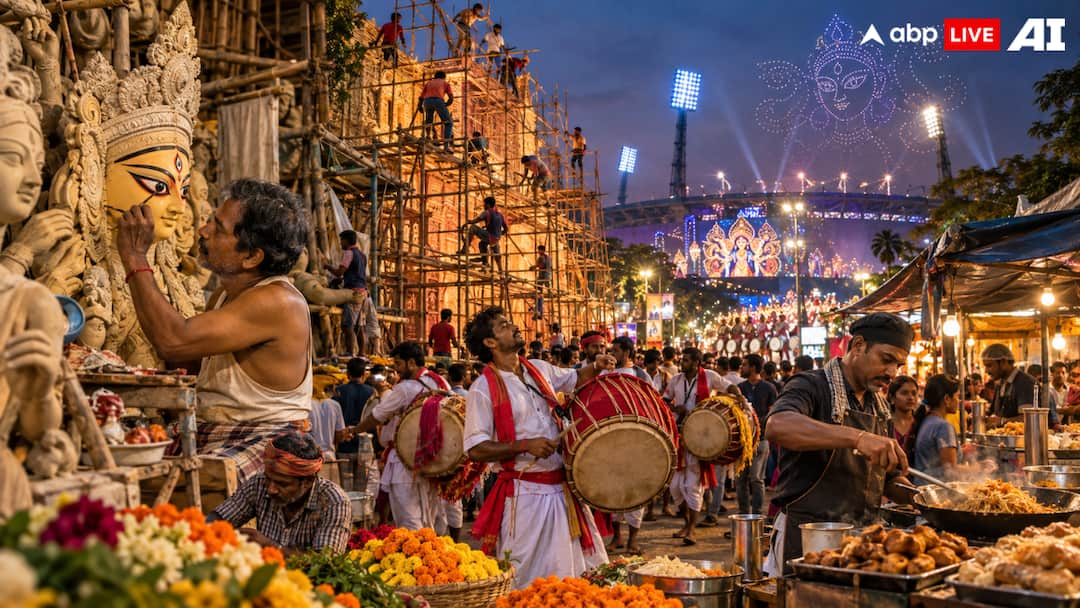
- Grand inauguration launched Durga Puja, fueling immense informal economy.
- Idol makers, pandal workers, food vendors drive festival economy.
- Despite global recognition, many workers face economic insecurity.
- Policy challenge: support small businesses for fairer economic participation.
When nearly 3,000 dhakis played together at Kolkata’s Eden Gardens on Mahalaya, the sound was more than a cultural announcement. It marked the beginning of a festival that transforms the city, brings millions onto its streets and sets thousands of livelihoods in motion.
The West Bengal government’s grand ‘Uma Agamani’ inauguration at Eden Gardens on October 10, 2026, gave Durga Puja an unprecedented opening. Drone displays, fireworks, music and a historic gathering of traditional drummers turned the iconic cricket ground into a stage for Bengal’s cultural identity. Yet behind this spectacle lies a less visible story, an enormous seasonal economy sustained by artisans, workers, cooks, vendors, transporters and small businesses. The festival begins with the arrival of the Goddess, but its economic activity starts months earlier.
The most revealing question is not simply how much Bengal spends on Durga Puja. It is who earns from it, how that money moves and whether the people who make the celebration possible receive a fair share of its value. A British Council study commissioned by the West Bengal government estimated the creative industries surrounding Durga Puja at Rs 32,377 crore in 2019, equivalent to 2.58 per cent of the state’s GDP at that time. The estimate covered ten creative industries and excluded sponsorships. It was not a measure of total festival spending, nor is it a verified figure for 2026. Nevertheless, it demonstrates the economic scale of an event that lasts only a few days but supports a much longer production cycle.
Kumartuli, Kolkata’s historic potters’ quarter, offers a striking example. The study valued the idol-making economy at approximately Rs 260–280 crore. Behind every Durga idol is a chain of work involving clay, straw, bamboo, paint, jute, transport and skilled labour. The artist whose hands shape the Goddess depends on suppliers, helpers and seasonal workers, many of whom have limited financial security outside the festival period.
The same chain extends to the pandals. Carpenters, welders, electricians, painters, fabricators and decorators work against demanding deadlines. Printers produce banners and invitations; transporters move materials; security personnel and cleaners keep crowded spaces functioning. Hotels, restaurants, neighbourhood shops, taxis and app-based transport services experience additional demand.
Sourav Sil, a pandal maker, expressed, “People see the finished pandal for a few nights. For us, the work begins months earlier, with procuring materials, workers, deadlines and the responsibility of turning an idea into something the entire neighbourhood can experience, and shall remember.”
That labour is easy to overlook because the final product is temporary. A structure that takes weeks to design and build may stand for only a short period before being dismantled. Yet the income it generates can sustain households long after its bamboo frames and decorative panels have disappeared. Food is another major part of this informal economy. Pandal hopping is inseparable from Kolkata’s street-food culture. Rolls, fish fry, biryani, chowmein, momos, sweets and countless local favourites turn the streets into temporary marketplaces. Each plate connects a customer to cooks, suppliers, delivery workers, fuel sellers and stall owners.
But high footfall does not automatically mean high profit. Raktim Sen, a food stall owner, explained the contradiction simply, saying, “Dada, the crowds bring customers, but the cost of ingredients, cooking gas and helpers has also gone up manyfold. During Puja, we need to sell more just to protect our margins, to be honest.”
Recent reporting has highlighted precisely this pressure on Kolkata’s street-food vendors, with rising LPG and kitchen costs prompting some to consider higher prices during the 2026 festival season. The festival may create demand, but small traders still carry the risk of rising costs and uncertain returns. Restaurants and temporary food stalls must also manage perishables, long working hours, unpredictable crowds and additional staff. A successful night can produce strong sales, but poor location, bad weather or a sudden rise in input costs can quickly reduce the gains.
Now, the chefs who work behind the scenes face a similar balancing act. The Co-head Chef of Sienna Café Calcutta, Koyel Roy Nandy, expressed her views, stating, “During Puja, the real challenge is to serve a much larger number of people without compromising on quality. That takes careful planning, fresh ingredients, reliable suppliers and a team that can handle the rush. For me, Durga Puja is much more than four days of celebration. It is perhaps Bengal’s biggest annual informal economic engine. We often measure the economy through corporate jobs and organised businesses, but Puja shows us how much can be achieved through individual skills, hard work and small enterprises. The work begins months before the festival. Kumartuli’s artisans get busy with their idols, dhakis prepare for the season, and people involved in chalchitra, shola craft, lighting, jharbati and pandal-making begin their work. Flower growers, potters, tailors, decorators and countless daily-wage workers also depend on this season for their earnings. Many work without formal contracts, yet their contribution is essential to the festival. Even a small fuchka or ghugni seller can see a significant rise in business during these days”
She further added, “As a chef working in the eastern frontier of India, I find the food economy of Durga Puja particularly interesting because it brings everyone together. A neighbourhood food stall, a standalone restaurant and a five-star hotel may serve very different segments of customers, but all find their place during the festival. From a Rs 20 bowl of ghugni to a plate of jhal muri or an elaborate elite buffet, there is something for everyone. That diversity is what makes this informal economy so special. Food also becomes a great equaliser during Puja. Many families spend less time cooking at home because everyone wants to step out, meet friends and enjoy the festivities. Even the mothers who spend much of the year in the kitchen get a little break! Luchi and alur-dom, fish fry, biryani, momos and street food become part of the celebration. But every plate has a supply chain behind it. Meat sellers, poultry suppliers, fish traders, vegetable vendors, transporters, cooks and temporary kitchen workers all see the impact of this seasonal demand. The connections stretch from wholesale markets in Kolkata to farms and fishing communities in the surrounding districts. Many people earn their living during Puja without ever appearing on a company’s payroll. That is why I see Durga Puja as an economy built from the ground up. It brings together people from different income groups, creates opportunities for small businesses and allows traditional skills to find a market. In that sense, it shows what an inclusive, community-driven economy can look like. As chefs and food businesses, we also have a responsibility towards this ecosystem. Puja food should not be seen only through the lens of Bengali cuisine. It is equally about the people who grow, source, prepare and serve that food. If we buy responsibly, pay our suppliers fairly, value local produce and respect the people behind every dish, we become part of the Puja economy in a more meaningful way. Ultimately, the festival is sustained not just by the money people spend, but by the thousands of hands that make it possible. Durga Puja belongs to everyone, and its economy should recognise everyone who helps bring it to life. “
Then there is the sound that announces the festival, the dhaak. For a dhaki, the drum is both a cultural inheritance and a source of seasonal income. Performers travel from villages to cities, often relying on festival bookings to support their families. Their contribution is central to the Puja experience, yet their earnings can depend on the number of engagements they secure and the travel and accommodation costs they must bear.
Gurupada Banik, a dhaki, shared his perspective to capture the larger truth, stating, “When the dhaak sounds, people feel that Puja has arrived. For us, those beats also carry the hope of earning enough to take home after the festival, for the rest of the year.” These voices point to a wider reality. Durga Puja is not simply an occasion when consumers spend more. It is a temporary economic network that connects urban demand with rural skills, traditional craftsmanship, and small enterprises. Money moves between neighbourhoods, districts, and supply chains, often through people who do not appear in formal corporate accounts.
The festival’s global recognition has added another dimension. UNESCO inscribed Kolkata’s Durga Puja on its Representative List of the Intangible Cultural Heritage of Humanity in 2021. The recognition strengthened international attention on the festival’s artistic and cultural value. Kumartuli’s idols and Bengal’s creative traditions also reach audiences beyond India, extending the market for skills developed over generations. But, visibility and economic security are not the same thing. A globally celebrated artisan can still face a shortage of working capital. A pandal worker can remain dependent on seasonal employment. A food vendor can be exposed to fuel prices and ingredient costs. In 2026, reports of clay-supply difficulties in Kumartuli showed how disruption to basic raw material could threaten idol production and the livelihoods connected to it.
This is the paradox of Bengal’s Puja economy. Its strength lies in the flexibility, creativity and social networks of small enterprises. Its vulnerability lies in the fact that many of those enterprises have limited financial buffers and depend on a short, intense period of demand.
The policy challenge, therefore, is not merely to celebrate the festival’s economic size. It is to improve access to affordable credit, reliable raw materials, skills training, safer working conditions and better market access for artisans and small businesses. Economic assessments should also distinguish clearly between creative-industry value, retail spending, tourism revenue and total festival expenditure. Different estimates measure different things; combining them without care can produce a misleading picture.
The Eden Gardens spectacle offered Durga Puja 2026 a historic opening. But the festival’s real scale cannot be measured by a drone display, the size of a pandal or the number of visitors alone. It must also be measured in the earnings of a clay artisan, the wages of a carpenter, the sales of a food vendor and the money a dhaki carries home. When Bengal looks at a Durga idol, it sees divinity. When an economist looks at the festival, there is a supply chain. And when we look closely at the hands behind that chain, we see thousands of people whose labour makes the celebration possible.
The dhaak announces the festival. But long before the first beat is heard, Bengal’s informal economy has already started beating.
Disclaimer : This story is auto aggregated by a computer programme and has not been created or edited by DOWNTHENEWS. Publisher: abplive.com