
Beyond the Spotlight is The Better India’s culture series on regional, indie, and often-overlooked artists reshaping Indian cinema and art from its margins — one story, one village, one language at a time.
For most of her working life, a midwife named Bua Dolma walked the same punishing path almost every day — a narrow, slippery trail of dry mud, barely wide enough for one person, that took over an hour to trek down into Kandhar, a village in Kinnaur that has since been abandoned to landslides and dam construction.
She went because there was no one else to go. There was no hospital, no road, no alternative. She went because that was simply what the work demanded of her.
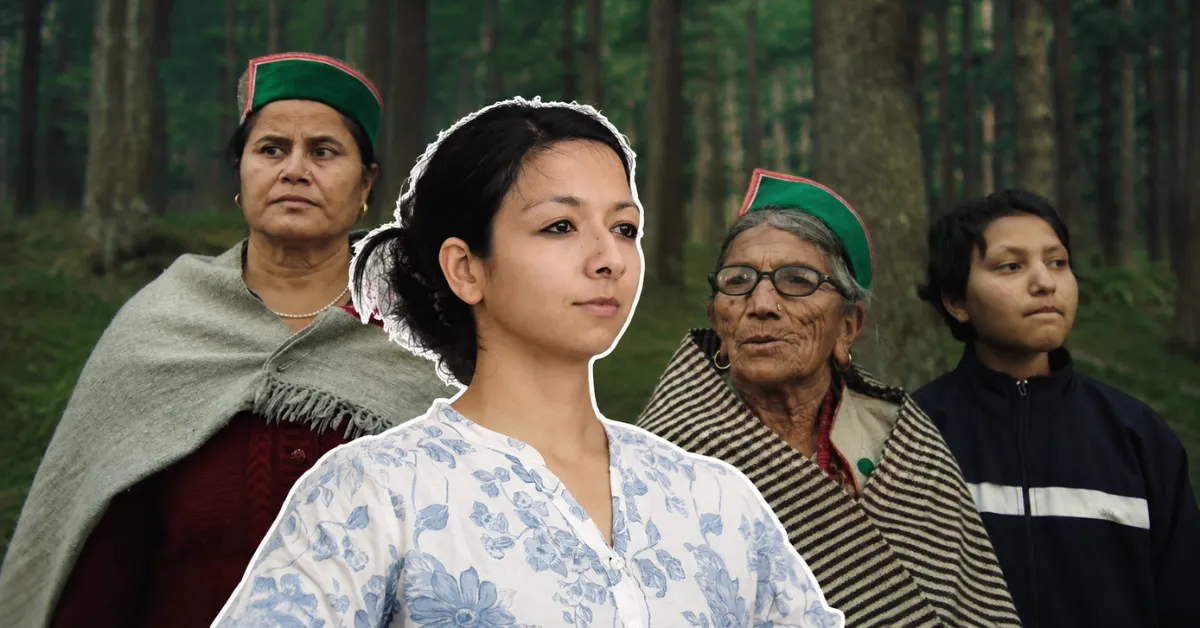
Decades later, her niece would turn that walk — and that life — into India’s first narrative film in the Kinnauri language.
“It’s kind of like working — it takes a village to make a film,” says Nihaarika Negi, the writer-director of Tenfa, “but we were literally making a film with a village.”
That isn’t a metaphor. It’s closer to a job description.
A story that belonged to everyone before it belonged to her
Nihaarika didn’t arrive in Kinnaur as a filmmaker looking for a subject. She arrived as a granddaughter, a niece, someone from Sungra in the Nitschar Valley returning, almost every year since 2022, to a place her own family called home.
/filters:format(webp)/english-betterindia/media/media_files/2026/10/14/2-2026-10-14-18-39-51.jpg)
She’d been travelling the length of the valley with the theatre collective Asagri Jagash and the trans-led studio Starhopper, researching a documentary theatre project on climate change and indigenous identity, when the shape of Tenfa began to form — not as a script, but as a set of conversations.
“I’m really a facilitator of the experience,” she says of her role, careful to place herself alongside her collaborators rather than above them. The story that emerged was Bua Dolma’s — a midwife revered across the region, whose life became the emotional spine of the film.
Nihaarika’s other aunt, Chachi, plays her on screen. In a twist nobody planned for, old footage of Chachi dancing as a young woman turned up during research and found its way, unedited by time, into the final cut.
Before a single scene was shot, the script went back to the community it belonged to. It was shared with Z-Tales — the Kinnauri cultural organisation run by Pramiti and Mahesh Negi — and with Satish Uncle, who composed the film’s original song, simply to check if anything felt “not landing properly.”
The younger cast read the script for themselves. The older generation had it narrated to them, in person, the way stories in Kinnaur have always travelled.
It helped, Nihaarika says, that the story didn’t feel foreign to anyone. Kinnaur, in her words, is “a very, very culturally rich region” — one where “singing, dancing, and aesthetic sensibility are woven into everyday life,” where every woman in her family sings simply because that is what women in her family do.
The grandmother who took the longest to convince
Every actor in Tenfa is a non-professional, drawn entirely from the community. Nihaarika calls it a deliberate choice, one rooted in her own background in contemporary performance — she wanted to write “a film that these specific people could do,” something “not so far away from their lived experience.”
/filters:format(webp)/english-betterindia/media/media_files/2026/10/14/3-2026-10-14-18-40-15.jpg)
The hardest person to cast, ironically, was the grandmother — a role finally played by a village elder named Appi, after several attempts with other actors didn’t work. Appi belongs to a generation that never learned to read. Kinnauri, spoken, is the only language she has ever known.
So the crew built a chain. Nihaarika would explain a scene to Chachi. Chachi would translate it into Kinnauri for Appi. Appi’s lines were taught through call-and-response, repeated until they became familiar, and during the actual shoot, someone crouched just off-camera to prompt her, line by line. It sounds laborious on paper.
On set, Nihaarika says it barely registered as a problem at all — Appi and the rest of the cast picked up the strange new grammar of filmmaking, learning when to hold still, when not to look at the lens, “things that were not an issue at all.”
Behind all of it stood Chachi, doing the quiet, unglamorous work that keeps a shoot alive — rallying goodwill in Sungra, convincing neighbours to help, managing resources on the ground. “De facto co-producer” doesn’t quite cover what she did.
Holding on to a mountain, literally
Kinnaur’s terrain doesn’t make allowances for a film crew. Compared to gentler valleys like Sangla, Nihaarika describes it simply as “quite up-and-down” — a six-day shoot across sixteen locations meant equipment carried by hand down paths that no vehicle could reach, then carried back up again.
/filters:format(webp)/english-betterindia/media/media_files/2026/10/14/5-2026-10-14-18-40-40.png)
One memory has stayed with her more than others: a scene shot on the Rarang slope, a burnt, slippery hillside where the entire crew had to slide down and grip trees or stones just to hold their position while filming. The cinematographer nearly lost his footing completely; the team held him steady while Nihaarika gripped a tree with one hand and watched the monitor with the other.
The sound recordist slid down separately, equipment in tow, until she found something to hold onto. Elsewhere, on a bridge near a dam construction site barely wide enough for one car, the crew had 30 minutes — while their line producer stopped traffic on both sides — to get the shot they needed.
It was Ritwik Negi, a Kinnauri assistant director who also operated the clapperboard, who made it look effortless, sliding down what Nihaarika calls “seemingly treacherous paths in two seconds,” as though the mountain belonged to him — which, in a sense, it did.
Through all of it, the production stayed deliberately light.
Line producer Mahesh Negi, also an environmental activist, insisted on a green shoot — natural light wherever possible, one camera, three LED strips, no waste that couldn’t be recycled. The palki in the film was built by local craftsmen. The costumes were stitched by a village tailor. The food came from local women who cooked for cast and crew alike.
Why a simple love story wasn’t enough
Tenfa began, in Nihaarika’s early drafts, as a straightforward narrative. It was in the edit that something felt incomplete.
/filters:format(webp)/english-betterindia/media/media_files/2026/10/14/2-2026-10-14-18-43-20.png)
“It felt like this could be a story of anyone in any village in Himachal,” she says — true, moving, but missing the specific weight of what Kinnaur itself was living through: a landscape that could change within months, through landslides, deforestation, and the slow erosion of memory.
So the film became something else — a hybrid of narrative and archive, folding in personal phone footage Nihaarika had shot on every trip since 2022, alongside old Doordarshan and independent documentary footage she found uploaded to archive.org. She calls the finished film “a time capsule” of her family, her village, and Kinnaur at a moment that may not look the same again.
That erosion isn’t abstract. Kinnaur is a constitutionally protected indigenous region, its people entitled to their land and forests — and yet, Nihaarika says, that land keeps being acquired under promises of local employment for dam construction that rarely materialise.
“It repeats this cycle of exploitation without giving back to the community that it’s taking from,” she says. By her own estimate — “I could be off on the numbers” — roughly 140 dams are built, under construction, or planned along the Sutlej River running through Kinnaur, a region that also sits on a seismically active zone.
She’s careful, though, not to flatten the argument. “We were not trying to say that development is bad,” she says. “It’s just that when it’s unsustainable and perhaps unscientific in a way, and not really taking into account how to make the region still survive after all of this development has happened — that’s the thing that perhaps we need to question.”
That tension — between what Kinnaur has gained and what it has quietly lost — sits at the heart of the film’s ending too, which Nihaarika deliberately left open. In Kinnauri storytelling, she explains, “the memory or the knowledge is really a cosmic knowledge — it exists in the land and the nature and the air.”
Folk songs, to her, are “a form of indigenous technology,” and Tenfa closes not with an answer but with people singing — translating an old song across languages, through a mobile phone, without ever being literal about what that means.
Watching themselves, in their own language, for the first time
If the making of Tenfa was collective, so was its first life in front of an audience. Thirteen screenings over 10 days across Delhi, Chandigarh, Shimla, and Kinnaur drew nearly a thousand people, roughly half of them schoolchildren.
/filters:format(webp)/english-betterindia/media/media_files/2026/10/14/5-2026-10-14-18-44-55.png)
In Kinnaur, where there is no cinema hall to speak of, the film travelled with a portable projector and speaker into schools and gram panchayats — equipment Nihaarika jokes was “almost better than some screening places in Bombay.”
In one village, a man organised a screening at the last minute during a religious festival, sourcing a projector from a wedding rental company. The whole village turned up.
In Sangla, the screening turned into an impromptu two-hour concert, with the film’s own composers performing folk songs and villagers invited to sing whatever they remembered.
For Nihaarika, watching entire families — grandparents and grandchildren — sit together and then talk about what they’d just seen was its own kind of homecoming. “It reinstates your faith in community screenings,” she says.
Children who’d appeared as toddlers in the archival footage came to the Sungra screening as adults, and watched the film twice — partly, she suspects, just to see themselves.
At a screening for 300 students at Eklavya School, a group of 12-year-old girls told her they loved horror films and wanted to be filmmakers themselves. A group of 16-year-old boys asked pointed questions about the budget, the edit, and who had written the song.
“Gen Alpha that’s coming up is actually going to be super interesting,” Nihaarika says. “They have such a broad palette of taste because of the internet” — and, she notes, they already understand the departments of filmmaking in ways she didn’t grasp until her early 20s.
What the mountain taught her
Nihaarika is candid that Tenfa pulled her away from her usual instincts as an artist — her other work, she says, tends to be “a little bit edgy,” not built for the broadest possible audience. This film demanded something different: simplicity, patience, and a willingness to step back.
/filters:format(webp)/english-betterindia/media/media_files/2026/10/14/3-2026-10-14-18-43-20.png)
“You have to let go of a lot of these ideas of what a project should be, or what you imagine it should be, and really try to force your intellectual vision on something,” she says.
Instead, she found herself working the way a documentary filmmaker does — responsive to whatever her collaborators and circumstances gave her, rather than what she’d originally scripted in her head.
“The edit taught me to listen to the material and what it requires,” she says, “as opposed to thinking about how it’s not the thing you originally thought it was going to be.” She believes that surrender is exactly why the film has landed the way it has: “There is a lot of truth in the film that really resonates with people on a deep level.”
She describes the whole experience — script to shoot to a village watching itself on screen — the way you might describe a trek. “Going up the mountain,” she calls it. “This trek that changes you because of what you experience along the way.”
Her advice, if you want to start
Nihaarika doesn’t romanticise the industry she’s working in. “The industry, what you know as the industry, has collapsed,” she says. “It doesn’t practically exist — there’s no real business model that actually recoups.”
Her advice for anyone starting, distilled: begin with whatever you already have access to, wherever you are. Be clear about what you actually want to say before worrying about the “how.” Make something, share it, and let that build your confidence.
/filters:format(webp)/english-betterindia/media/media_files/2026/10/14/1-2026-10-14-18-47-53.png)
Use the internet to find and reach out to people you admire, apply to the writing labs and incubators now cropping up across India for regional stories and let your ambition grow with your craft, rather than the other way around.
Above all, she says of filmmaking as a path: “It shouldn’t be like plan B for your life. It should be the main plan that takes you to bigger dreams.”
What comes after the mountain
Nihaarika’s next project, Feral, is a deliberate swerve — a psychological horror film and Indo-German co-production, currently taking shape during a three-month Berlin artist residency, with Naren Chandravarkar producing on the Indian side and Rana Musicich of Mayana Films on the German.
Disclaimer : This story is auto aggregated by a computer programme and has not been created or edited by DOWNTHENEWS. Publisher: thebetterindia.com




