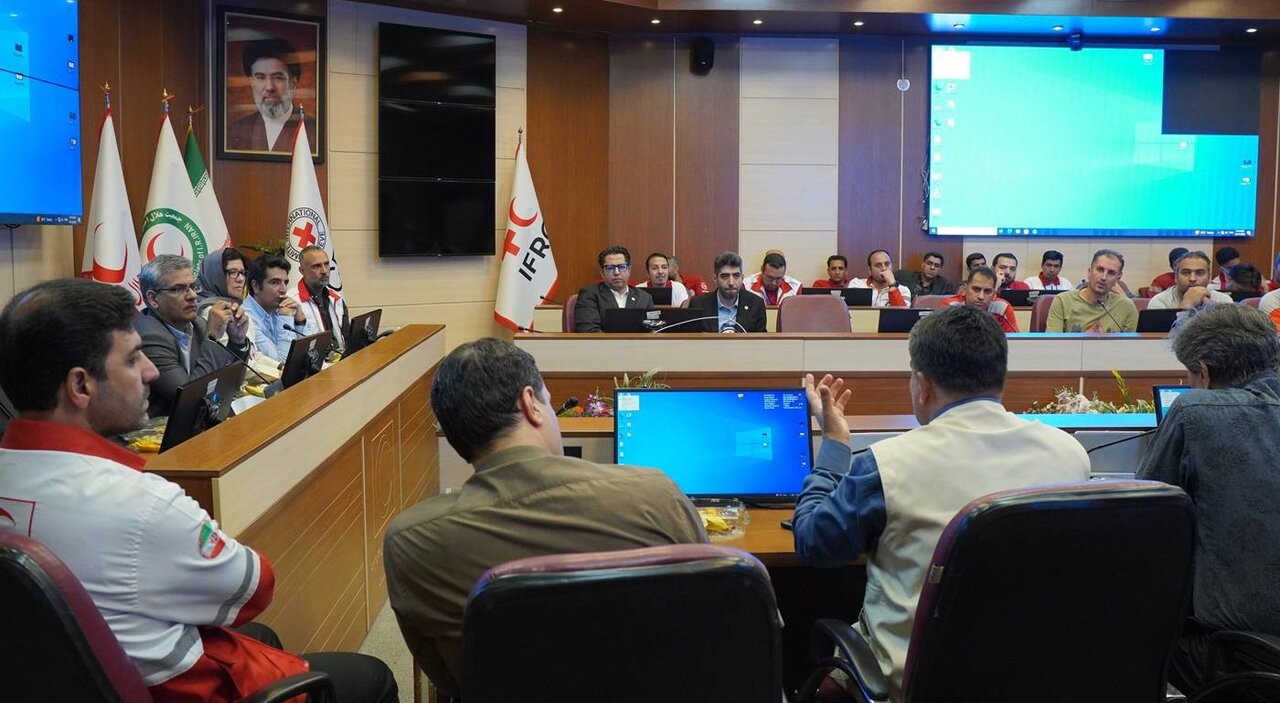
TEHRAN – The Iranian Red Crescent Society (IRCS) and the International Red Cross and Red Crescent (ICRC) have held the second and third training courses on Application of Personal Protective Equipment during Chemical, Biological, Radiological, and Nuclear (CBRN) incidents.
The first round of the course was held in Tehran from June 7 to 21. The second and third courses were held from October 4-8 and 11-15, separately. The courses aimed to improve preparedness and the operational capacity of relief teams and has been attended by a total number of 150 members of rapid response teams from different provinces in the country, ICRC website announced in a press release on October 15.
During the closing ceremony, the attendees and instructors reviewed achievements, strengths, and ground for improvement. Stressing the need to repeat the exercises, organize the course in provincial levels, and to provide complementary equipment required, the attendees emphasized that the experience was different from previous maneuvers.
The instructors also expressed gratitude for the participants’ active involvement, reiterating their positive performance during practical simulation exercises in applying the learning points and following the decontamination process suited to each type of contamination.
Speaking on the sidelines of the ceremony, the head of ICRC’s Tehran Delegation, Marisela Silva Chau, highlighted the close collaboration between ICRC and the Iranian Red Crescent Society, citing the workshop a concrete example, putting together IRCS’ operational experience and ICRC’s academic expertise and technical, equipment support. She reiterated the ICRC’s readiness to throw support behind similar courses to be held at a provincial level, while stressing the importance of transferring learnings to operational teams and their application in daily activities.
The IRCS Deputy Director for Education, Research and Technology, Rouzbeh Rajaei, also stressed continued training, teacher training, and planning for similar course to be held for female participants, noting the participation of experts from different scientific institutions and centers.
The continued collaboration and transfer of knowledge and experience to operational teams is an important step in strengthening the incident preparedness and response capacity.
The first training course targeted basic health care unit (BHCU) team leaders from five high-risk provinces, namely Tehran, Qom, Markazi, Isfahan, and Bushehr, as well as passive defense trainers.
ICRC hails IRCS efforts, bravery during war
In April, the president of the ICRC, Mirjana Spoljaric Egger, commended the efforts, bravery, and accomplishments of the IRCS during the recent imposed war by the United States and the Zionist regime of Israel on Iran.
“I admire the courage and commitment of the Iranian Red Crescent Society aid workers to provide humanitarian relief to people affected by the recent war. Your efforts were both important and outstanding,” Mehr news agency quoted Spoljaric Egger as saying.
The official made the remarks on April 30 in a meeting with the head of the IRCS, Pirhossein Kolivand.
Highlighting the importance of respecting international humanitarian law (IHL), the official noted that the IHL is frequently violated in the region; the war impacts on civilians, particularly children, are unacceptable. There is no justified reason for depriving children of their rights.
The measures that lead to the breach of IHL, and the attacks that target civilians and humanitarian workers, have to be stopped and reversed, she added.
The official described the current situation as dangerous, saying that “We, and the Iranian Red Crescent Society’s staff, should use our capacity to reduce tensions, which is essential for the protection of civilians and children.
That is why we are here, staying here; we fulfil our responsibility inside and outside the country to change the situation, and offer assistance in any way that is possible.”
The IRCS is a leading, strong national society, equipped with good facilities. The ICRC representative in Iran will help meet the country’s medical needs to set up hospitals and facilitate the import of supplies that are not allowed under sanctions, she further noted.
The official went on to thank the head of the IRCS for his continuous follow-up on the issues and for providing the ICRC with information and reports.
Vincent Cassard, the representative of the International Committee of the Red Cross (ICRC), has highlighted the need to expand collaborations with the Iranian Red Crescent Society (IRCS) in 2026.
In December 2025, Cassard met with Razieh Alishvandi, the director of the Iranian Red Crescent Society (IRCS) for international affairs, lauding the IRCS for its efforts and enumerated joint activities, such as holding a conference on rehabilitation, establishing a rehabilitation secretariat by the IRCS, and co-hosting a webinar on ‘Early Rehabilitation in Conflicts and Disasters’, with the IRCS playing a key role in organizing the event.
Cassard went on to say that the ICRC office in Tehran has secured the budget to implement plans, such as rehabilitation services to vulnerable groups, particularly refugees. He added that the second conference on rehabilitation is planned to be held in the second quarter of 2026.
MT/MG
Disclaimer : This story is auto aggregated by a computer programme and has not been created or edited by DOWNTHENEWS. Publisher: tehrantimes.com